
Have you ever wondered why certain writing advice works for some authors but feels completely wrong for you?
Why some writers painstakingly map out intricate plots while others discover their stories by letting their characters run amok?
Or why marketing strategies that work brilliantly for one author feel inauthentic for another?
The answer lies in your Writer Archetype.
Archetypes are part of our psyches. If you’re familiar with Carl Jung’s work, you’ve likely heard of the collective unconscious—a secret well of patterns and images. Joseph Campbell delved deeply into this concept with The Hero with a Thousand Faces, in which he explores the connections across human cultures—the gods, the myths, the symbols, the rituals that iterate across time, distance, and language.
Often, you will hear of people having the same idea at the same time in different areas of the world. Much of the imagery in human dreams is universal. Our gods and saints and heroes have their counterparts in other cultures. These patterns not only exist in our religions and legends, but in the fiction we write today. Most interesting of all, these structures exist in ourselves. Reality mirrors the interior, or vice versa.
We can all picture the archetype of the wise old sage, the jezebel, the fool, the knight in shining armor. These pervasive, recognizable figures are called archetypes. Archetypes are powerful tools in fiction. They help us define a character and their motives, giving the reader enough familiar framework so they can fill in the gaps without the writer having to tell their whole life story.
More fascinating still is that we, as living people, also have a tendency toward embodying an archetype. Think about your astrological sign, your Myers-Briggs personality type, or your Enneagram (do you see the pattern here?). Because our desires and motivations tend to be hidden from us, we can use these systems to uncover what we really want and why, what our strengths are, and what shadows could be lurking in our unconscious that make our lives difficult and prevent us from growing.
That is why I developed a writer archetype system for Write Catalyst—a comprehensive writer personality assessment rooted in the Jungian tradition of archetypal psychology, informed by the broader archetype literature, such as the work of Carol S. Pearson, and applied specifically to creative writing. Not only will it help you discover why you’re called to write fiction and what you’re trying to express, it will help you approach your creative process from a meta-cognitive perspective.
You’ll identify fears and self-limiting beliefs that are keeping you from shining your creative force. You’ll know how to write true to your heart instead of molding yourself to the next trend. Also, when you know what you stand for, marketing becomes natural—even a compulsion. You become proud of who you are and excited to share your work with the world.
What are the 12 Writer Archetypes?
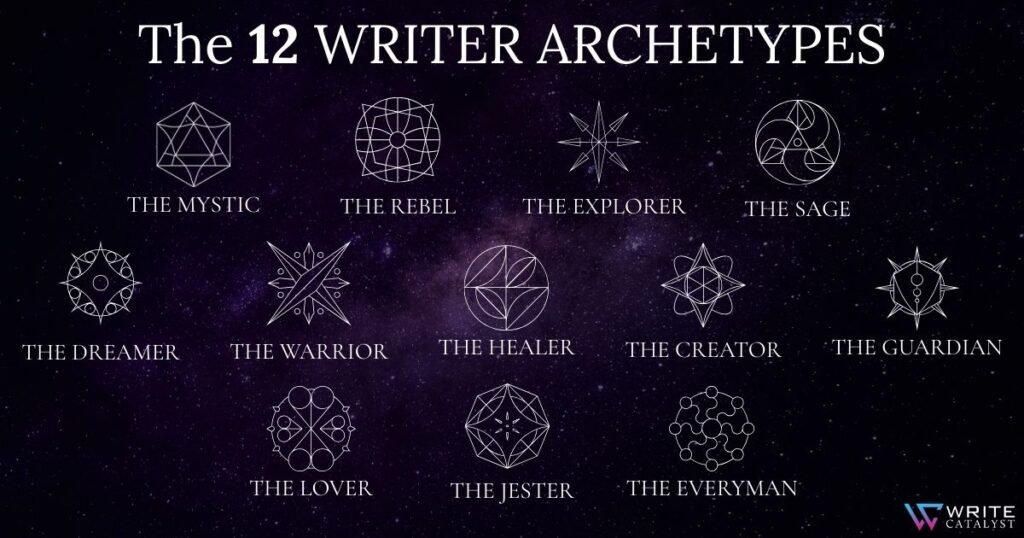
Here I outline the Write Catalyst™ 12 Writer Archetypes. Can you guess which one you are?
[Take the Writer Archetype Quiz]
1. The Mystic ✨
Conduit for otherworldly wisdom, weaving magic into words
Core Desire: To serve as a bridge between the spiritual and material worlds, translating cosmic revelations into accessible stories
Goal: To create transformative fiction that awakens readers to higher consciousness and universal truths
Greatest Fear: Losing connection to intuition; being dismissed as “too woo-woo”; spiritual transformation that bypasses authentic human experience
Strategy: Channels inspiration through meditation, dreams, and intuitive practices; weaves metaphysical concepts into compelling narratives
Weakness: May struggle with practical story structure; tendency to prioritize message over plot; can become ungrounded in ethereal concepts
Talent: Exceptional ability to access non-ordinary states of consciousness; writes with prophetic insight; creates atmosphere that feels truly otherworldly, yet familiar
2. The Rebel 🔥
Challenges conventions and shatters literary boundaries
Core Desire: To challenge unjust systems, expose hypocrisy, and inspire readers to question everything
Goal: To create fiction that disrupts complacency and ignites positive change in readers and society
Greatest Fear: Being silenced, censored, or co-opted by the very systems they critique; losing their edge or becoming part of the establishment
Strategy: Subverts genre expectations, challenges social norms through character choices, uses unconventional narrative structures
Weakness: May prioritize message over story craft; tendency toward preaching; can alienate readers with aggressive approach
Talent: Fearless exploration of taboo subjects; ability to spot societal blind spots; creates compelling anti-heroes and morally complex situations
3. The Explorer 🧭
Ventures into uncharted territories of human experience
Core Desire: To discover new worlds, experiences, and perspectives, then share these discoveries through compelling narratives
Goal: To create fiction that expands readers’ horizons and inspires them to seek their own adventures
Greatest Fear: Stagnation, repetition, or being trapped in familiar patterns; writing stories that feel predictable or confined
Strategy: Constantly seeks new experiences, researches exotic locations and cultures, experiments with different genres and perspectives
Weakness: May struggle with settling into consistent writing routines; tendency to abandon projects for new adventures; can lack depth in favor of breadth
Talent: Exceptional world-building abilities; authentic cultural and geographical details; natural gift for adventure pacing and discovery arcs
4. The Sage 📚
Keeper of wisdom, sharing profound insights through narratives
Core Desire: To understand life’s deeper meanings and share hard-earned wisdom through compelling storytelling
Goal: To create fiction that helps readers navigate life’s complexities with greater wisdom and understanding
Greatest Fear: Sharing false wisdom or leading readers astray; being seen as pretentious or out of touch with real human struggles
Strategy: Draws from extensive life experience, research, and study; creates characters who learn and grow through trials; weaves philosophical insights naturally into plot
Weakness: May become overly didactic; tendency to prioritize message over entertainment; can write characters who feel like mouthpieces rather than real people
Talent: Exceptional insight into human nature; ability to see patterns and connections; creates profound character development arcs
5. The Dreamer 🌙
Transforms dreams into vivid realities where anything is possible
Core Desire: To create magical worlds where impossible becomes possible and inspire readers to believe in wonder
Goal: To craft fiction that rekindles readers’ sense of wonder and reminds them that magic exists in unexpected places
Greatest Fear: Being forced to write only “realistic” stories; losing connection to imagination and wonder; being told their dreams are “just fantasies”
Strategy: Draws inspiration from actual dreams, daydreams, and flights of fancy; creates richly imagined worlds with their own internal logic
Weakness: May struggle with grounding fantastical elements in emotional reality; tendency to prioritize wonder over character development; can avoid conflict
Talent: Limitless imagination; ability to create genuine sense of wonder; exceptional at magical realism and fantasy elements
6. The Warrior ⚔️
Fights for justice and truth through stories
Core Desire: To fight injustice and defend the vulnerable through powerful storytelling that creates real-world change
Goal: To create fiction that inspires readers to stand up for what’s right and fight their own battles with courage
Greatest Fear: Writing stories that perpetuate harm or fail to help those who need it most; being a passive observer of injustice
Strategy: Creates protagonists who face overwhelming odds; addresses social issues through character struggles; writes with moral clarity and passionate conviction
Weakness: May create overly simplistic good vs. evil scenarios; tendency toward heavy-handed messaging; can struggle with moral ambiguity
Talent: Exceptional at creating inspiring heroes; natural gift for building tension and conflict; ability to motivate readers to action
7. The Healer 💚
Uses words to heal hearts and transform lives
Core Desire: To create fiction that helps readers heal from trauma, pain, and life’s wounds through the transformative power of narrative
Goal: To write stories that provide comfort, hope, and genuine healing for readers struggling with their own challenges
Greatest Fear: Inadvertently causing harm or triggering readers; failing to provide the healing that readers desperately need
Strategy: Draws from personal healing journey and understanding of trauma; creates characters who work through realistic healing processes; focuses on hope and resilience
Weakness: May avoid necessary conflict to prevent reader discomfort; tendency to rush healing processes; can become overly protective of characters and readers
Talent: Exceptional empathy and emotional intelligence; ability to portray trauma and healing authentically; creates safe emotional spaces through writing
8. The Creator 🎨
Builds entire worlds from the fabric of imagination
Core Desire: To bring entirely new worlds, creatures, and realities into existence through the sheer force of creative imagination
Goal: To create fiction that showcases the unlimited power of human creativity and inspires readers to become creators themselves
Greatest Fear: Creative stagnation or being told their imagination is “too much”; failing to fully realize the magnificent worlds they envision
Strategy: Approaches writing as world-building first; creates detailed mythologies, languages, and cultures; prioritizes originality and innovation
Weakness: May become so focused on world-building that character and plot suffer; tendency to over-complicate; can struggle with finishing projects
Talent: Unlimited creative imagination; exceptional ability to create consistent, believable fictional worlds; natural gift for innovation
9. The Guardian 🛡️
Preserves stories and brings lost voices to life
Core Desire: To preserve important stories, traditions, and cultural memories for future generations through faithful and respectful storytelling
Goal: To create fiction that honors the past while making historical and cultural stories accessible to contemporary readers
Greatest Fear: Important stories being lost forever; misrepresenting or dishonoring the people and cultures they write about; cultural appropriation
Strategy: Conducts thorough research; collaborates with cultural experts; focuses on authentic representation; writes with deep respect for source material
Weakness: May become overly cautious about taking creative liberties; tendency toward perfectionism; can struggle with balancing accuracy and entertainment
Talent: Exceptional research abilities; deep respect for cultural authenticity; ability to make historical periods come alive
10. The Lover 💕
The Romantic Soul who writes to explore the depths of passion and human connection
Core Desire: To experience and express the full spectrum of love, passion, and human connection through storytelling
Goal: To create stories that help readers fall in love—with characters, with life, with themselves, and with the transformative power of deep relationships
Greatest Fear: Writing stories that feel emotionally cold, disconnected, or fail to touch readers’ hearts; being seen as shallow or overly sentimental
Strategy: Crafts deeply emotional narratives with rich character development, focusing on relationships, internal conflicts, and the journey toward authentic love and connection
Weakness: May prioritize emotional impact over plot structure; tendency toward idealization; can become paralyzed when writing about pain or conflict in relationships
Talent: Exceptional ability to create believable, passionate relationships; writes dialogue that crackles with emotional authenticity; masterful at showing vulnerability and emotional growth
11. The Jester 🎭
The Wise Fool who reveals truth through humor and playful irreverence
Core Desire: To bring joy, laughter, and lightness to the world while revealing deeper truths through humor and wit
Goal: To create stories that entertain, delight, and help readers see life’s absurdities with compassion and wisdom rather than cynicism
Greatest Fear: Being seen as frivolous or meaningless; writing humor that falls flat or accidentally hurts rather than heals; losing their sense of play
Strategy: Uses humor, satire, wit, and playful language to explore serious themes; creates memorable characters through quirky details and unexpected situations
Weakness: May struggle with sustained dramatic tension; tendency to deflect from emotional depth with humor; fear of being taken seriously as an artist
Talent: Natural comedic timing in prose; ability to find humor in dark situations; creates memorable, quotable dialogue; skilled at using comedy to make difficult topics accessible
12. The Everyman 🤝
The Relatable Voice who writes stories for and about ordinary people
Core Desire: To create authentic, accessible stories that reflect the real experiences of everyday people and validate their struggles and triumphs
Goal: To write fiction that makes all readers feel seen, understood, and less alone in their human experience
Greatest Fear: Being pretentious or out of touch; writing stories that alienate ordinary readers; losing connection with real, everyday experiences
Strategy: Focuses on relatable characters facing universal challenges; writes in accessible language; draws from common human experiences and emotions
Weakness: May avoid taking creative risks or exploring experimental forms; tendency toward self-doubt about the worthiness of “ordinary” stories; fear of being too simple
Talent: Exceptional ability to capture authentic human experiences; creates deeply relatable characters; writes with clarity and emotional honesty that resonates broadly
Discover Your Writer Archetype
Ready to find out which archetype drives your creative vision?
Take the [Writer Archetype Quiz →] in just 3 minutes.
You’ll instantly receive:
- Your primary Writer Archetype
- Your unique archetype symbol
- Your creative strengths and shadow challenges
- A personalized 5-part email series to optimize your writing process