Purple prose is writing that is overly embellished. For me, the first thing that tips me off to purple prose are sentences that distract me from the story.
It’s a tricky balancing act to write descriptively without overdoing it. Some writers write more simply and let the story make the impact. Others have longer, slower plots that would put me to sleep if it wasn’t for their beautiful language.
I love language and the long, complex sentences that were common in fiction a few hundreds years ago. But modern readers are not so keen on a sentence that involves ten types of punctuation and occupies half a page. I’ve had to tone it down a notch.
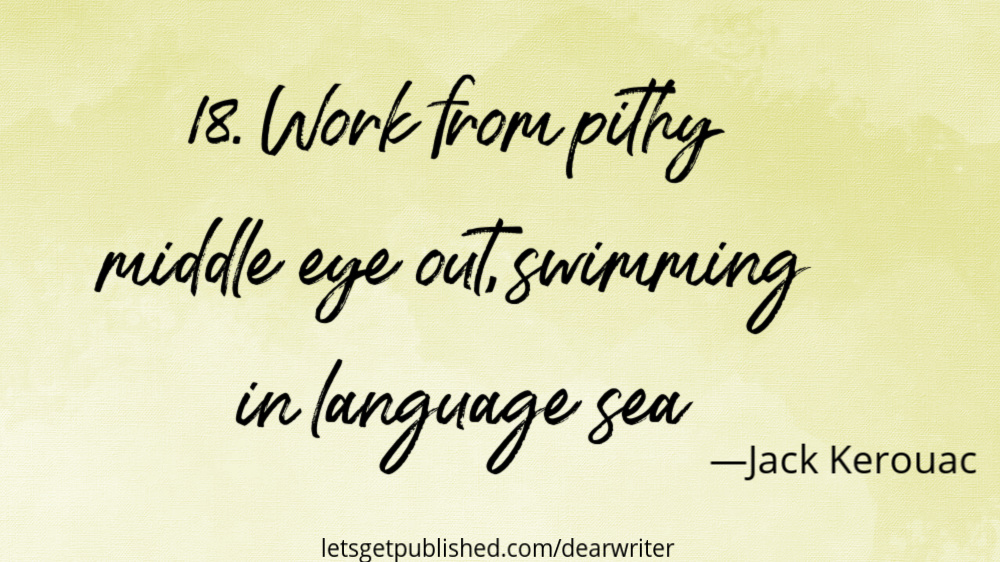
So where is this elusive spot between purple prose and plain, boring writing? We swim in a language sea. How do we distill our ideas into the right words?
By writing a lot and reading even more.
Sometimes I don’t realize what I’m doing to my reader until it’s done to me. This can be a rude awakening, but it brings priceless self-awareness to your writing voice.
The jewel center of interest is the eye within the eye
So, we are past the halfway mark of Jack Kerouac’s Belief and Technique for Modern Prose, and he is riffing off his ideas like a heroin-infused jazz musician.
I am doing my best to elaborate on them, and I can’t promise you that my interpretation is what he meant. Some of his tips are very abstract, like this one about “the eye within the eye.”
But art is a two-way exchange. What the creator transmits and what the consumer receives may be two different things. Sometimes that’s the point of it.
So here’s my stab at #16.
I believe the jewel center of interest is curiosity. It is the eye within the eye because our curiosity is wisdom itself. It knows where to lead us, even when we think we are lost. And if we never find the answer we expected, our quest to leads to discoveries we never dreamed of.
For example, say you’ve outlined the perfect story. Then, as you write, you go wildly off course. You think you’ve ruined it, but you’re curious to see what happens. You keep going and once you’ve arrived at the end you realize that it’s much better than your original idea. In fact, you can’t picture it any other way.
What do you think?Am I close?
I’d love to hear your interpretation. Please share below!
Telling the true story of the world in interior monolog
We all walk around with an interior monolog. For most of us, it’s a jumble of surface thoughts like…
What should I make for dinner?
Did I pay the internet bill?
Why did this asshole cut me off in traffic?
Man, I shouldn’t have eaten that shrimp taco.
It’s estimated that 95% of our thoughts are repetitive. Many of them are negative and unproductive. If we wrote from this place, we would torture our reader.
But there is another monolog, the one we keep with our inner creator. This is the one we write from.
Tapping into this deeper layer gives us peace. This is why writing is such a wonderful escape. We dive beneath the choking stream of shallow thought and swim through the aquifer of the extraordinary.
I think we can safely say that Jack Kerouac may have been intoxicated when he wrote these writing tips. ‘Teahead’ means ‘pothead’ (I had to Google that).
I don’t know if Marcel Proust was really a pothead or if weed makes you a better writer. In my case THC gives me hamster cheeks and terrifying panic attacks.
What I think Jack is trying to say here (besides justifying his use of weed by making an accomplice out of a literary figure) is that you shouldn’t write by the rules.
In tranced fixation dreaming upon object before you
Dear Writer,
Have you ever been in a writing trance? The muse. Divine inspiration. The force. Whatever you want to call it, when it’s there, you feel it. Nothing can stop you from creating the art you want to manifest into the world.
Well, except things like work, spouse, kids, social obligations… Life gets in the way.
Don’t waste this energy. When your neurons are on fire with an idea, hide somewhere for a writing sprint. Lock yourself in the closet. Get up at 2 a.m. when everyone else is asleep. Do what you have to do before the dream slips away.
Happy Writing,
—Christa
Where is your favorite writing place? Please share.