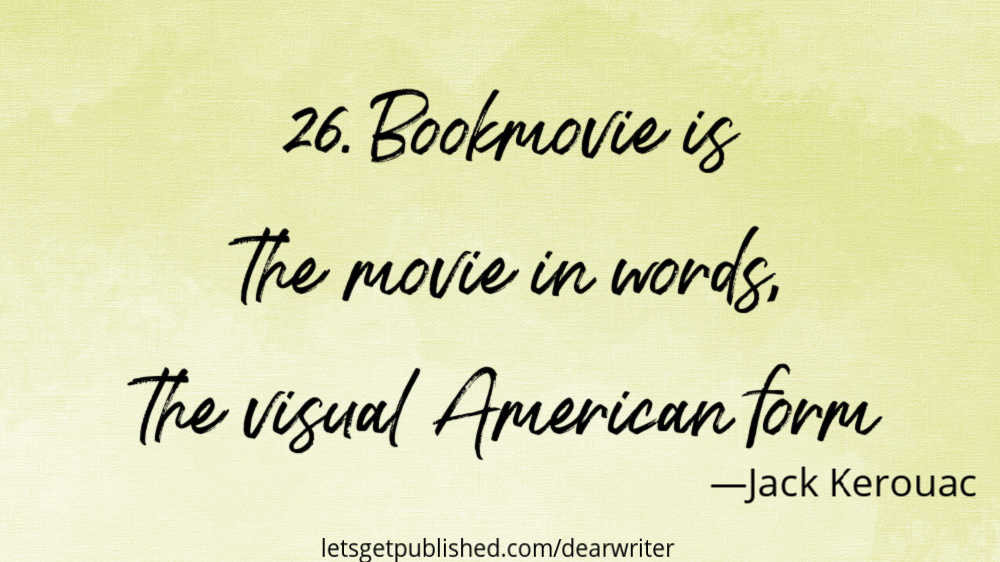
Remove literary, grammatical and syntactical inhibition
Jack Kerouac
Do you proofread as you write?
Whenever spell check underlines something in its taunting red line, I immediately want to make it disappear. I know this interrupts my flow, but it’s almost impossible not to fix the mistake before moving on (I’m doing it right now as I type this!).
I notice that I tend to do more self-editing when I’m stuck in my stories. This is the sneakiest form of writers’ block. It feels like I’m being productive, but what I really am doing is stalling. Instead of getting a thousand words on the page, I get a few over-edited sentences.
Jack Kerouac said to remove literary, grammatical, and syntactical inhibition as you write—not forever. Just until you finish. You’ll have plenty of time to correct your mistakes when the mad dash is over.
May the muses be with you,
—Christa
Do you correct mistakes as you write? What’s your worst procrastination habit?
Want a proofreading checklist for a flawless manuscript?
Look forward to Candace Johnson’s masterclass in the Writers’ Mastermind
SYSTEMIZED SELF-EDITING
Get access to this class and all the benefits of membership with your free trial.
We talked about bookmovies before, but before we develop our book for the screen, we need to accurately describe the mental movie in our heads.
This is so much harder than it sounds. How do we create the emotions we feel when we think about our story? How do we capture its atmosphere? How do we get readers invested in our story as much as we are?
Here are a few tips for describing the mental movie:
Be the director – It’s all up to you to communicate your vision to the reader. Think about scenes like a movie director. Which is the best angle? Who is the dominant character? Who is the submissive? Do their body positions reflect this? What symbolic colors, sounds, and objects can you incorporate in the scene to reiterate the theme?
Don’t rely on the plot – The stories that make the most impact are the ones where we witness the transformation of a character. What occurs in the plot doesn’t have any impact if we don’t care about the characters who are part of it. Focus on your characters’ inner struggle. What do they want? What do they fear? What’s keeping them from getting what they want?
Create a playlist – All the best movies have epic soundtracks that we remember all our lives. Whenever we hear the song, we’re reminded of the film and how it made us feel. Music is a powerful and quick way to immerse your brain into the mental movie of your story. Make your own soundtrack in your favorite music app and listen to it before you begin writing for the day. It will give continuity to the mood of you story.
If you’ve been writing for a while, you might notice that much of your writing is similar.
Character-types repeat.
Themes replay over and over.
Settings and atmosphere don’t vary much.
This is good when starting out. You settle into your voice, genre, and style. You get comfortable.
Don’t languish in a writing rut.
Once you’ve found your footing as a writer and are confident in your process, it is time to take some risks.
Sure, your readers will expect a certain something from you, but they will also like to be surprised and delighted. Don’t tell the same story over and over again.
Experiment with different POVs, genres, and twists. Ask yourself, how can I make this story unique?
Predictability is boring for you and your readers. Go wild. Go crazy. See what happens! Be remembered!
Will our consciousness survive the death of our body?
No one is sure about what happens after we take our last breath. It can leave us confused, depressed, and maybe even a little bitter.
Humans cope with the big mystery of life by creating. By expressing ourselves through art. By asking the big questions, and hopefully finding an answer to them.
One way we do know consciousness can survive is through writing. Think about the books you’ve read by a dead authors. How have they changed you?
In the bleak, inhuman loneliness, we can touch others all over the world and beyond our physical existence through our books.
I grew up obsessed with movies. Even though I love to binge on series, I still I prefer to watch movies over any other kind of video format.
I think most writers write from a mental movie that plays inside their heads. We fantasize about our books being adapted for the big screen. It’s natural for us to have this mindset when movies are such a huge part of our culture.
Some authors hire screenwriters to adapt their story and pitch their bookmovie’s the hard way. But there is a shortcut…
If you have a book that you think would make a good movie, Screencraft runs a yearlyCinematic Book Contest. Get your submission ready. It opens in September! CLICK HERE.