This week, Let’s Get Published is revealing the top finalists and the grand prize winner of our inaugural short story contest.
Today we are pleased to present Another Brick in the Wall, a story by Casey Millette.
Another Brick in the Wall by Casey Millette
Some days he didn’t know why he lingered on the bare patch congested with the remains of all things.
(“The eyes are the windows to
the soul.”)
Only when human decency, so tested these days, was at stake he’d remember.
(“Where’d you read that, little one? A fairy tale?”)
Not that his memory was his most faithful attribute. The man dug his paws into the mud and slathered it across cold. There was no more cement; they’d run out over a fortnight ago, and the sticky paste was a weak substitute that only worked because it would freeze solid.
(“No, silly goose!” [He recalled this moment most vividly; it was the first and last time his daughter’s thin, sweaty lips called him a goose, and a silly one at that. Where did she pick up on this stuff? He’d noticed her vocabulary beginning to mature. How long before silly goose became shitty bastard?] “It was an optic. Before I absorbed my glass of water last night. Before bedtime.”)
It was January, and a lonely one. Holding his breath, he glanced over his shoulder to affirm that he was alone once, twice, three times. Nothing moved but the flies drunk on city steam, dancing by him within maddening centimeters of his reach. It was past midnight after all, so he guessed as much.
“Head home for the night. You need it.”
(“You need to stop watching those optics. You know I think they’re harmful, little one.”)
Not as alone as he thought.
The man felt his employer’s leathery face study him for any reaction. As people were labeled by numbers nowadays, this forgettable person was easily recollected. Mr. Fredrick came from a rather old-fashioned family, and although it was scandalous to keep his inherited lettered name, he’d resisted the pressure. As for the man, he didn’t mind his number; it just bothered him to refer to his daughter that way. So he didn’t.
“We’re projecting only a hundred more tonight, so we don’t have to overdo it this time.” Mr. Fredrick was one of those people who didn’t live up to the grandeur of his name. He was a short, skeletal creature whose greatest danger other than the plague was being blown away by the smallest hiccup.
“And those projections are how old?”
(“But I’m eight-years-old; I would literally be the only one my age that’s not engaged in it.”)
“As of 16:00 this afternoon. And I know you need the money, but. . . We both know you can’t be late.”
“It’s not about the money.” The man manifested a wad of saliva that crackled on the pavement louder, thicker than the rain. “It’s a distraction. More or less. So. . . you will be there?”
“You know I’ll try. This is your daughter, after all.”
The man turned his back on Mr. Fredrick and tentatively looped the wires of a scrub mask over his one and a half ears. He always thought it was a bit pathetic; it’s not like this papery curtain of nylon would do much to shield him from the toxins that prostrated the city. It was an easy disease to catch; the first defining symptom of a plague victim was the blood spouting from the nostrils, then the ears, and the eyes, the brain’s juices leaking from holes punctured through its heart.
Mottled scraps of grass were oppressed by concrete not a mile from his “workplace.” His nose was so used to the acrid fume of rainwater against asphalt that it barely wrinkled when his slip-on sneakers met city street. He slipped through alleyways that wormed their way from the Outside District and into the center of screens, steel, and grey.
(“It’s only a screen. Somehow you can live without it, I promise.”)
Enormous television-like portals danced with optic advertisements, the lights and voices bombarding lost souls and drawing them in as a distraction from the city’s carcass. The illusion of poisonous fungi prickled in the man’s gut before twisting into a cactus; how was it that developers could scientifically engineer entertainment to make it more addictive, and still couldn’t find a cure for the plague gnawing at their every cell, at their every thought?
The stark building of the CDC reared its glass-windowed head in front of him. The plague, a virus that drilled and infected the brain, had impeded his daughter so badly that they were forced to move on the CDC’s very street, Clifton Road, as its new hospital department had the best chance of a cure than all the rest. Leaving their friends and support system behind had been a risk. His little one didn’t mind, though; it was exciting to live on a street that had the name of her favorite character played through the optics, Clifton, the Little Green Dog.
(“Please, Daddy. Just one more
time. You know I love Clifton. Please, please, please!”)
The dust on the floor of his shabby
apartment was interrupted with his own footprints. Now that his daughter no
longer walked the halls, the apartment was stupendously silent; it settled on
his skin like a cold blanket, making him want to scream, laugh, anything just
to fill its ravenous belly.
The man crossed his ratty living room to a kitchen strewn with take-out leftovers and newspapers. He absorbed a peanut-butter sandwich, numb, aching for something to make a noise to reaffirm himself that that more than just plague existed; for a cockroach to scuttle across the counter, for a pigeon to screech. There came only the buzzing of the futuristic optics machine, one he’d never used, that intruded on his self-contained world.
(“No.” [Now he’d been stern.] “If the devices I used when I was your age ‘fried brains’, what do you think this crap does to you?”)
He found himself drifting toward the machine. The couch sagged beneath him when he landed on its mossy cushion. He loudly cleared his throat; what was there to be scared about? Everyone was using this phenomenon all over the world and thriving. . . Everyone, except for him. What could be the harm?
He hesitated before slowly coiling the headpiece around his head – An unexpected jerk in his naval told him he was being flung across the room – This was a bloody mistake – No – The warping sensation of music flooding his ears and entering his veins made his heart skip a beat. It was Tchaikovsky. Ah, yes, and there were the canons. Only Russians would think to use freaken’ canons as an instrument. . . But the melody was incomplete. . . Something was off, perhaps mathematically. . . Maybe he was just mental. . . He was beginning to have a searing headache after all. He remembered his daughter complaining of a headache when she first started the process, saying. . . You only had to build up resistance. Bloody resistance. Don’t play for too long, or it would kill your mind.
“Welcome to Optic Ultraviolet Stimuli 3000,” boomed a feminine voice. “Choose your scenario.”
His vision was obscured by several kid-friendly reality games, the one captivating him most was Clifton, the Little Green Dog. . .
***
He woke up still plugged into the
machine.
His head hadn’t stopped hurting since the optics, so he didn’t press his suit. The cloth, though slightly ragged, was the most expensive thing he owned that was still. . . human. He did not think the machine system that people obsessed about as human.
The journey to the “workplace” was shorter than usual, as he was too preoccupied with his head pounding to notice the steam from the rain fusing the city floor and sky into a single slab. He absorbed a pitcher of coffee along the way, thinking the caffeine would bleach his brain into the notion that his head was normal.
The corpses of flowers crunched underfoot as he joined the funeral procession; he wondered how their stock of flowers was right now. . . Mr. Fredrick reported that they only had a hundred more bodies today (the plague’s work), so it should be enough. He wondered which would go extinct first, humans from disease or the flowers for them.
Mr. Fredrick hadn’t come. He recognized the people carrying his daughter’s casket, but not because he knew them; he’d been a headstone fashioner long enough to be familiar with the colors, the long faces. He was relieved when he saw that they’d covered his daughter’s body. The heat filtered forward with the frequency of a fever—was he the only one that felt it? It became nearly intoxicating as the casket was lowered beneath the crumbling crust of earth . . . Hell, did his head threaten to split . . . And his daughter was gone. Her headstone that he himself carved from a chunk of granite gaped at him namelessly, just another brick in a wall of stacked humans, cheap lives wasted on a silly little goose that drilled and drilled into the brain.
He didn’t realize that he was on his knees until he tried to walk. He could feel the goose now, or was it a green dog? A green dog chewing, devouring its way into his center cortexes, into his mind . . . The Tchaikovsky song shrieked on its incomplete rhythm . . . He must’ve been plugged into the machine too long . . . Yes, falling asleep with it stuck inside him would do the trick . . .
He tasted it first. And a bead of red rolled from his nose.
Congratulations to all of our finalists and to everyone who participated!
This week, Let’s Get Published is revealing the top finalists and the grand prize winner of our inaugural short story contest.
Today we are pleased to present The Nowheres, a literary fiction story by David Antrobus.
The Nowheres by David Antrobus
A couple times each month, he’d drive out from the city to
what he called the Nowheres, a flat, unremarkable piece of the rural Midwest,
and pay for two nights, sometimes three, in a nondescript motel somewhere off
the beaten track, thirty bucks a night or thereabouts. Sometimes he’d bring
along a fifth of cheap bourbon, and other times he’d find a bar nearby and
drink steadily and methodically, speaking only to the bartender before hiking
unsteadily back to the motel on dark and mostly silent county roads.
He never told the few friends he had in the city what his
purpose was, what he did out there in the Nowheres while Lucinda, Shelby, and
Patty emptied their abandoned, melancholy hearts on a jukebox at the bar or on
a cheap boombox in his room, in time with the ebb and flow of the Wild Turkey
he tipped and swallowed without joy. He never told a single soul that he came
out to the Nowheres to get drunk and write shit down—not any old shit, but the
kind you needed to get out or it burrowed into your dark places like a soft, blind
thing and over time became hard, mean, and cancerous.
Something about the lingering sunsets. The sudden stillness.
Crepuscular rays spotlighting barns, grain elevators, corn patches, painting
them briefly gold. Streaks of byzantium, coral, and vermillion like fever-dream
inlets separating dark cloud archipelagos, ushered slowly westward into the
flat horizon by the gentle darkness.
Like it or not—and sometimes he truly did—this was his
country, on some level he barely understood.
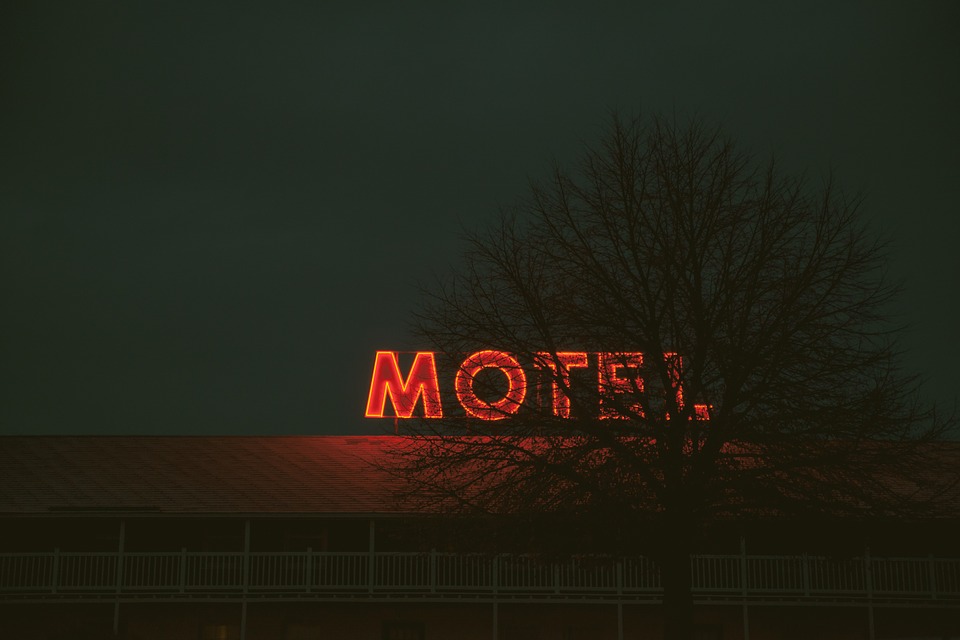
This night, he crossed the gravel parking lot of the basic
two-story L-shaped motel, looked up at the sign, the neon in one of the letters
long leaked away: Mote. Because it was a mote, and he was a mote, and all the
people and cattle and corn and fields were motes of inconsequential dust under
the stars, which were also motes, but made of brightness. Beneath that sign, a
smaller one, also broken: acancy, which sort of made him laugh. These lonely
visits sure felt like acancies, even though he knew that wasn’t a word.
Other nights, after dark, he would look up at that same sky,
in which a few stars trembled between the dark reefs of cloud that scudded
furtive like the decamped souls of everyone who’d once pined and then died of
some related strain of sorrow in this wide and disregarded place.
Traffic on the distant interstate was usually a muffled
commotion that sounded like the landscape dreaming fitful dreams, but the
railroad was closer, and when he heard the familiar abandoned rattle and moan
of a passing train, his mind went to dirt and rust and peeling paint, went to
sleeplessness and silent entreaties to sellout gods, went to shrieks and sparks
and graffiti, and unquenchable longing. Went to her. His momma. Went to that
day—and every day since—she’d turned off most of the light in his world by up
and leaving. He’d been perhaps eight when he watched her slip away in the
night, heard her quiet sobs until a night freight had blared and clattered by,
stamping its larger grief on their smaller one, erasing theirs so no one even noticed
it. No one but him. Those days, passing like ghost trains, each boxcar filled
with ever more solitude. Those days when he couldn’t possibly blame her. Those
days when he blamed her with a savage, perilous heat.
The pages he filled with longhand he’d sometimes set light
to over the john, make of them black flurries, tiny apocalyptic storms, other
times would tuck behind heating or air-conditioning units, slide into gaps in
the fake wood paneling, under mattresses, or tear in tiny pieces while he cried
raw tears. His memories made into words. Mostly of his momma but sometimes of
his papa too. He still missed her; and less often, his papa too, god help him.
He could keep on missing that sonofabitch forever, though, as he was never
coming back from whatever sorry hell he’d volunteered for by finally swallowing
the muzzle of a military-issue Beretta M9.
He knew he couldn’t do this forever. The coming of the
interstates had proved a slow and lingering extinction event for the era of
these motor courts, and this—whatever this was—wouldn’t work the same way in
some Comfort Inn or Motel 6. Take this place—thirty-two units and only three
vehicles parked out front. Always, always an acancy.
Back in the motel, room 27 on the second floor, where the
two wings of the L join, he hit play and grabbed a notepad and pen, while
Lucinda sang about some farmhouse out a ways and how she didn’t want no one to
come find her if she strayed, and his whole breath hitched. He felt strange,
like he was smaller and more scared, remembering his fear of the dark and of
the lightning bugs that lit the dark, believing they were the souls of demons
who’d lost their way to hell. More Wild Turkey and he began to write like the
little boy version of himself was watching over his shoulder and giving him
tips.
“Papa was meaner’n a yard mutt, but he never took his
belt to me. He managed a kind of meanness you’d have to study for at some
school of evil, if such a place existed. I know Momma left ’cause a him, an
p’raps he did take his belt more’n once to her, or worse, but never to me. When
he was real drunk he’d threaten to hang hisself from the rafters in the barn,
or go lay down on the railroad tracks, or some variety of same. It sure got
tiresome. But one day might as well stand in for all the days, he told me to
follow him out to the barn, and I didn’t want to, but I knew things would only
go sideways quicker if I said no. He sat on a hay bale and looked at me funny.
He always looked at me funny, but this were a different kind of funny, like he
didn’t really see me but someone else: maybe God or Jesus or some loan officer
whose name he cussed on a regular basis. He was so drunk he was swayin’
slightly. He slurred, too, which was unusual as he had a high capacity for the
rotgut he liked to drown hisself with. ‘Son,’ he said, ‘go bring me the
shotgun.’ I stood still. I didn’t want to do such a thing, given the tenor of
his usual threats. He looked at me out of one eye, the other closed as if even
the dusty murk of the barn was too much light for him. ‘I said, go git me the
shotgun or there’ll be hell to pay.’ Far as I could see, there already was hell
to pay, no matter my part in all this, so after thinking about running and
hoping he’d forget when he sobered up and then quickly abandoning that plan
soon as I remembered I’d seen lightnin’ bugs out there earlier, I went to the
tackle room and grabbed the old Winchester pump-action 12 gauge, trying not to
think about what hell charged. When he seen me with it in my arms, like an
altar boy bringing the priest the host, his face twisted into something
unrecognizable. ‘Son, you’d bring a man fixin’ to end it all a goddamn fuckin’
weapon? Not jes’ any man, neither, but your own kin?’ I had no words. I jes’
stood there and took it. ‘You some kind of cold-blooded monster, boy?’ He
stared for what felt like a whole day, and I closed my eyes and didn’t answer.
I didn’t have no answer. Then he stood and without another glance in my
direction went back to the house and to bed. While I stayed in the darkness of
the barn, eyes still closed, and all of me trembling.”
He was trembling now, sometimes felt like he’d been trying
to get halfway warm again for twenty-some years ever since, so he got up, put
on a fleece jacket, and went out on the balcony for air. The night was quiet
and cool. His pickup sat in a pool of light, as if the heavens were beaming him
a message.
Then he had a dream.
A road-scarred nineties-model Corolla pulled up beside his
truck and she got out the driver’s side. It was her; he had no doubt. Older,
sadder-looking, dressed in black denim, but his momma. She didn’t see him right
away, but when she finally looked up he waited for a reaction but saw little of
anything at all in her dark Spanish eyes.
“Mister, could you help me here?” she said.
He swallowed and couldn’t make his voice work.
She opened the rear door of her Toyota and started dragging
out something dark.
“Mister? Please? I hate to ask, but I think I twanged
something in my back last night, and I jes’ need to get this into
room”—she dug out a key and squinted at it—”eleven. Room 11.”
“Oh sure, ma’am. Be right down.”
That bare bulb was still spotlighting their two vehicles
like they were on some ethereal backlot in a movie by David Lynch. This
couldn’t be real, but he played along and took the nearby stairs to ground
level. He wanted so badly to embrace her, to hold her, to bury his face in her
cool dark hair now shot with strands of gray the color of heartbreak. When he
recognized the object in the backseat as a guitar case, he felt like crying. Damn.
She still played.
“You a musician?” he asked.
“You might say as I am, but it don’t exactly pay the
bills.”
He recalled her thin but melodious singing voice and the
early months of her learning to play, helping her string her thrift-store
guitar and figure out how to tune it, grasping at chord shapes and building
calluses, and how those were about the only happy memories he had from back
then, before the light had gone out, before the music had quite literally died.
Turned out room 11 was directly below his. He carried her
guitar and placed it on the bed.
“You’re a sweet man,” she said. “You gonna be
around tomorrow night?”
“Uh, maybe, sure.”
“Well, you are or you ain’t, but if you are, I’m
playing at The Busted Flush on Route 40, a couple miles east of here, and
you’re welcome to come hear me. Ain’t no Patsy Cline but I know my way around a
few good tunes.”
“I might just do that, ma’am.”
“You’re a polite boy. I like that.” She smiled
briefly, then looked troubled for a moment, then let the veil fall again.
He wanted to scream at her, tell her in no uncertain terms
who he was, rail at her for her betrayal, plead with her to come back, beseech
her for her love, but none of that felt right, somehow. He was no longer a boy
and this had to play out the way it decided to play out. Let her find his
scraps, even if she was a dream; let him follow her spore, even if it weren’t.
Some believe each moment splits into many versions of
itself, that we live so many different lives in so many possible worlds. If so,
did he hook up with his mother, as appalling as that sounds, or did he go watch
her play in a bar and get involved in a fatal confrontation after some drunk
asshole heckled her, or did he do neither and return to the city and his shadow
life there? Did he live all these things and more? Possibly. Better still, was
his story really her story, and did she find his notes in a series of
nondescript rooms over weeks and even months and piece together his identity
and movements until she could pinpoint him, find him, try to make it up to him?
That’s good, too.
But in this world it appears he returned to his room, to his
sad caucasian girls and his fragments of memory, to stale air and worse decor,
where he picked up the Beretta that had killed his papa, knowing why he’d kept
it but afraid all the same, and he listened to another freight train run its
ragged fingernails down the grainy backdrop of the Midwestern night, and he
pounded more Wild Turkey while the reedy sounds of a phantom woman singing
country tunes a floor below nearly drove him mad, out in the Nowheres, out
where no one else came.
Congratulations to all of our finalists and to everyone who participated!
This week, Let’s Get Published is revealing the top finalists and the grand prize winner of our inaugural short story contest.
Today we are pleased to present The Perfect Patient, a science fiction story by Carolyn Hoffert.
The Perfect Patient by Carolyn Hoffert
The white, metallic dome curved high above Dan’s head. He arched his back to take in the full view. It was perfect. Every detail, from the hexagonal tiles that lined the walls to the eight-hundred cameras peering in from every angle stood as a testament to his wishes. If only he could have been here when the trials started. He had been away too long.
A door to his right slid open with a burst of cold air, and
he hurried through. He had made so much progress, no backsliding now. He
waltzed into the command room full of blinking lights and buzzing air. This was
where the magic happened. Where he belonged. And where Sara and her winning
smile sat waiting for him. What would he do without her?
She swiveled around in a black, low-backed chair and waved
him in. “Are you ready to watch your first live round of animatron
qualifications?”
“It’s not like I’m new to all this,” he said with a tinge of
hurt. “I haven’t been gone that long. And the whole idea for the Emulation Dome
was my idea, lest you forget.”
Sara chuckled. “I know, I know. Don’t get all twisted up.
I’m well aware of how long you’ve been waiting for this. I live with you after
all. Come, sit. I think you’ll enjoy this next one. I daresay he might be the
perfect subject.”
“A widower in his early forties with little to no support
network?”
Sara’s grin widened. “Alright Director, no need to show off.
We all know you wrote the manual.”
The tension in Dan’s shoulders softened with the gentle
chime of her laugh. “Shall we begin? I’m eager to bring someone back from the
dead.”
Sara pressed several large buttons, turned a knob, and
clattered over the glass with unceremonious oomph. Her hands darted quickly
over the colored patterns in a flurry of color he could hardly fathom. The
display was completely smooth. How did her fingers know where to go? Maybe he
had been gone too long. He watched for a moment, enjoying the smooth flow of
her movements, then voiced on all the screens.
Under normal circumstances, the computer displayed only the
views that best captured the subject’s facial cues inside The Dome. But today,
Dan wanted to see the full power of what he had created through all
eight-hundred high-definition lenses.
Sara’s long fingers finished tapping. “Ready?
Dan nodded.
The door into the Dome wooshed open. A tall man with dark
curls and a scraggly mustache entered. He wore faded blue jeans and a pair of
boots. His feet tup, tup, tupped to the center of the circle.
Sara tilted the screen displaying the man’s stats toward
Dan. “His name is Jackson Frau. From the U.S. Lost his wife, Emily, at the
beginning of the year.”
Dan nodded. “Has he paid?”
“In full.”
“And his animatron?”
“Still in the warehouse. With Dome 2.0, we decided it’s best
to make sure the applicants are a good fit before customizing their animatron.”
Dan hiked his eyebrow up a notch. “I thought you said he was
the perfect subject. Why wouldn’t he be a good fit?”
“We’ve had a few anomalies in the past. A few misplacements.
Only the data can tell for sure,” Sara said.
“Indeed. Well, let’s get to collecting some data then.” Dan
leaned back in his chair and adjusted his headset. He spoke through the
microphone hovering by his lips. “Mr. Frau, can you hear me?”
His voice sounded deeper through the electronic median and
filled the empty space inside The Dome.
Jackson glanced upward. “I can.”
Despite the evenly spaced speakers throughout The Dome,
Jackson chose to look up. Interesting, Dan thought. He looked to the data to
confirm. The Dome agreed with his assessment, registering a possibility of
religious beliefs.
Jackson tipped his head this way and that before settling
his gaze on the biggest camera eye in the hexagon straight ahead.
Sara grinned, the left corner of her lip higher than the
other. “Standard response. They’re told they’re being watched by hundreds of
cameras and they don’t know which way to look.”
“Good,” Dan said through the microphone. “Please perform
each task in the way described and be as genuine as possible.”
Jackson smirked. The system registered irony.
Dan smirked, too. Though for a different reason. Jackson had
no idea what he was getting into.
“Let’s begin. Walk around the dome in a hurried state.”
Jackson bent his knee, then paused. “What am I hurrying
for?” he asked. “Work? Because I know I’d be dragging my feet. Or do you mean
something like my wife’s deathbed? Because I ran through the middle of traffic
and caused several accidents just to see her last breath.”
Static.
Well, that was blunt.
Sara’s fingers flurried over her interface as she ran a few
simulations. Her fingernail clinked against the glass under the system’s
proposed answer.
“Work,” Dan said.
Jackson shuffled around in a wide circle, following the
curved walls. The balls of his feet remained on the floor while his heels
tipped up and down, sliding over a section of tile then scuffing through
carpet. Next cement, and at last, a patch of grass. He furrowed his brows and
his arms swung like pendulums at his side.
The screens blinked and blipped as the Dome registered
subtle cues in Jackson’s behavior. Tiny calculations and measurements smattered
the subject’s face in faint white lines, analyzing, through algorithms, what
the man felt. Determination from his brow. Rebellion in the sharp timber of his
voice. Even a note of discomfort due to his penchant for walking on the
outsides of his feet. Despite a few unique spikes of emotion while The Dome
learned how Jackson’s face displayed particular cues, the system’s calculations
ran right along the lines Dan expected them to. A good sign.
Dan coughed into his microphone and a screech reverberated
around the room. Sara shot him a pursed-lip look.
He grinned apologetically. “That will do, Mr. Frau. Thank
you.”
Sara activated the second trial. A square panel skated open
in the center of the Dome and a black cube emerged, stopping at table height. A
plate of bowtie pasta covered in deep red sauce waited on top.
Dan leaned forward. This segment had been the most fun to design.
“Please, eat.”
Jackson cocked his brow and glanced upward. The green line
charting his potential for religious beliefs rose five percent.
Jackson took the dull, silver fork in his hand and twisted
the wet noodles into a swirl of amber and crimson. He gave the tangled mass a
sniff and looked away.
“He’s remembering,” Sara said, pointing to shifting graph of
data on her display. Several screens zoomed in on the angle of his eyes and the
dip of his lips. Calculating. Measuring. “This part took some digging, but from
various bits of footage Jackson sent in of his wife, we were able to parse
together one of her staple recipes. Tomatoes, oregano, basil, and a touch of
cinnamon. Of course, we added a hint of something else.”
“Eat,” Dan commanded.
Jackson closed his eyes and opened wide, stuffing the entire
forkful into his mouth. He coughed and gagged, spluttering the unchewed
tendrils back onto the plate. His mouth popped open and his eyes drowned in
tears.
Dan grinned and switched off the microphone. “I see you
chose to add one of the more unpleasant surprises.”
“The Dome thought it best to test for anger at this stage.”
Sara pressed the button to finish the segment and confirm emotional responses.
Another pedestal arose, round this time, and offered Jackson
a glass of milk. White droplets splashed across the table when he grabbed it.
He guzzled it down, swishing the last gulp around in his mouth before
swallowing.
“What gives?” he asked the air, his face cherry with heat.
The screens in the command room lit up with notifications.
But Dan didn’t need The Dome to tell him what Jackson’s facial cues meant.
Anger pulsed in his “V” shaped eyebrows and narrow eyes. Violence dripped from
his vocal cords.
“Please describe your emotional state,” Dan said, working
hard to keep his tone neutral. He didn’t need to ask, both he and the machine
were sure. But he couldn’t help having a little fun.
Jackson knocked the plate of noodles off the pedestal,
splattering chunky sauce halfway up one of the dome walls. Red spots coated
several camera lenses, marring the glass with virus-like speckles. “You want my
emotional state? Try angry.”
The screens buzzed with warnings of violence as several
lenses zoomed in on his clenched fists and taut shoulders.
Sara captured the data and saved it to Jackson’s file. “That
should do for this trial.”
“Almost,” Dan said, folding his arms across his chest and
slouching into the back of his chair. He blipped the microphone back on. “On a
scale of one to ten, please rate your anger.”
Jackson’s mustache twitched. “I’d say I’m at a
pummel-you-blue.”
Static.
Dan chuckled, and Sara swatted his arm. It didn’t hurt, of
course, it was meant to serve as a warning for his childish behavior. “Alright,
alright. We can move to the next trial.”
“Good,” Sara said, activating the next sequence.
Dan bounced the microphone by his mouth, enjoying the
vibrations that tickled his face. “Your next task will involve interaction.”
“Interaction?” Jackson asked. He gave his coarse mustache a
twist, and his gaze wandered somewhere far away.
“He’s remembering again,” Dan said as he read the data with
the microphone off. “And the computers are registering misery. Why does he keep
sifting through memories if it hurts?”
Sara circled the set of data Dan had purposefully ignored.
“He feels love, too. That’s why.”
The trial started, and the same door he walked in through
slid open with a burst of air. Lissom fingers held the door open. Jackson
straightened his back and let go of his mustache. He cleared his throat and
pulled at his collar.
The woman’s other hand appeared, this time holding a brown,
leather leash. Jackson’s eyes followed the cord down to a curly, red poodle.
The supple hands unclipped the dog before disappearing. The door shut. The
fluffy ball pranced, its feet padding around. The sound of its little paws
reverberated in the microphone like a hail storm.
Jackson’s eyes shot upward and his lips wrinkled into a
frown.
The system’s screens flashed purple. Religious affiliation
confirmed.
The puppy wiggled its way closer to Jackson and scratched at
his jeans.
“Scat,” he said. The poodle barked back. “Shoo. Go,” he
commanded to no avail.
Little jaws grabbed at the hem of his pants and pulled,
unraveling white threads. Jackson bent down and picked up the squirming ball of
fluff.
“I’m interacting,” he said to The Dome. “Happy now?”
The system’s sliding scale of sarcasm shot to the right.
Jackson patted the dogs head and scratched its soft chin.
The dog’s speckled tongue lapped at the webs of his fingers. His mustache
twitched, and he set the wriggling canine on the floor.
Dan activated the speaker. “Please describe your emotional
state.”
“Confused,” Jackson said. He looked down as the dog peed on
his shoe. His lips curled down in opposition to his mustache. “And annoyed.
What is all this? I was told I just had to come in for a few minutes of
speaking and perfunctory actions so y’all could get a reading of my mannerisms.
That, plus ten grand on my part and months of sending in recordings of my wife
was the deal. I want to see Emily.”
In response, the door opened. With a whistle the dog ran
from the room, leaving Jackson alone. He walked over to the patch of grass and
sat. He plucked a blade, lay down, and closed his eyes.
Yes, get comfortable. Dan rocked in his chair. You’ll want
to lie down for this next one.
A schwiff of wind blew, ruffling Jackson’s dark curls as the
door opened. His head fell sideways, and he opened his eyes. A few feet away
stood toned legs in azure heels. His gaze eased upwards and his face flushed.
System analysis: excitement, desire. Dan grinned. Thataboy.
Jackson’s eyes stopped at the woman’s waist and the
computer’s numbers plummeted.
Disappointment. Dan tapped the screen to see if the data
would change. What was there to be disappointed about?
“Did he realize the woman was an animatron? Is that why he’s
bothered?”
Sara registered his consternation. “No. Look at data set
three. He was hoping she was his wife, Emily, but his wife is a bit more
portly, so when he got to the waist, he knew it wasn’t her.”
Dan nodded. He understood what she was saying, even if the
feelings behind it made no sense.
“What’s next?” Jackson asked the woman, cracking his eyes
open just enough to see. “Want me to jump through more hoops? Or is that why
you have the dog?”
The animatronic woman spoke, her voice fresh and bright, “I
know this whole thing seems unmethodical, but I assure you there’s purpose in
it all. A greater purpose than what you think you seek.”
Jackson’s eyes shot open. He sat up. “What are you talking
about? This better not be about Emily. I paid the money. I sent in her clips. I
flew across the world. All so I could see her again. So I could bring her home
with me.”
Dan focused on the screen displaying a direct view of
Jackson’s face. The Dome’s system flushed with perceived emotions; more than
Dan thought anyone could feel. Some he expected: anger and confusion, for
instance. But others like fear and relief were puzzling. Was the system working
properly?
“I’m sorry,” the woman’s voice floated across The Dome to
Jackson. “You have not been selected to participate in the program.”
Jackson’s fist punched the soft grass he sat on, cushioning
a blow the system indicated would have broken his hand. Sara pressed a button
on the simulator and one of the hexagon panels on the wall popped open behind
him. He turned. The panel shifted upward, revealing a plasma screen. With a
bwip, black flashed into a face. The face. Of Jackson’s Emily.
Dan’s jaunty smile twisted downward at the corners. The
simulations had been as much fun as he had hoped, but he hadn’t anticipated
this ending. He was supposed to bring Jackson’s wife back, not watch him
suffer. Where had the numbers gone wrong?
Jackson jolted up and surged toward the wall. He grabbed the
edges of the screen, leaving pudgy fingerprints on one of the cameras nearby.
“Hey baby, I’m here. I’m here,” he said to the electronic Emily.
Love, lust, anger, and doubt swung the scale of positivity
back and forth in the running analysis.
“Jackson, is that you?” Emily asked.
Jackson laughed. “It’s me. It’s me. I’ve come to bring you
home.”
Emily’s face tilted to the side. She bit her bottom lip. And
everything felt all too real. Dan glanced at Sara, who shrugged.
“It’s her signature look, I can’t help it if it looks like
mine.”
Dan coughed sheepishly in relief. “Sure, of course.”
It was not real, this fake Emily and her lop-sided smile. He
was glad Sara was there with him, providing support, explaining away the pain
of others. He turned his gaze back to the Dome.
Jackson stroked the image of Emily’s cheeks. “I know you’re
confused, baby. I know. But don’t worry. You’ll be back with me, soon.”
“But I’ve moved on,” Emily said matter-of-factly.
The simplicity of her statement cut through Jackson’s
hopeful eyes. His cheek muscles sunk a centimeter. The scales monitoring
confusion and misery spiked, while hope took a nosedive. The system registered
a tightening of Jackson’s chest and an ever-increasing heart rate.
“No, baby. No, you haven’t. You belong here, with me.
Don’t worry. I’m bringing you home,” his voice stretched into pleas.
Dan looked away from the screens and over to Sara. Jackson’s
pain was pulling his heart sideways. Sara remained unmoved, clicking buttons
and swiping screens with cool indifference.
“I have moved on, Jackson,” Emily said through the screens.
Jackson shook the hexagon that displayed his wife, knocking
several camera angles askew. “Emily,” his voice quivered, “it’s time to come
home.”
“This is it,” Sara murmured to Dan in the control room.
“Closure. The final goodbye.”
Dan watched from eight-hundred viewpoints as Emily smiled
and Jackson’s knees trembled. As a tear splashed on his mustache and clear snot
streamed from his nose.
Emily reached up and touched the screen. “I am home,
sweetie. And so are you. It’s time for you to go live.”
“But how?” he begged. He covered his face with his hands.
But only for a second. “How can I go on without you? Your chair is empty. Your
flowers—” his voice choked, “they’re dying. I don’t know how to tend to them
like you. You left our laundry at the dry cleaners and I haven’t picked it up
yet. I’m waiting for you to do it because you hate how the cashier flirts with
me.” He attempted a chuckle. “See? I need you.”
Dan clenched the sides of his chair. This was no fun at all.
This was inhumane. Torture.
Emily leaned forward and kissed the screen. “You will be
alright. You will find love again.”
Jackson’s fingers gripped white before he let go. “No. I
won’t. I need you. Your smell, the mixture of sweetpea and you, is fading from
my pillow. I’ve forgotten the sound of your laugh. Please,” he begged.
The screens ran through a torrent of registered mannerisms,
but those rife with grief soared high above them all. The man was completely
consumed with mourning.
Emily gave Jackson one last smile. “Goodbye,” she said, and
the screen faded into darkness.
Jackson crumpled to the floor.
The Dome registered pain. Just pain. Nothing else.
Dan turned away. His stomach twisted in eight-hundred knots.
He cleared his throat and looked to Sara. “Are you sure the system made the
right call, here?”
“The data sets are never wrong, Dan, you know that,” she
said. Her lips twitched upward in that quirky smile she made. It was never quite
what he was looking for, but his heart squeezed just the same. “All
calculations were based on the information sent in by the hospital staff and
psychologists who monitored him during his wife’s passing, as well as the
emotions displayed today in The Emulation Dome. He is capable of moving on from
his grief. An animatron is not right for him.”
Dan snuck a glance at the wall of screens.
Jackson’s pain tore at him. Pain so palpable, a ball formed
in Dan’s chest and challenged his lungs to breathe.
“The Dome only ran ten percent of the trials, how can it be
sure?”
Sara stood up and tapped the viewpoint screen that faced
Jackson head-on. Her grey fingernails circled the tear-stained eyes and the
creases in his cheeks, then finished by tracing the parted and anguished lips.
“The analysis is always correct. Thousands of hours watching myriads of
subjects. The system can identify both subtle and obvious cues.”
“But his sorrow,” Dan said. He paused the screens displaying
Jackson’s tormented features. If the eyes are windows into the soul, Jackson’s
looked upon a churning ocean shadowed by ragged cliffs. “He’s hurting.”
“And that’s okay,” Sara stood up and held his hand. Her
fingers felt warm, just as they should. “It’s okay to experience grief. He is
still living. He gets angry at small things, he cracks a joke. His pupils
dilate in the presence of a woman. He even held the puppy. He will be okay,
with time. The system even indicated a belief in a higher power. That’s an
excellent tool for overcoming grief.”
Dan jabbed at the stats blinking on a screen in the middle
of the wall. “He may believe in a higher being, but he doesn’t seem very happy
about it. How will that help?”
Sara’s brows knit together in a look of empathy. “The belief
alone is enough. Whether he is on good terms or not with his god, the window is
open for him to take hope in an afterlife. The hope that he can see his wife
again, after he has let go, will propel him into healing. An animatron will
only get in the way.”
Dan shifted from one foot to the other. Of course. He knew
all these things. He helped build The Dome and establish perimeters for
acceptance in the early stages of conception. But this was the first time the
implications weighed on his mind, the first time he had been present in the
observation room during a subject’s trial, and the first time the Dome’s
numbers had not coincided with his expectations.
“It seems cruel, making him say goodbye to a compiled image
of his wife.”
Sara shook her head. “It’s what he needs, you know that. To
him, it’s anything but snippets of movies our system put together. To him, it’s
her. His Emily. She is helping him let go.”
Dan rubbed his forehead and pinched the bridge of his nose.
“You’re showing signs of uncertainty.” Sara moved closer,
stroked his hand. “Trust the machine. An animatron of his wife will only hinder
his progress.”
Dan nodded, but the desolation in the eight-hundred sets of
Jackson’s eyes haunted him. They pierced the blackness in his heart; a ray of
light in the cavern where he drowned.
“Did I look like that?” he asked, his fingertips converging
on the screen closest to him.
Sara grabbed his outstretched hand, now holding both, and
lay her head on his chest.
“No,” came her simple reply. “Your eyes were dead and you
could not feel.”
“But now?” He took her head in his hands, locked his eyes on
hers.
A circling moved within their black centers. “That remains
to be seen.”
There was a glimmer in her pupil from the lights overhead
suggesting a spark of life. But he knew it for what it was. His forehead
wrinkled as he gazed deeper into her glass-green irises. Who knew what he hoped
to see, but he was sure wouldn’t find it.
He pulled her close in a grip that should have crushed her.
Kissed her forehead. She didn’t move as his hand inched up her back. Nor when
he reached behind the nape of her neck.
“I love you,” his said in a trembling whisper.
He stabbed the button at the base of her hairline and she
collapsed into his arms. Quivering, he set her reverently on the floor and
stared at what he had done.
For minutes he stood there next to her body. Or it could
have been hours; he didn’t care to know. He ripped his gaze away from her and
to the depth in Jackson’s eyes.
He was ready to feel again.
Congratulations to all of our finalists and to everyone who participated!