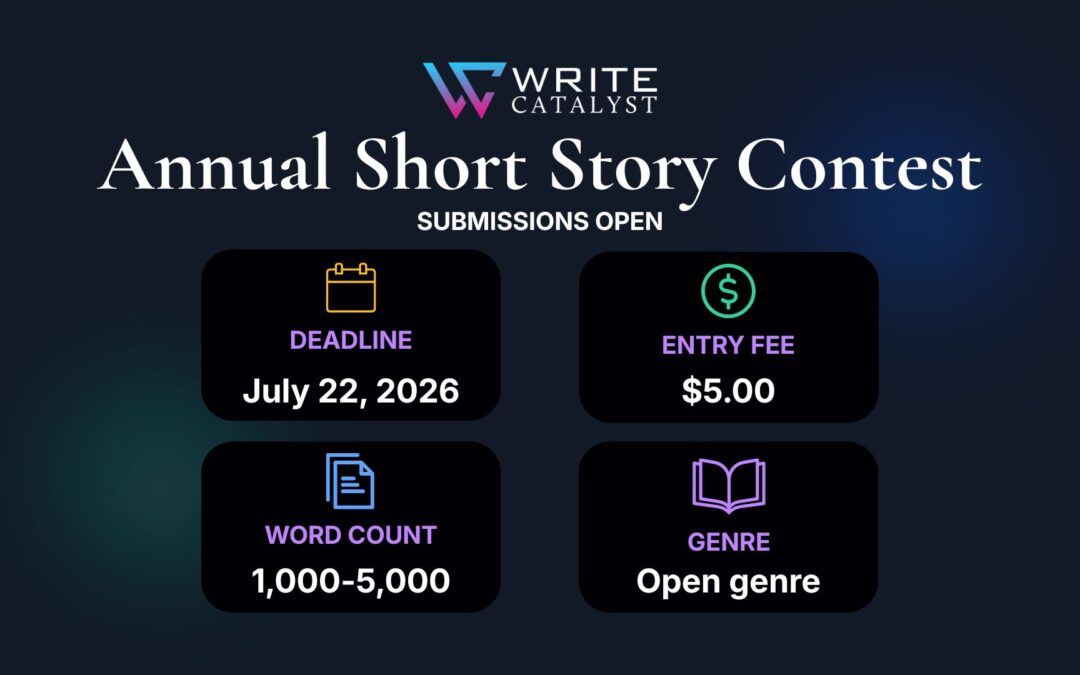
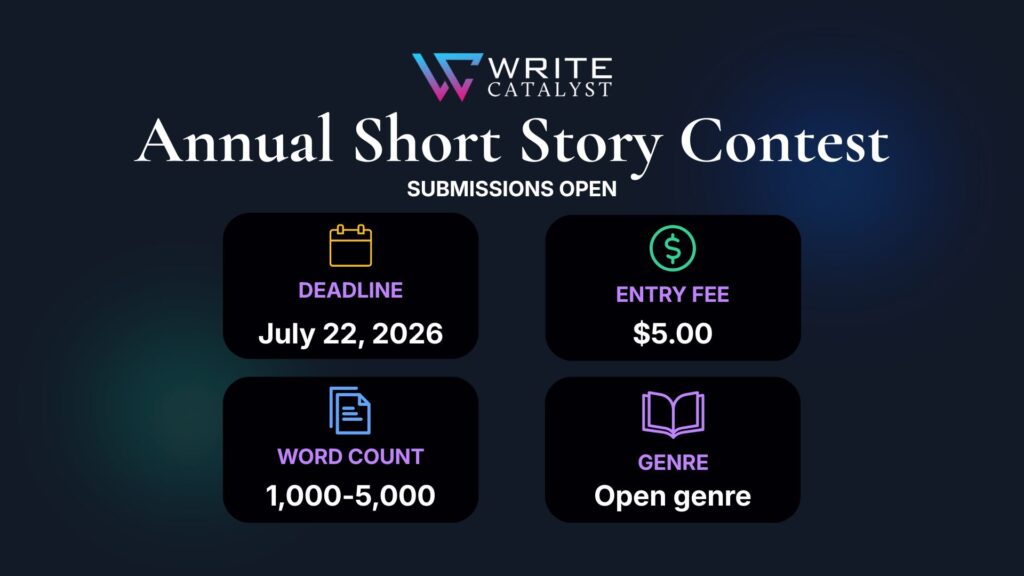
The Write Catalyst Short Story Contest is back and open for submissions until July 22, 2026. We’re looking for breakthrough voices and experienced authors alike.
Our previous contests astounded us. The quality of the writing, the range of voices, the heart in these stories was a reminder of how many genuinely talented writers are out there not getting the recognition they deserve.
So today, we’re showcasing the winners from our last contest.
Winners of the Write Catalyst Short Story Contest receive cash, memberships, and are published and promoted through our platform. The contest is also listed by Kindlepreneur and Reedsy among the best writing contests to enter.
Thanks to the winning authors and all who participated. We invite all writers to submit your short fiction to the current contest.
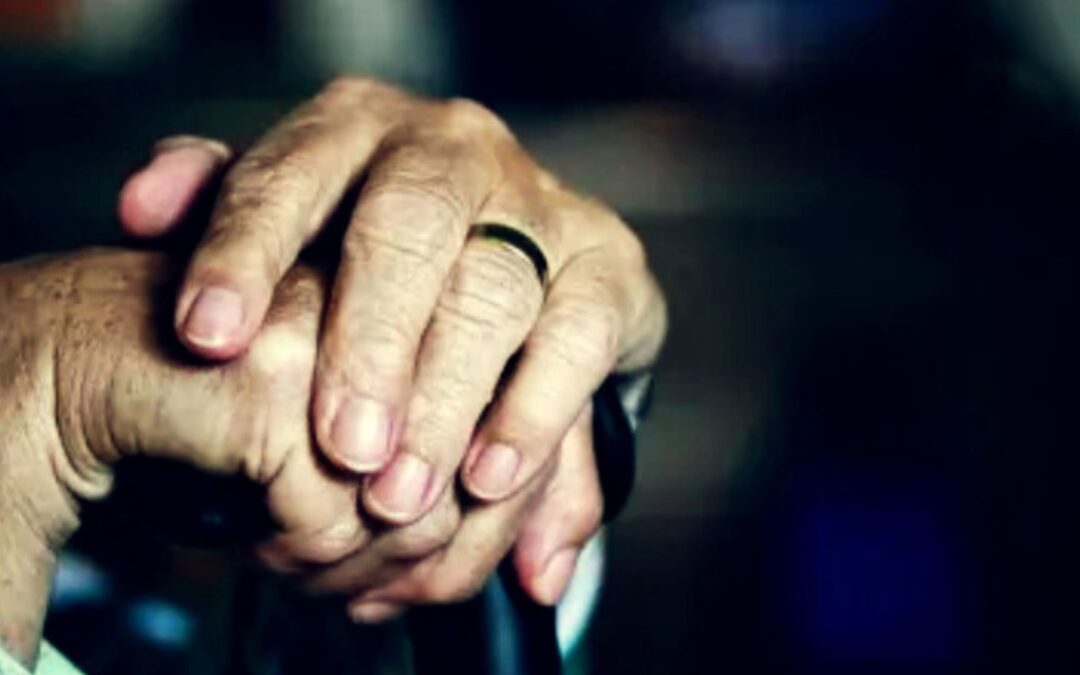
… most of us well into our eighties, gather every morning to claim our familiar positions at a table under an umbrella on the veranda, at The Bowers, an upscale assisted-living facility, our lives lived in slow motion, killing time, in similar, desperate ways.
All at once my whole being seemed to shrink, as though something had reached inside my chest and grabbed my very soul, and with bony fingers was attempting to wrestle it out of existence.
When does life begin? Does it start in the air as the breeze carries a lover’s call? Does it start in earth as warm bodies roll around in the soft grass? Does it start with fire as a look ignites new possibilities? Does it start in water as the amniotic sac explodes and pushes us out into the world?
We have run this contest twice before under our former brand, the Writers’ Mastermind at Let’s Get Published, where it was recognized by Kindlepreneur as one of the best writing contests to enter.
Both times, we were genuinely moved by what writers sent in. The quality of the stories, the range of voices, the courage it takes to put your work out there — it reminded me why we started this writing community in the first place.
This time, there are cash prizes on the table, plus publication on the Write Catalyst blog/newsletter and promotion to the whole community.
Here’s what you need to know:
SHORT STORY CONTEST 2026 PRIZES
— 1st Place: $150 cash or gift card + publication + 1-year Write Catalyst membership
— 2nd Place: $50 cash or gift card + publication + 1-year Write Catalyst membership
— 3rd Place: $25 cash or gift card + publication + 6-month Write Catalyst membership
(All placing stories receive mailing list and social media promotion)
SHORT STORY CONTEST 2026 DETAILS
— Entry fee: $5 per story (multiple entries welcome)
— Word count: 1,000–5,000 words
— Genre: Open — write what you love (excluding extreme horror and gratuitous erotica)
— Format: 12pt font, double-spaced, 1-inch margins. Include word count on first page. No self-identifying info.
— Deadline: July 22, 2026 at 12:00 AM EDT
A panel of judges will evaluate each submission for plot, theme, structure, characterization, atmosphere, originality, prose, and overall impact.
Note: In the past, members of the Write Catalyst community were not permitted to enter our contests. I’m happy to announce that we have changed that this year as our new submissions system allows for blind reading (meaning we can’t see the name of the story’s author).
Members may now enter stories as long as their submission is not one they have shared with the group before (as in getting any type of feedback during a write-in, Facebook group, or privately via email) or has used any part of the story in one of our live reading events.
If you’ve been sitting on a story — half-finished in a drawer, waiting for the right moment — this is it.
To submit, just click the link and upload your story.
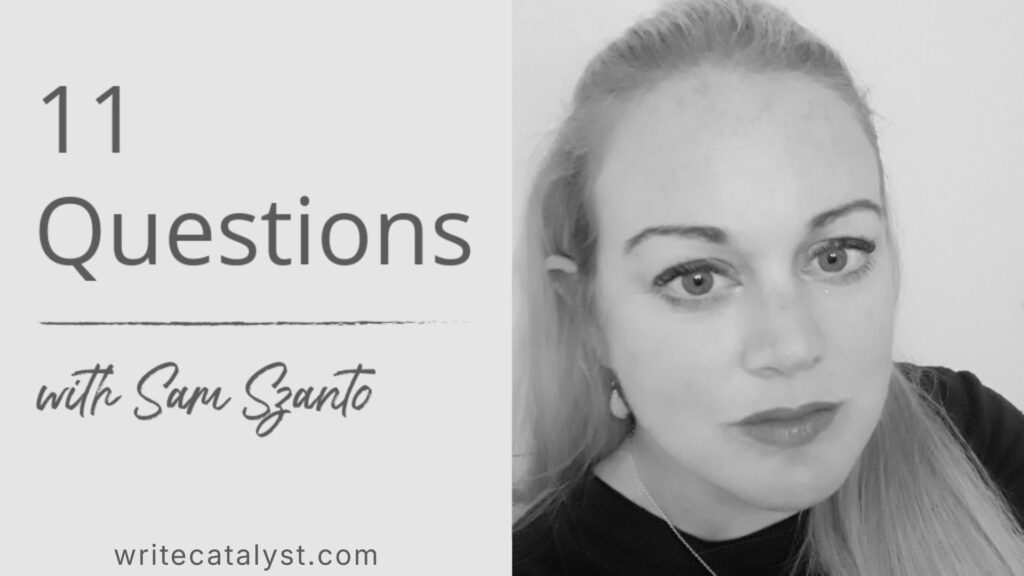
To continue our series of interviews with our short story contest winners, we talk to Sam Szanto, author of second place winner, If No One Speaks. Sam is an accomplished writer and poet, whose had nearly 40 stories and poems published and listed in competitions.
11 Questions with Sam Szanto
1. Tell us a little bit about yourself. Where are you from? Where are you now? What has your life been like?
I’m originally from Eastbourne (known as God’s Waiting Room), a seaside town in South-East England. I’ve lived all over England but mainly (20 years) in London. Last April, my family and I migrated to the other end of the country and now live in Durham, a city where everyone knows everyone (except us). I have a husband, two young children and an old tabby cat. Life has involved a number of jobs from (wo)manning an ice-cream kiosk to working at a girls’ private school to marketing for a national blind charity, and now writing as much as possible while freelancing as a copy-editor and English tutor. Much of my copy-editing is academic research for clients in Taiwan, although I also do novels, PhDs and whatever else anyone asks for.
2. What kind of stories do you like to write?
I write stories and poems; some are political, some about love relationships and some combine the two. They tend to be realistic, although I do like to add in the odd ghost! I also write a lot about displacement and alienation, with a particular interest in refugees (I am from a refugee family who came from Hungary in the Second World War). I like to place my writing in a wide variety of settings: Mexico, Madrid, Thailand, Cambodia, Venezuela, Russia, Bangladesh, etc. If you can’t travel far in real life, you can in your mind!
3. What sets you apart from other writers in your space?
I guess I haven’t read any other stories that sound as though I could have written them. But presumably every writer feels like that. I’m lucky now that I have the time to write, as I didn’t when I was younger – I have been reprimanded by a former boss for writing when I should have been working!
4. What drives your writing? What do you mean to accomplish with your stories?
I was once told by a novelist that ‘Writers need to write.’ This is absolutely true for me; and the older I get, the truer this is. I need to write, and I want to write. My aim is to publish a short story collection, which I have recently finished and am querying.
5. Who are your favorite writers and books? What are your other creative influences?
So many. I’m reading Val McDermid’s ‘1979’ at the moment, and Carolyn Forche’s ‘The Country Between Us’. I also always have an audio book on the go. My favourite short story writers and influences are Tessa Hadley (I was lucky enough to have been taught by Tessa on my MA in Creative Writing) and Elizabeth Bowen. My favourite novelist is Kate Atkinson and favourite poet Simon Armitage (neither seem very original answers!) but I could go on listing all day…
6. Tell us about your writing space. When and where do you write? Do you work in silence? Or music?
I write as much as possible, when I’m not doing paid work, housework or school pick-ups (I do also sleep). I can’t write with music anymore, although I did all my A-level English coursework with happy hardcore bulldozing into my ears. I write in silence in a study, interrupted by my kids asking what’s for tea and my husband asking what’s for lunch. The study is a luxury and blessing, as I spent each of the lockdowns in London writing at a table while the kids bounced up and down in front of the TV at the other end of the room.
7. What is your favorite thing to do when you are not writing?
I exercise a lot, mainly at the gym at the moment although we’ve also just bought a rowing machine. I’ve also got into gardening so I know I’m middle-aged. I also like the theatre. And of course, reading! When I was younger, I was often to be found unwashed at a music festival.
8. Who is your current artistic muse?
I’m not sure I have one, but I am smitten with the poetry of Warsan Shire, who wrote the poem I wish to have written (‘Home’).
9. Why do you think it’s important to write fiction?
Fiction has so many important roles. I can’t remember a day of my life when I haven’t read a book. Escaping into different worlds has got me through all the problems and hardships in my life to date. I’ve also learned so much about different worlds and times. Writing also has a very important role in mental health: it certainly helps me with that.
10. Who would be the best writer, alive or dead, to tell the story of your life?
Tessa Hadley. If only!
11. What are you working on right now?
A story about a school reunion, featuring a ghost, entitled ‘Everybody loved Romy’.
*****
About Sam
Sam Szanto lives in Durham, UK with her husband and two children. She has had almost 40 stories and poems published and listed in competitions.
In March 2022, her short story ‘If No One Speaks’ won second prize in the Writers’ Mastermind Short StoryContest; ‘Mikey’ was longlisted for the Bedford International Writing Competition (previously also highly commended in the Write by the Sea KQ Competition) and ‘The Thought of Death Sits Easy on the Man’ was published in WayWords, Issue 5 and ‘The Yellow Circle’ was published in Personal Bests Journal 3 (also published earlier by Storgy). In 2021, her story collection ‘Courage’ was a semi-finalist in the St Lawrence Book Awards; ‘Quiet Love’ placed third in the Erewash Writers Open Short Story Competition; ‘The New House’ was longlisted for the Crowvus Ghost Story Competition; ‘Rubbish’ was highly commended in the Glittery Literary Summer Competition and published in Anthology Volume 2; and ‘Don’t Refuse Me’ was listed in the Parracombe Prize Story Competition and published in the Parracombe Prize 2021 Anthology.
In 2020, Sam’s short story ‘Inaccrochable’ was published in Storgy; ‘125’ was a finalist in the 2020 Literary Taxidermy Competition and published in the Regulus Press anthology 124 Beloved – another of her stories in the 2021 competition also received an Honourable Mention; ‘Ferhana’ was published by Momaya Press in their Short Story Review 2020 and ‘Phil in Real Life’ was published in Secret Attic Booklet #6. ‘Making Memories’ was highly commended in the Michael Terence Publishing Winter Short Story Competition 2019 and published in the anthology The Forgotten. Also in 2020, Sam had stories shortlisted in the Writers Forum Competition, the 2020 Exeter Literary Festival Short Story Competition, the Doris Gooderson Short Story Competition and the 2020 Pennine Ink Writing Competition; and longlisted for the Flash 500 2020 Quarter One and the Cranked Anvil Short Story Competition.
In 2019, she won second prize in the Doris Gooderson Short Story Competition with her story ‘Letting Go’, which was published in the 2019 Chairman’s Challenges Anthology. Also in 2019, one of her stories was shortlisted in the Henshaw Press December Short Story Competition. Her flash fiction, ‘The Things that he Gave Me’ was published in Gold Dust.
Sam is also a poet and in 2022, three of her poems will be published in Europe Poetry Magazine and Horned Things Journal. In 2021, she was published in Alternate Route Zine. She won both the 2020 Charroux Prize for Poetry and the First Writers 12th International Poetry Competition. In 2019, she won second prize in the Hammond House International Literary Prize and was published in the anthology Leaving. Her poetry was shortlisted for the Grist Prize in 2019.
Sam is currently studying for the UK Poetry School / Newcastle University MA in Writing Poetry and also has an MA in Creative Writing from Bath Spa University.
Last month, we announced our Writers Mastermind Short Story Contest winners. In this series, we interview each of them to discover the soul behind their story.
Today we talk to Tomas Marcantonio, who won third place with his story, Feathers. He taught English in South Korea for most of the past decade, and is now settling in England to finish his dystopian noir series. Learn about his experience abroad and what drives his writing.
Meet Tomas Marcantonio, author of Feathers (3rd Place Winner)
Tomas Marcantonio is a writer from Brighton, England. He graduated from the University of Sussex with a BA in English Language and Film, and he spent most of his twenties teaching English while travelling and writing.
Tomas is the author of two travelogues, Gift of the Gap and How Not To Live Your Twenties, as well as the coming-of-age novel The Leap of Grebes. His dystopian trilogy Sonaya Nights is being published by Storgy Books, with first installment This Ragged, Wastrel Thing released on August 1st, 2020.
Tomas is also the author of numerous short stories, many of which have appeared in literary journals and speculative fiction magazines online and in print. He has placed in several short story and flash fiction competitions, and was the winner of the‘Just Back’ travel writing competition in The Telegraph in 2017. In 2020, Tomas was also nominated for the Pushcart Prize and Best of the Net.
When not scribbling about future worlds or his two beloved seaside cities, Brighton and Busan, Tomas is often writing obscure articles about Korean football. Otherwise, he is most likely getting lost in neon-lit backstreets somewhere, searching for new brands of makgeolli.
1. Tell us a little bit about yourself. Where are you from? Where are you now? What has your life been like?
I’m from Brighton on the south coast of the UK, but I spent most of the past ten years in South Korea, where in addition to writing I was teaching English. I recently moved back to Brighton to be closer to family and friends. It’s great being back, but I do miss the thrill of being abroad. I did a lot of travelling in my twenties, but now that I’m in my mid-thirties I’m trying my best to settle!
2. What kind of stories do you like to write?
I love exploring alternate worlds, especially dystopian or futuristic societies. I also frequently write about anxiety, and coming of age through travel. I rarely write about mundane life – I love travel and adventure and diverse peoples and places.
3. What sets you apart from other writers in your space?
I suppose my dream as a writer is to combine genre writing with literary fiction. As a reader I adore both, but I haven’t come across too many writers who write genre fiction with the poetic prose I enjoy. That’s the little corner I aim for.
4. What drives your writing? What do you mean to accomplish with your stories?
I recently wrote a Writer’s Manifesto as part of my Creative Writing Master’s degree – I called it the Soul Tattooist’s Manifesto. The idea is to ‘tattoo’ your soul into history, to make a permanent record of your thoughts, fears, feelings, and inspirations. I love the idea of trying to capture your true self in your writing, and the possibility that future generations will be able to read it and have an insight into your identity.
5. Who are you favorite writers and books? What are your other creative influences?
It’s hard to narrow this down to a few! I adore the writing of James Lee Burke, one of the few crime writers I’ve read whose beautiful descriptions of places and people can take my breath away. In terms of prose I’m hugely inspired by the writing styles of the likes of Laurie Lee, Virginia Woolf, and Annie Proulx, but I also love the big ideas and imagination of fantasy and speculative fiction novels. Haruki Murakami is my go-to writer if I’m in need of a definite pleaser.
6. Tell us about your writing space. When and where do you write? Do you work in silence? Or music?
I tend to write better in cafés, so a little background music is welcome. In Korea my ideal writing routine was to get up early and head to a quiet café with sea views and spend the whole morning there. I haven’t found my perfect writing café since moving back to Brighton, so I’m still searching!
7. What is your favorite thing to do when you are not writing?
Apart from curling up with a good book, my favourite hobby these days is beach volleyball. There’s nothing better than jumping around in the sand on a sunny day – especially if there’s a cold pale ale waiting afterwards.
8. Who is your current artistic muse?
My biggest artistic muse of the past decade has been Busan, my favourite city in Korea. Sandy beaches, sprawling mountains, labyrinths of neon-lit backstreets, and don’t get me started on the food. A huge city bursting with personality, and inspiration in every little nook.
9. Why do you think it’s important to write fiction?
I want to avoid trying to give a deep, profound answer here, so I’ll just answer this from my personal point of view as a writer – it’s a release, a calling, a joy.
10. Who would be the best writer, alive or dead, to tell the story of your life?
I’d love to read a Murakami novel of my life – he’d be able to side-step the boring parts by having me stumble upon a parallel world.
11. What are you working on right now?
I’m tidying up Book 3 of my dystopian noir trilogy, Sonaya Nights, from Storgy Books. I’m also working on a fantasy novel, which is something I’ve always wanted to do. I love world building and letting my imagination run riot, so it’s been a joy so far.
*****
Thanks to Tomas Marcantonio for letting us into his world.
Last month, we announced our Writers Mastermind Short Story Contest winners. In this series, I interview each of them to discover the soul behind their story.
Today we talk to Yong Takahashi, author of The Elements. You’ll learn about her struggles as a Korean immigrant and how she writes all her drafts in longhand on pink legal pads.
Meet Yong Takahashi – The Elements (FINALIST)
Yong Takahashi is the author of Observations Through Yellow Glasses: A Memoir Through Poems, Rising, Sometimes We Fall, and The Escape to Candyland. She was a finalist in The Restless Books Prize for New Immigrant Writing, Southern Fried Karma Novel Contest, Gemini Magazine Short Story Contest, The Writers’ Mastermind Short Story Contest, and The Sexton Prize for Poetry.
Yong’s YA novel, Camp Detroit, will be published in 2023. To learn more about Yong, visit: linktr.ee/yongtakahashi
OBSERVATIONS THROUGH YELLOW GLASSES
Yong Takahashi moved to The United States with her parents when she was three years old. She grew up in a traditional household where her Korean and American worlds pulled her in opposite directions. Shortlisted for The Sexton Prize for Poetry, OBSERVATIONS THROUGH YELLOW GLASSES invites you to follow her journey as she learns life’s bitter lessons, longs for love, and attempts to heal the wounds she collects along the way.
1. Tell us a little bit about yourself. Where are you from? Where are you now? What has your life been like?
I was born in Seoul, South Korea and grew up in Detroit, Michigan. Currently, I live in Atlanta, Georgia. I was the only Asian student in a newly desegregated school. The white students lived on one side of the highway and the black students lived on the other. I remember the landlord telling my parents we could choose which side because we were yellow. Trying to fit in was difficult and a lot of the pain in my writing comes from surviving childhood. Some of my experiences are in my memoir, Observations Through Yellow Glasses: A Memoir Through Poems.
2. What kind of stories do you like to write? I write poetry, songs, short stories, and novels.
I tend to lean towards darker storytelling. Many of my protagonists don’t have happy endings or struggle to find them. I find this is more realistic as life is not wrapped up in a bow.
3. What sets you apart from other writers in your space?
I blend my Korean and American experiences into my work. It tends to be a tightrope walk between the two cultures.
4. What drives your writing? What do you mean to accomplish with your stories?
I want the reader to see a perspective other than their own. I want them to say: Could that really happen? Well, maybe it could. Let me read it again.
5. Who are you favorite writers and books? What are your other creative influences?
My favorite book is The Metamorphosis by Franz Kafka. It is the only book I’ve read more than twice. The Inspector Gamache books by Louise Penny are the only ones I wait for each year. I don’t really read mystery but her words are just magical.
6. Tell us about your writing space. When and where do you write? Do you work in silence? Or music?
I usually listen to music while I make my to do lists and drink coffee. Then, I start writing or editing. It needs to be completely silent for my editing or writing sessions. If I’m at a coffee shop, I wear noise cancellation headphones. Prior to the pandemic, I wrote at Starbucks for three to five hours a day. Then, I’d come home to type my notes. Now, I write in my backyard or in bed.
7. What is your favorite thing to do when you are not writing?
I binge watch all my recorded shows. I just finished the 23rd season of Law & Order: SVU. I’m on season eight of the original Law & Order.
8. Who is your current artistic muse?
I study songwriters. I also watch cover artists on YouTube before my writing sessions.
9. Why do you think it’s important to write fiction?
I think every form of writing is important: poetry, fiction, nonfiction. However, fiction allows me to create worlds I could never live in. It lets me insert myself into situations that would never happen in real life.
10. Who would be the best writer, alive or dead, to tell the story of your life?
I absolutely love Louise Penny’s way of drawing the reader into her stories. It would be an honor if she’d write about me or just join me for coffee.
11. What are you working on right now?
I’m editing a YA novel. I hope to complete it next month. It will be published in 2023.
Add these contest deadlines to your calendar and get your stories ready! This article also provides tips on how to submit and increase your chances of winning.
You live to write and have numerous short stories to prove it. Best of all, people other than your mother love and praise them! But because your name doesn’t happen to be Danielle Steel, no publisher is currently knocking down your front door to rip manuscripts from your printer before the pages even cool. So what is an aspiring writer to do? Apply to a writing contest, perhaps?
If you were a singer, you could try out for American Idol; if a dancer, you could apply to So You Think You Can Dance. But let’s face it, a television show where you typed at your keyboard is not must-see TV.
Even so, there are numerous (non-televised) writing contests where you can display your skills and improve your writing. Plus, if you win, you might receive some well-deserved critical acclaim—not to mention a cash award and potential future writing contracts.
In this article, you will learn:
How to enter a writing contest and increase your chances of placing or even winning
Which contests are reputable
Which contests are currently accepting submissions