I wrote with strict adherence to the five-act structure and classical ideals of storytelling. I always pushed myself towards greater and greater depths of emotional weight. I agonised over sentences, spent entire weekends devoted to single plot-points, refining and refining them so that they could land with maximum impact.
I know I am not alone in this. By definition, creativity is obsessive. To devote oneself to a single pursuit so completely is inherently compulsive. Sometimes, my obsessions even led to breakthroughs. But more often than not, they ended in burnout.
I have now come to realise that this was not a state of balance. A wise person once said, “Don’t let the perfect be the enemy of the good.” And that is precisely the trap into which I fell.
I wanted my work to be perfect. And while that never manifested as procrastination or avoidance of actually releasing my books, it certainly hampered my writing of them. What at first was one of the greatest pleasures of my life eventually became a torture-rack into which I would willingly insert myself, wringing every last ounce of craftsmanship out of my brain, until I was left nothing but a broken, hobbled husk.
What at first was one of the greatest pleasures of my life eventually became a torture-rack into which I would willingly insert myself.
This is the path so many authors take, but in the words of Tolkien, “Are you sure you do not suffer needlessly?” There is another path we might take.
Letting the goblin drive.
The irony of all this is that perfectionism does not just kill the joy of the creative act—it actually dampens your creativity.
If we look at some of the greatest works of literature—truly great works that have stood the test of time, and that are beloved of the people, not just the academics—we see a pattern. A pattern not of perfectionism but of imperfection.
J. R. R. Tolkien famously wrote, in a letter to W. H. Auden dated 1955:
“I met a lot of things on the way that astonished me. Tom Bombadil I knew already but I had never been to Bree. Strider sitting in the corner at the inn was a shock, and I had no more idea who he was than had Frodo. The Mines of Moria had been a mere name; and of Lothlorien no word had reached my mortal ears till I came there. Far away I knew there were the Horselords on the confines of an ancient kingdom of Men, but Fangorn Forest was an unforeseen adventure. I had never heard of the House of Eorl nor the Stewarts of Gondor. Most disquieting of all, Saruman had never been revealed to me, and I was as mystified as Frodo at Gandalf’s failure to appear on September 22.”
In other words, he was a “pantser”. The Lord of the Rings was not meticulously worked out—albeit, the languages and ancient lore of the setting might have been—but he was discovering it as a he went along.
You can tell from the wording of the letter that this process of discovery made the work exciting to write. And this excitement of course inevitably translates to the reader. Even after seventy years, reading The Lord of the Rings evokes this feeling of discovery, of newness, that around any corner there might be some new wonder to behold.
We see the same thing in a contemporary example.
In a 2024 interview with GrimDark magazine, Matt Dinniman—author of the smash blockbuster LitRPG series Dungeon Crawler Carl—was asked about how he created some of his zanier characters, including Samantha, a sex-doll head possessed by the spirit of a demon-god. His response was laconic and hilarious:
“I am what some people call a ‘pantser.’ That basically translates to ‘he makes it up as he goes along.’ I never planned on having a reanimated sex doll head a major, important character. But here we are.”
As if that is not enough, in an interview with Maude Garrett, he was asked about whether he knew how the whole DCC series ended. “Not a clue,” he responded, to laughter from the audience.
It would be easy to dismiss pantsing or discovery writing as mere laziness on the part of the writer, but I’ve come to believe it is a crucial part of the creative process. In allowing things to organically emerge, rather than pre-planning them, the creator delegates the work to their unconscious mind, rather than their conscious mind.
Our unconscious mind is scientifically proven to know more, perceive more, and understand more than our conscious minds by quite some margin. It is a pattern recognition machine that may even have access to a human-collective or at the very least DNA-derived intelligence. What our unconscious mind spontaneously produces from its chasmal depths will almost always be more interesting, more mythically charged, more idiosyncratic than anything we can rationally think up staring at a blank page.
On a personal level, I often find my unconscious mind is ahead of me in terms of plotting, meaning the more I trust my spontaneous decisions midway through writing a chapter, the more I see, ten chapters later, how I was actually planting a seed for something much bigger. At the time, I am “mystified,” to quote Tolkien, but in the long-run, it seems that my unconscious brain already grasped the whole tapestry.
The phrase “discovery writing” is very apt indeed, for it hints not that the writer is really creating the work, but that they are uncovering something that already existed, whole and complete. The process of uncovering always necessitates some loss of the original vision, just as archaeological digs cannot succeed in excavating tombs without some material damage. But in essence, to tell a story is not to really make something new, but to dig up a sculpture out of the sands of time.
Letting go of control is one of the hardest things to do in any situation, whether we’re talking about relationships, coping with loss or setbacks, or indeed the creative process. But without abdication to the higher power of the Muse, or our own unconscious intelligence, or however we want to say it, we are doing both our work and ourselves a disservice.
Last year, I made a conscious decision not to plan so meticulously. This was in part due to the fact I was taking on a 15-book series. You can plan a trilogy. You can plan a 5-book series. But you cannot plan 15 books. There has to be room for surprise, subversion, diversion, and general madness. Yes, there is an overarching theme, and a vague idea of the end-point, but the road to get there is by no means already paved. I am laying each stone as I go. And I have to say, I am not sure I can ever go back to planning; this process has revolutionised my writing.
I now sit down to write (three times a week) with an unprecedented sense of excitement. The joy of discovering something new. The thrill of what surprises might lie in store. It is like I am tuning into my favourite TV show of all time. I don’t know how it’s going to turn out—that is the joy.
And yes, of course, there is work to be done in the editing stage to smooth things out. Not every spontaneous decision works out for the best. Neither have I completely abandoned the five-act structure, which is an invaluable tool for noticing where your emotional beats might not be paying off. But the initial act has changed drastically. Where before it was measured, now it is bold and unmapped.
Another way to view this shift is play.
Tolkien was a playful man despite his immense erudition and learning and his position as an Oxford professor. Matt Dinniman, likewise, embodies that childlike energy. His books feel so energetic precisely because they are raw, and chaotic, and bristling with almost too many ideas.
There is a famous quote attributed to Ursula Le Guin, although she subsequently amended the wording: “The creative adult is the child who survived”. I personally think she was bang on the first time. Children continuously create, continuously play. It is their natural state. Ideas are fecund and spontaneous. Nothing bores them more than some meticulously worked out game with lots of rules. The best games and stories emerge in the moment, co-created, sometimes dazzlingly stupid, but always entertaining and memorable. If we want to write works that speak to the heart, and if we want to fall in love again with our own creativity, then we must learn to play again.
If we want to write works that speak to the heart, and if we want to fall in love again with our own creativity, then we must learn to play again.
So next time you sit down, say to hell with structure, and to hell with genre. Take your hands off the wheel for a moment and let the wild goblin of your inner child drive. You might be surprised, not only by how much fun you have, but also by how good the end result is.
Joseph Sale
Joseph is the author of more than 30 books, including The Book of Thrice Dead, Virtue’s End, Dark Hilarity, and The Claw of Craving. He is drawn to the baroque, the spiritual, and the mythic like a moth to flame.
He lives in the south of England with his wonderful family, where he obsesses over table-top RPGs, trading card games, book bindery, esoteric Christianity, and anime.
The Write Catalyst Short Story Contest is back and open for submissions until July 22, 2026. We’re looking for breakthrough voices and experienced authors alike.
Our previous contests astounded us. The quality of the writing, the range of voices, the heart in these stories was a reminder of how many genuinely talented writers are out there not getting the recognition they deserve.
So today, we’re showcasing the winners from our last contest.
Winners of the Write Catalyst Short Story Contest receive cash, memberships, and are published and promoted through our platform. The contest is also listed by Kindlepreneur and Reedsy among the best writing contests to enter.
Thanks to the winning authors and all who participated. We invite all writers to submit your short fiction to the current contest.
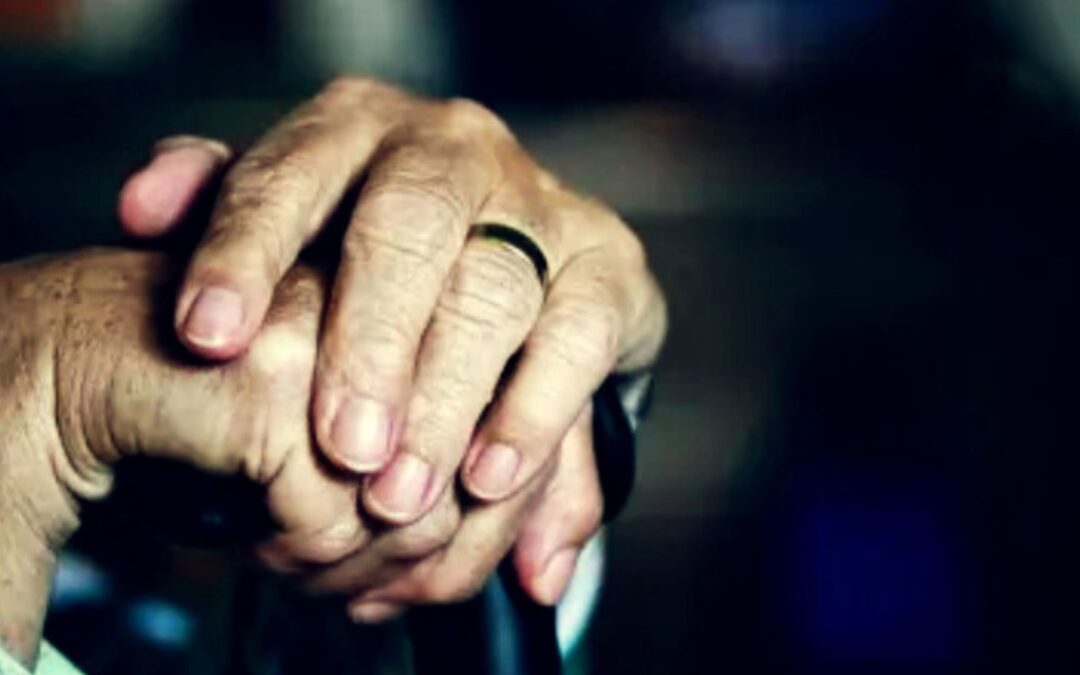
… most of us well into our eighties, gather every morning to claim our familiar positions at a table under an umbrella on the veranda, at The Bowers, an upscale assisted-living facility, our lives lived in slow motion, killing time, in similar, desperate ways.
All at once my whole being seemed to shrink, as though something had reached inside my chest and grabbed my very soul, and with bony fingers was attempting to wrestle it out of existence.
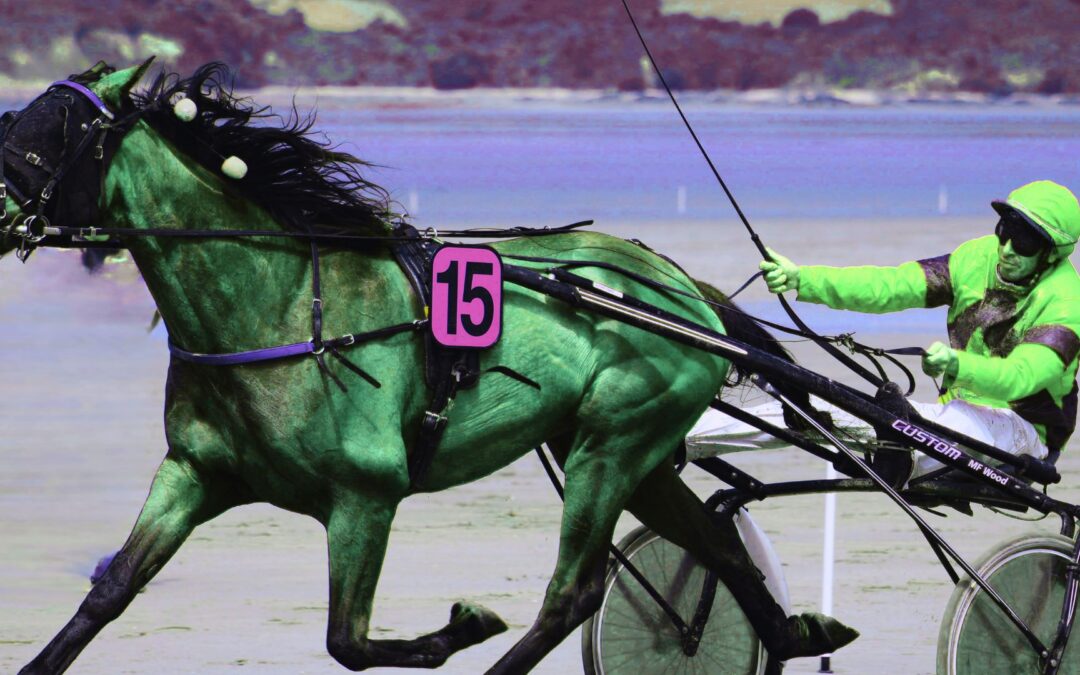
When does life begin? Does it start in the air as the breeze carries a lover’s call? Does it start in earth as warm bodies roll around in the soft grass? Does it start with fire as a look ignites new possibilities? Does it start in water as the amniotic sac explodes and pushes us out into the world?
…I wrote an anticipatory piece about a little video-game called No Man’s Sky. Back then—ten years ago, eek!—No Man’s Sky seemed more of a vision of the future of video-games than something concrete. We were all enraptured by the idea of infinite exploration, a living universe populated by the unbridled creativity of algorithmic chance. And then came the fall—the disastrous release of No Man’s Sky that garnered it such negative reviews and perception.
It would be pointless for me to write about this, or indeed No Man’s Sky’s epic recovery and transformation into potentially the most beloved sci-fi exploration game of all time. Many other writers and journalists have covered this topic in extensive and sometimes hands-on detail with the developers, so there is very little I can add.
What I do want to share is how, ten years later, No Man’s Sky still manages to feel fresh. Slipping back into the game feels like walking back into a bright dream. There is an energy about it. A ferocious clarity of vision. And I think the core of this is something that we writers, artists, and creatives can learn from.
There are two intertwined elements that make No Man’s Sky such an immersive and, frankly, addictive experience.
The Glorious Vicissitudes of Chance
The first I have alluded to already: chance. The randomness of the worlds creates a feeling of personal discovery that is intoxicating. This is something we writers, in particular, often forget. The visual artist intuitively understands that the accident of a brushstroke, or a combination of colour, can create revelation. Glass-makers literally do not know how their final composition will appear, for in the firing process colours change, structures shift, and the whole warp and weft of the thing transforms. There is an element of randomness, of chaos, inherent in the art-form, and a part of its joy.
Rolling the Die
We writers, by contrast, tend to believe in working everything out logically. Yes, we receive surprises when our characters misbehave, but rarely do we leave anything to chance.
But sometimes, chance is what a story needs. Sometimes, rolling a die to see whether a character lives or dies, or where a party of explorers end up next, is exactly what a story needs to take some unprecedented leap into the unknown. I have used this technique, particularly with my GameLit / LitRPG series Levi’s Game, where certain locations and creations were procedurally generated.
We receive surprises when our characters misbehave, but rarely do we leave anything to chance.
Joseph Sale
I did this because the locations actually are procedural in the story, so it felt fitting to reflect this in the creative process and challenge myself—and my characters—with an unexpected outcome. Incidentally, if you’re curious about how this turned out, the first book in the series has recently been released on audiobook. Check it out here.
But procedural generation can be applied in any number of ways. Once you start thinking more like a Dungeon Master and less like a writer, you begin to realise that storytelling is pure play, and randomness becomes not your enemy, but a way of accessing previously inaccessible powers of surprise.
The Depth of Mystery
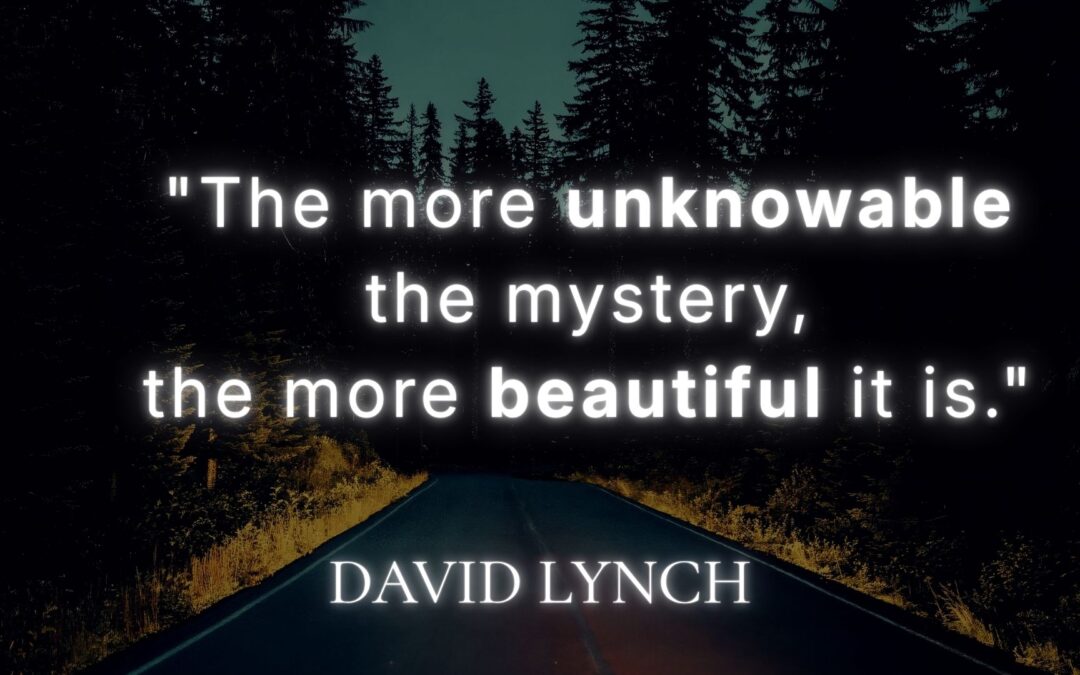
The great David Lynch once said, “The more unknowable the mystery, the more beautiful it is.” And he is absolutely right. Human beings are called by the siren-song of mystery. We yearn to know the unknowable. Nothing intrigues us more than a riddle that seemingly has no answer. It is why Mystery fiction will remain evergreen.
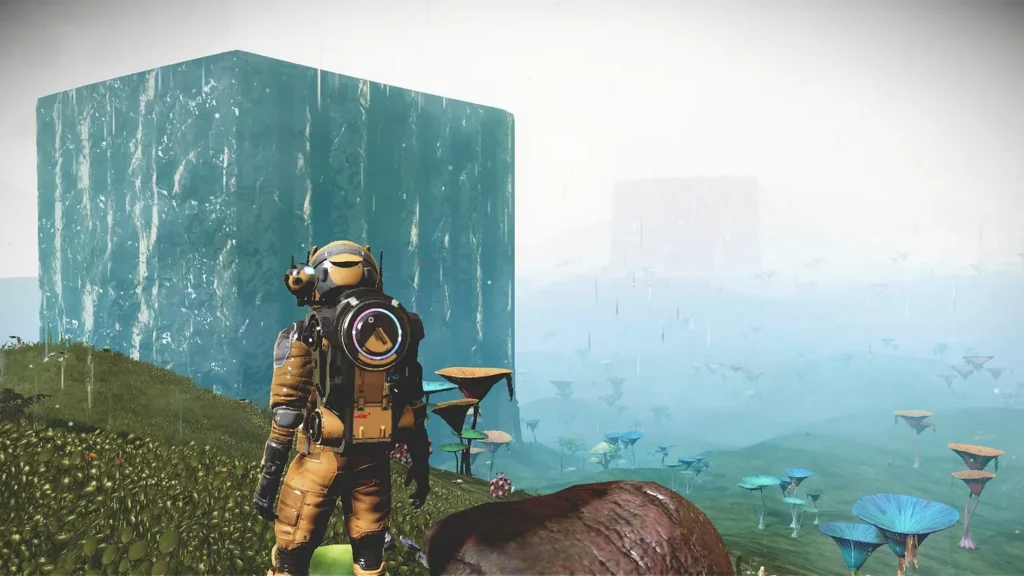
Mystery is the second—and far less talked about—element that No Man’s Sky gets right. We awaken on a strange world with no memory of who we once were, only the stark reality of a destroyed ship, limited supplies, and the will to survive. However, it seems there is some kind of benevolent force in the universe, for we are given clues in the form of cryptic messages, guiding us back to the true path and towards some ultimate destiny.
We know so little, at the start of our journey. And the more we find out, the less it seems we know. There is a species called the Gek who leave ancient standing stones, imparting knowledge of their language to explorers. Why? There are robotic sentinels patrolling some planets and protecting their bio-diversity. Why? Were they left behind by some colossal civilisation now undone? Every answer prompts a new question. But most mysterious of all is the question of our own nature of why we are called to strive, survive, and reach the stars. It is an unanswerable mystery. The heart of the human condition itself. And somehow, impossibly, No Man’s Sky captures this.
Stepping Into the Unknown
As writers, we tend to want to explain our reasoning, to provide motivations for our characters, to ensure our plots hang together logically. I am not advocating we abandon this entirely. But what No Man’s Sky—and indeed the great masters of literature—teach us is that mystery must prevail. Without mystery, there is nothing to compel the human imagination. The unknown is not to be feared; it is our natural habitat. If we are to inspire and ensoul the world, we must go forth into that vast dark without fear, without caution, and fully embrace the divine mystery of the universe, for it is only in embracing the mystery that we can finally embrace ourselves.
Joseph Sale
Joseph is the author of more than 30 books, including The Book of Thrice Dead, Virtue’s End, Dark Hilarity, and The Claw of Craving. He is drawn to the baroque, the spiritual, and the mythic like a moth to flame.
He lives in the south of England with his wonderful family, where he obsesses over table-top RPGs, trading card games, book bindery, esoteric Christianity, and anime.
Earlier this year, I was at Authorcon VI in Williamsburg and fortunate enough to share a table with one of my dearest friends and most admired writers of all time, Joseph Sale. Near the end of the convention, I decided to make my rounds and pick up a few books from authors unknown to me. As I returned to the table with haul, I showed Joseph my choices.
“I hope they’re good,” I said.
“Easy to tell,” Joseph said. “Did they pass the first line test?”
“What’s that?”
“I can tell if a book is going to be for me by reading the first line.”
I stood there a bit dumbfounded. So simple, and yet, I had not thought to open the books and read a few lines before buying.
So I looked at the first lines of the novels I’d purchased. Luckily, they were pretty good.
But what if they hadn’t been? What if I had spent money on them, opened them up, and immediately wanted to put them down?
And, then I thought … what if someone put my novels through the first line test?
My books happened to be stacked in front of me on display. I picked up each one and read the first lines.
For the most part, I was underwhelmed. They weren’t bad, but would they compel a person to read the whole book from just one sentence?
I wasn’t going to lie to myself—the answer was no. If I were a stranger, and read the first lines from a list books, mine would not be the must-reads out of the bunch.
That being said, I had written those books before I had ever taken a writing class. I didn’t think strategically about the first page. I didn’t understand why agents and publishers only wanted a few pages, or a few chapters. How could they tell if a story was any good without reading the whole thing?
Then in 2023, I had the amazing experience of working for Gamut, a speculative fiction magazine. As part of the editing staff, I learned from the other side of the game how crucial a good opening was.
I had to read 150 short stories per month, every month. If the first line wasn’t great, I would give the first paragraph a chance. If the first paragraph didn’t get me, I might read the whole page. If at the end of page one, the main character is still waking up and eating breakfast, it was a no go.
This is what I learned from my colleagues—if I started reading a story and didn’t feel like continuing, it meant our magazine subscribers wouldn’t either, and that would be the end of the publication.
A good opening doesn’t necessarily have to start off with an explosive scene, but it does have to have a hook. It can be a deftly crafted one-liner, but it also can be an extremely engaging character, a concept I haven’t encountered before, a dilemma that I can relate to. Even a slow burn can build enough tension and suspense to make a story impossible to put down. A seemingly benign beginning with just the right amount of foreshadowing will tip us off that something unsavory is about to go down.
As an editor, there were times I read through stories with sluggish beginnings because of a hint that it might become something greater. And often, lackluster openers ended up being a great story. But that doesn’t matter if no one finishes it.
Many readers won’t wait to see if a book gets better. Agents and publishers simply can’t afford to invest the time and money. If an author fails to get the story off the ground effectively, it will more than likely have to be rejected.
You don’t have to let this happen to your stories.
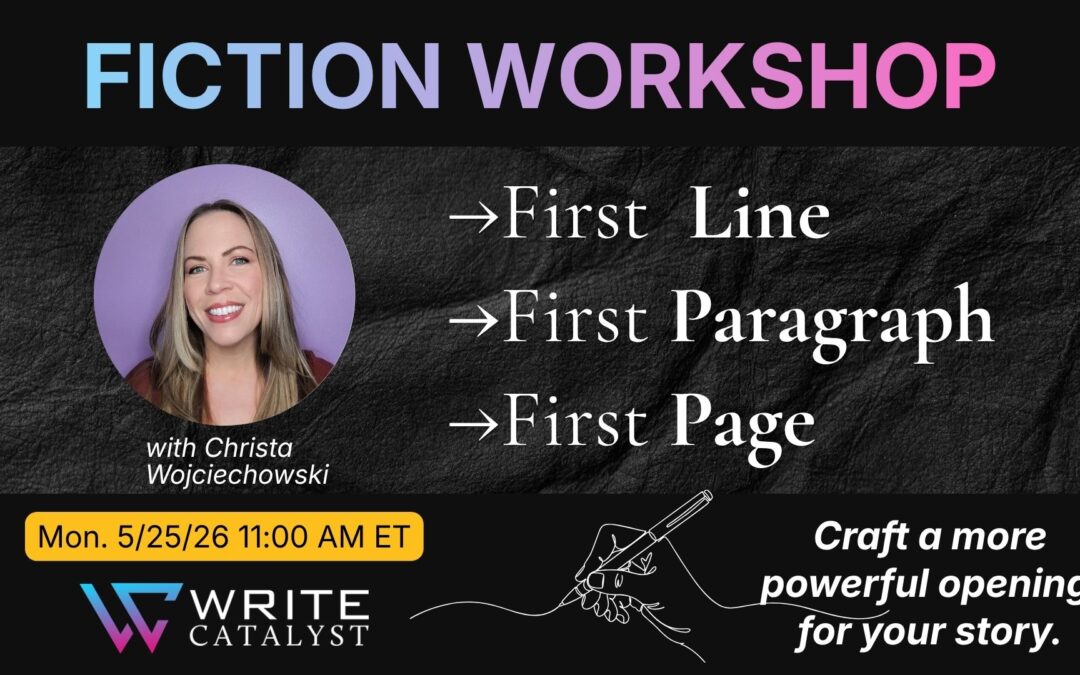
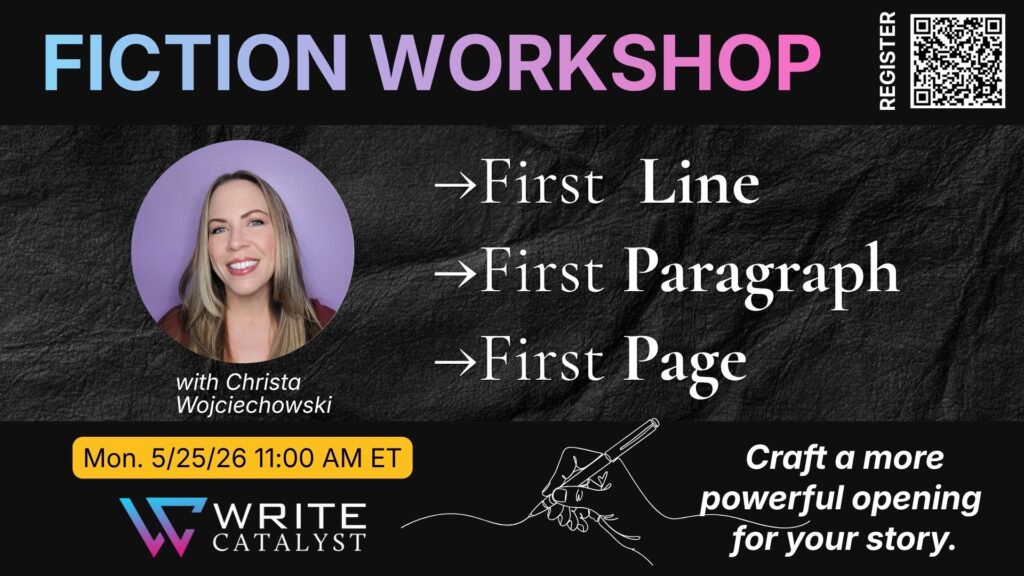
The First Line, First Paragraph, First Page Workshop
In the 1st Line, 1st Paragraph, 1st Page Workshop, each student will bring the first page of one story, novel, or work-in-progress to be shared and critiqued by the group. We will analyze the first line, then open up to the first paragraph, and expand into the first page to see where we are hooked as readers and what it is that makes us want to turn the page. We will discuss the context of the whole story to see what might improve the appeal of its beginning.
So look through your stories (can be published or unpublished). Let’s see where the reader takes the bait.
Especially now, when it’s almost impossible to disconnect from work, to get space in our day for quiet, to have a moment where there is nothing left on the to-do list and we can allow our minds to reset.
Even if we do step out for a walk, or escape to a hotel for a writing binge, we always have our phones. Which means that every friend, family member, boss, client, and work colleague comes with us.
They often join us in the bathroom. Not to mention notifications from complete strangers on social media.
Just imagine what it would look like if all those people were physically there, crowding around you as you tried to write.
When was the last time you were truly alone? With no way for anyone or anything to intrude on your thoughts?
It’s easier to remove ourselves from real people than it is from our endless virtual networks.
I used to just muddle through. But as I’ve become more aware of how the overstimulation taxes my neurons, I’ve learned that it’s my responsibility to carve out time to step away, take a breath, and let the dust settle.
Only then am I still enough to hear my own creative intuition. I show up better for my writing, as well as for my work, family, and social life.
I’m sharing this because, honestly, I’m at critical mass. My family is wonderful, but this is a very active household, and with work and writing, it’s a lot. My job as a digital marketing specialist means I am online all day, every day.
I’ve learned the signs that I need a break— feeling impatient, frazzled, overwhelmed, and blocked. The brain drain is poison to creativity, and the stress influences everyone and everything around me. My experience with digital burn-out inspired my novella, Popsicle, where the effects of internet overload end up with extreme consequences.
So for the next two weeks, I’ve planned a sabbatical. I’ll be alone — well, not totally alone. I’ll be with dogs, which is honestly the best company. My trick is booking nearby getaways on a pet-sitting app. I get a place to myself, and the owner gets someone to spoil their furbabies. Win-win.
I know we can’t always take off and leave our responsibilities behind, but even micro-getaways help. You can hide in a quiet corner at the local library. Put on headphones and lock yourself in a closet. Go to a park and wander around without a purpose. Sometimes I get into my car and drive to a nearby parking lot just to be in silence.
The crucial thing is to turn off your phone. Leave it at home, if you can. Not only do notifications interrupt you, the mere anticipation of getting messages puts you in a constant low-level alert mode. This steals bandwidth from your creative potential.
Notice how it feels to remove the possibility of being interrupted—to release the urge to send pictures, check email, or Google whatever random question comes into your mind.
Yes, it’s an uneasy feeling to be untethered.
But it’s so incredibly freeing.
Now, I ask you—what could you do to plan a small pocket of solitude?
May the muse be with you,
—Christa
P.S. Speaking of things worth your time—our short story contest is open for submissions, and we’re now accepting nonfiction essays on writing and creativity for publication on this blog.
All the details are on our submissions page. We’d love to read your work.
We have run this contest twice before under our former brand, the Writers’ Mastermind at Let’s Get Published, where it was recognized by Kindlepreneur as one of the best writing contests to enter.
Both times, we were genuinely moved by what writers sent in. The quality of the stories, the range of voices, the courage it takes to put your work out there — it reminded me why we started this writing community in the first place.
This time, there are cash prizes on the table, plus publication on the Write Catalyst blog/newsletter and promotion to the whole community.
Here’s what you need to know:
SHORT STORY CONTEST 2026 PRIZES
— 1st Place: $150 cash or gift card + publication + 1-year Write Catalyst membership
— 2nd Place: $50 cash or gift card + publication + 1-year Write Catalyst membership
— 3rd Place: $25 cash or gift card + publication + 6-month Write Catalyst membership
(All placing stories receive mailing list and social media promotion)
SHORT STORY CONTEST 2026 DETAILS
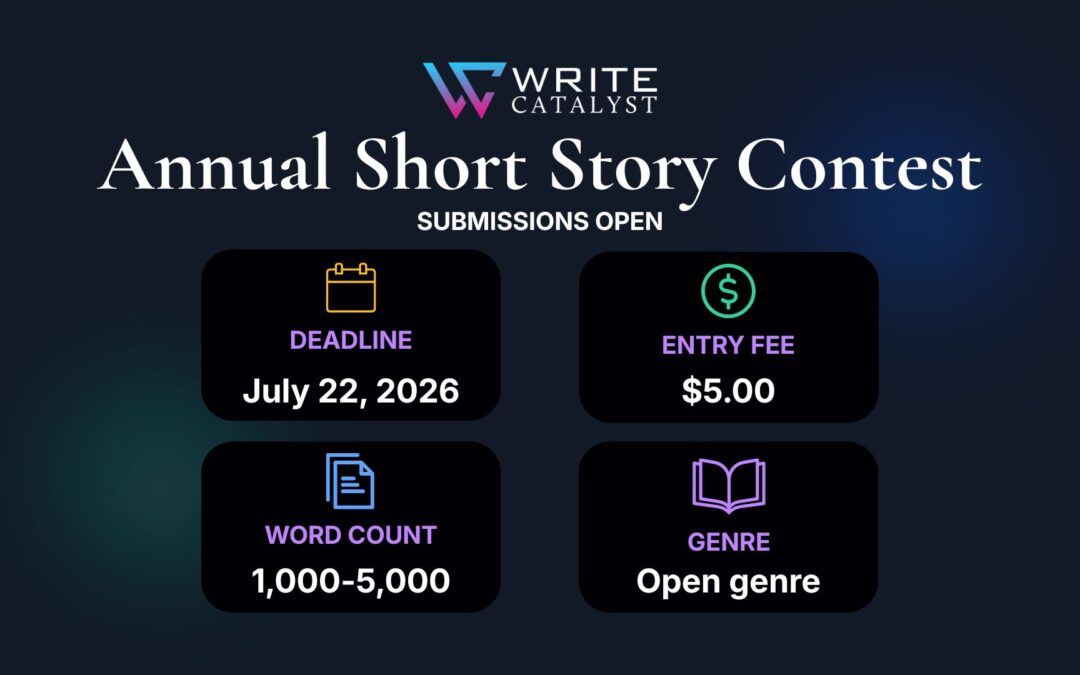
— Entry fee: $5 per story (multiple entries welcome)
— Word count: 1,000–5,000 words
— Genre: Open — write what you love (excluding extreme horror and gratuitous erotica)
— Format: 12pt font, double-spaced, 1-inch margins. Include word count on first page. No self-identifying info.
— Deadline: July 22, 2026 at 12:00 AM EDT
A panel of judges will evaluate each submission for plot, theme, structure, characterization, atmosphere, originality, prose, and overall impact.
Note: In the past, members of the Write Catalyst community were not permitted to enter our contests. I’m happy to announce that we have changed that this year as our new submissions system allows for blind reading (meaning we can’t see the name of the story’s author).
Members may now enter stories as long as their submission is not one they have shared with the group before (as in getting any type of feedback during a write-in, Facebook group, or privately via email) or has used any part of the story in one of our live reading events.
If you’ve been sitting on a story — half-finished in a drawer, waiting for the right moment — this is it.
To submit, just click the link and upload your story.