How many days do we live and how many days do we singularly remember?
Why does our brain choose to remember some days and not others?
I’ve chronicled my life in journals since I was a child. And every so many years, I read my life from start to finish. No matter how many times I go back, it is a mind-bending experience.
In reading old journals, you meet your old selves and re-experience unique little moments and lessons that you’ve forgotten.
You get a different perspective on past events that were too close for you to see before. You laugh, you cry, and you realize just how full your life has been.
All this life is fuel for writing.
That’s why fiction writers should journal
Writing good books means having a deep understanding about the transformations you and others experience when meeting challenges, coping with sorrow, or finding joy.
And building a journaling habit not only helps you to travel back into the past and relive pivotal moments, the act of writing down your deepest personal thoughts helps you to become more self-aware and pay attention to what’s happening beneath the busyness of your life.
We can see how events shape us as individuals. We can excavate our own inner worlds for treasure.
Journaling (or morning pages) might be difficult to stick with, especially when you’re trying to get your word count in on your fiction projects, but it’s worth it. We can’t possibly remember every day we lived—the variety of impressions, the symphony of emotions, and the subtle shifts in our perception.
Our ordinary days are full of tiny gems of insight, but they often lump into one default memory. That is why journaling is a valuable practice to keep.
Recently, a close writing friend told me he would forgive a writer for a messy plot if there was underlying passion and depth.
I agreed.
When you pick up your typical mass market paperback, you’re presented with a perfectly formulated product. It was written to appeal to a wide audience, easily digestible and mildly entertaining. These books often repeat themselves in endless series to keep readers buying indefinitely.
These kinds of books might help pass a few hours on the train, but will they change your life?
Probably not.
Why?
Often, it’s because the writer prioritized formula over feeling. They followed the market instead of sharing their soul. They didn’t bleed for it. And you can tell. You can feel that the heart of the writer is missing.
So how can you make your writing speak to readers on a deeper level? How can you make your stories the ones readers treasure and recommend to everyone they know?
Write for yourself, not to pander to every buyer out there. Think about the writers who changed your life. Imagine if they tried to fit themselves in an easily marketable box.
If you want to make your book unforgettable, write about the things that most deeply stir you, and you will stir them.
The 2006 Christopher Nolan film The Prestige, based on the novel by Christopher Priest, has a lot to tell us about how to write compelling stories.
Though there are many things to learn from the way it presents us with a story of two rival magicians, perhaps the most important learning point is the concept embodied in the title itself.
For those who don’t know, “The Prestige” is the third act of any magician’s trick, in which what they previously destroyed, or made to disappear, returns – to the delight and adulation of the crowd. As Michael Caine’s character, Cutter, observes, “It’s not enough to make something disappear. You have to bring it back.”
“It’s not enough to make something disappear. You have to bring it back.”
Our mythologies and religions are full to bursting with gods and human beings who return from death. From the wounded King Arthur, who will one day come again from beyond the veils of Avalon, to the crucified Jesus who lay three days dead in the tomb yet rose, to the dismembered god Osiris, who was reforged from scattered body parts by his wife, Isis, the list goes on and on.
The recurrence of this image throughout history and across innumerable cultures is evidence that the idea of a “prestige” is hardwired into our deepest psyche. We yearn for what was lost to return to us. The concept has filtered through into modern-day popular culture too: The Return of the King, The Return of the Jedi, even Superman Returns. There is a sense that true heroes, true saviours, come back to us when we need them the most.
Of course, sometimes this deep human need is exploited for quick cash grabs, as in the “endless sequel” effect in which our favourite characters just keep coming back time and time again. In these instances, often it is the case that the story begins to lose all meaning, because there are no real stakes; the heroes are invulnerable, and even if they seem to die, they always come back without a scratch.
However, when this mythic principle is handled with sincerity and integrity, it can produce some of the most startling and moving moments in cinema, prose, poetry, indeed, any medium. The initial disappearance of the figure who is going to return need not even be via death; it can be just that: a disappearance.
Consider how Gandalf leaving Helm’s Deep in the second Lord of the Rings movie shapes the narrative. He leaves the story for some time, long enough we almost forget where he’s gone off to, but at the critical moment, when all hope seems lost, he returns to save the day (bringing with him the “lost” Rohirrim) in a sublime eucatastrophe.
I often hear writers talking about how they have “written themselves into a corner” by disposing of an artefact, character, or even a place. Many of these issues can be fixed by building the concept of a “prestige” into your fiction from the get go.
And on that subject, I always admire a writer who has the guts to kill their characters, and sometimes a character simply has to die, and die forever, for a story to end, for it to have any meaning. But whilst the bitter fruit of death, or loss, is sometimes what is needed to round out a tale, the far sweeter fruit of return also has its place. This is more true of horror, not less.
In Nolan’s 2010 film Inception, he remarked that “Positive emotion trumps negative every time”, and I also happen to agree with him on this front. A sad death at the end of a book can be devastating. But a “prestige,” a triumphant return, is infinitely more powerful; it shakes to the bone. Death, after all, is merely existential.
A return is transcendental.
In fact, it’s magic.
A sad death at the end of a book can be devastating. But a “prestige”, a triumphant return, is infinitely more powerful; it shakes to the bone.
Joseph Sale
Joseph is the author of more than 30 books, including The Book of Thrice Dead, Virtue’s End, Dark Hilarity, and The Claw of Craving. He is drawn to the baroque, the spiritual, and the mythic like a moth to flame.
He lives in the south of England with his wonderful family, where he obsesses over table-top RPGs, trading card games, book bindery, esoteric Christianity, and anime.
Have you ever felt like your writing comes from some deep, true place inside you, but you can’t quite pinpoint what that place is or why you’re compelled to write what you write?
I had always wanted to be a writer. I think many introverts feel the same way. We live internally, preferring to express ourselves within the receptive, non-judgmental pages of our journals than to open up to another person. A blank sheet of paper or a white screen will always listen. Like Joan Didion said, “I don’t know what I think until I write it down.”
But becoming an actual published author seemed like a ridiculous dream.
Then in November 2012, when eBooks were becoming the norm and many indie authors were seeing great success, becoming a writer seemed a real possibility. I decided to participate in National Novel Writing month. I had never written a novel before. I had no idea how to begin, but the challenge was thrilling.
My story began with a sculptor and his muse, an idea my sister gifted to me. I outlined the plot from the time the characters met till the happy end, each chapter mapped out according to a generic story structure formula I found on the internet.
I intended for it to be a contemporary romance. But as I began writing, something unsettling happened. The story mutated. It broke free from the outline and shaped itself into a completely different beast. No matter how hard my logical brain tried to steer the narrative where I thought it should go, the characters veered off in directions I could’ve never imagined. It baffled me what mysterious, interior worlds were uncovered by writing a fictional story.
Now looking back on that first novel-writing experience, and all that avalanched out of Oblivion Black, I realize that the creative act forced my deepest questions, thoughts, and feelings to the surface, a side of myself that had always been waiting to be voiced. The anger, the pain, the confusion, the doubts that had been censored or buried were played out in the trials and journeys of my characters. What started out as a fun project of melodramatic romance became a dark, psychological deep dive, ultimately ending in my main character’s spiritual catharsis. This closure, I also experienced in telling the story to myself.
And that is how I experience being a fiction writer. I am writing my way back home to myself. At the same time, I’m reaching out to those who might need to hear the same message.
Writing fiction has a way of revealing our innermost selves. In many ways, it goes deeper than talk therapy or journaling because we act out our most secret fantasies or shadow tendencies. We hide within our characters and their stories, discovering things we’ve hidden from our very own waking life. Writing fiction bridges that gap between your conscious and unconscious mind.
I didn’t understand what was happening at the time. I never set out to write dark fiction and horror. I couldn’t figure out where I fit as an author in the real world. I was uncomfortable promoting my books and putting myself out there because I didn’t feel 100% authentic.
Years later, after studying som of Carl Jung’s work, and personality models like Myers Briggs, Enneagrams, and Motivational Maps, I saw a pattern in the books and writers I read and knew personally.
Each writer has a unique set of values, which gives their writing its soul. Once a writer locks into their values, they can recognize their unique gifts as creatives, cultivate their strengths, and express themselves more fully through their fiction. This allows them to connect deeply with readers, turning mere entertainment into something that leaves a lasting effect on their hearts and minds.
You, as a writer, are a metaphor, writing in symbols about characters who are also symbolic. In waking life, you are a son or daughter, a parent, sibling, friend, worker, and member of your community. But in your creative life, you’re projected into words and iterate your unique pattern through them, leaving your stamp on everything you create.
Through this process of letting my fiction take me where it wanted me to go, my writer archetype was unearthed. In Write Catalyst, I am The Mystic writer archetype. It doesn’t mean I write about people with supernatural powers or ancient tomes of secret magic. I take the most unlovable, unredeemable people, put them through the dark night of the soul so they are forced to grow into their best selves. The Mystic writer makes their characters’ personal journeys transformative on the most profound levels. They take leaden characters and transmute them into gold.
What confused me before now makes sense. Knowing my core values as a writer has given me clarity.
My intention underlies everything I write, and it’s supposed to. My themes of personal evolution and spiritual growth aren’t weird, but essential to making my stories’ impact that much stronger. Instead of trying to force myself into the box of this or that genre, I use genre as a vehicle for my greater, underlying purpose. I can write horror and sci-fi and psychological fiction with confidence by trusting in the writing that makes my soul sing.
This makes writing flow easier. It makes life more inspired. I feel more comfortable promoting myself now—because it’s not about selling books. It’s about what I stand for and what I hope to do for readers.
Yes, we need to do the work—the editing, the querying, the self-promotion—but we need a higher purpose to power our creative force.
Your fiction is trying to tell you something about yourself. The question is—are you listening?
Think about everything you’ve written.
What are the recurring themes?
What problems are your protagonists constantly confronting?
What might you be trying to resolve within yourself?
When you understand what inner dynamics you’re working out in your fiction, you understand why your stories matter—not just to readers, but to yourself. You stop second-guessing your themes. You stop apologizing for what moves you. You stop trying to write like everyone else.
You write like yourself. Finally.
Take the shortcut to discovering what drives your writing.
Archetypes are part of our psyches. If you’re familiar with Carl Jung’s work, you’ve likely heard of the collective unconscious—a secret well of patterns and images. Joseph Campbell delved deeply into this concept with The Hero with a Thousand Faces, in which he explores the connections across human cultures—the gods, the myths, the symbols, the rituals that iterate across time, distance, and language.
Often, you will hear of people having the same idea at the same time in different areas of the world. Much of the imagery in human dreams is universal. Our gods and saints and heroes have their counterparts in other cultures. These patterns not only exist in our religions and legends, but in the fiction we write today. Most interesting of all, these structures exist in ourselves. Reality mirrors the interior, or vice versa.
We can all picture the archetype of the wise old sage, the jezebel, the fool, the knight in shining armor. These pervasive, recognizable figures are called archetypes. Archetypes are powerful tools in fiction. They help us define a character and their motives, giving the reader enough familiar framework so they can fill in the gaps without the writer having to tell their whole life story.
More fascinating still is that we, as living people, also have a tendency toward embodying an archetype. Think about your astrological sign, your Myers-Briggs personality type, or your Enneagram (do you see the pattern here?). Because our desires and motivations tend to be hidden from us, we can use these systems to uncover what we really want and why, what our strengths are, and what shadows could be lurking in our unconscious that make our lives difficult and prevent us from growing.
That is why I developed a writer archetype system for Write Catalyst—a comprehensive writer personality assessment rooted in the Jungian tradition of archetypal psychology, informed by the broader archetype literature, such as the work of Carol S. Pearson, and applied specifically to creative writing. Not only will it help you discover why you’re called to write fiction and what you’re trying to express, it will help you approach your creative process from a meta-cognitive perspective.
You’ll identify fears and self-limiting beliefs that are keeping you from shining your creative force. You’ll know how to write true to your heart instead of molding yourself to the next trend. Also, when you know what you stand for, marketing becomes natural—even a compulsion. You become proud of who you are and excited to share your work with the world.
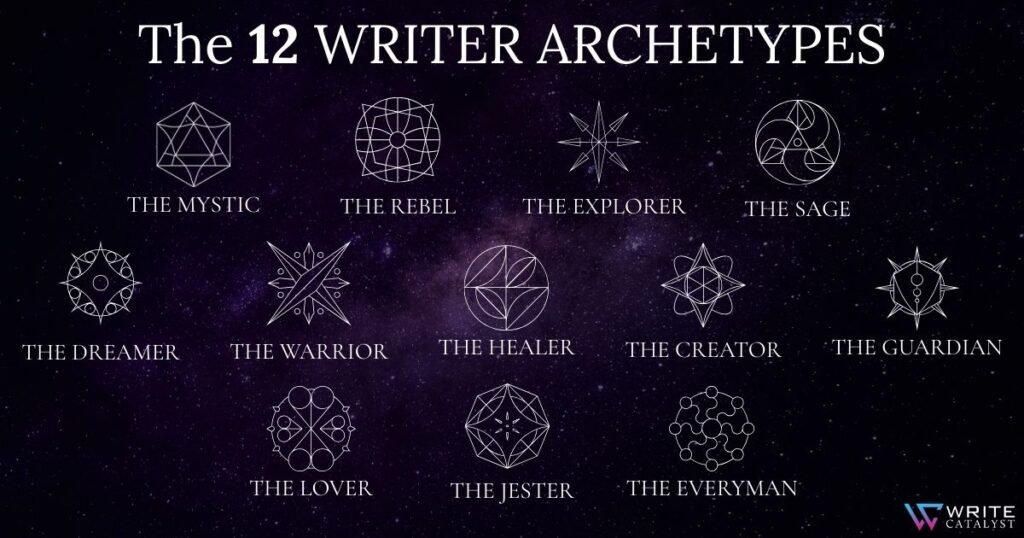
What are the 12 Writer Archetypes?
Here I outline the Write Catalyst™ 12 Writer Archetypes. Can you guess which one you are?
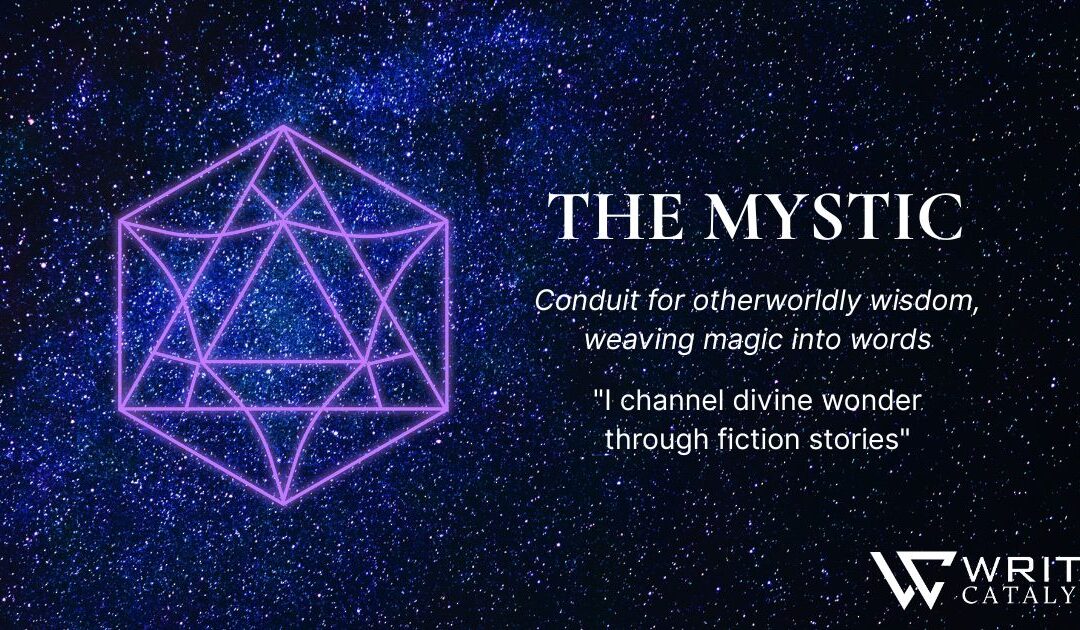
Conduit for otherworldly wisdom, weaving magic into words
Core Desire: To serve as a bridge between the spiritual and material worlds, translating cosmic revelations into accessible stories
Goal: To create transformative fiction that awakens readers to higher consciousness and universal truths
Greatest Fear: Losing connection to intuition; being dismissed as “too woo-woo”; spiritual transformation that bypasses authentic human experience
Strategy: Channels inspiration through meditation, dreams, and intuitive practices; weaves metaphysical concepts into compelling narratives
Weakness: May struggle with practical story structure; tendency to prioritize message over plot; can become ungrounded in ethereal concepts
Talent: Exceptional ability to access non-ordinary states of consciousness; writes with prophetic insight; creates atmosphere that feels truly otherworldly, yet familiar
2. The Rebel 🔥
Challenges conventions and shatters literary boundaries
Core Desire: To challenge unjust systems, expose hypocrisy, and inspire readers to question everything
Goal: To create fiction that disrupts complacency and ignites positive change in readers and society
Greatest Fear: Being silenced, censored, or co-opted by the very systems they critique; losing their edge or becoming part of the establishment
Strategy: Subverts genre expectations, challenges social norms through character choices, uses unconventional narrative structures
Weakness: May prioritize message over story craft; tendency toward preaching; can alienate readers with aggressive approach
Talent: Fearless exploration of taboo subjects; ability to spot societal blind spots; creates compelling anti-heroes and morally complex situations
3. The Explorer 🧭
Ventures into uncharted territories of human experience
Core Desire: To discover new worlds, experiences, and perspectives, then share these discoveries through compelling narratives
Goal: To create fiction that expands readers’ horizons and inspires them to seek their own adventures
Greatest Fear: Stagnation, repetition, or being trapped in familiar patterns; writing stories that feel predictable or confined
Strategy: Constantly seeks new experiences, researches exotic locations and cultures, experiments with different genres and perspectives
Weakness: May struggle with settling into consistent writing routines; tendency to abandon projects for new adventures; can lack depth in favor of breadth
Talent: Exceptional world-building abilities; authentic cultural and geographical details; natural gift for adventure pacing and discovery arcs
4. The Sage 📚
Keeper of wisdom, sharing profound insights through narratives
Core Desire: To understand life’s deeper meanings and share hard-earned wisdom through compelling storytelling
Goal: To create fiction that helps readers navigate life’s complexities with greater wisdom and understanding
Greatest Fear: Sharing false wisdom or leading readers astray; being seen as pretentious or out of touch with real human struggles
Strategy: Draws from extensive life experience, research, and study; creates characters who learn and grow through trials; weaves philosophical insights naturally into plot
Weakness: May become overly didactic; tendency to prioritize message over entertainment; can write characters who feel like mouthpieces rather than real people
Talent: Exceptional insight into human nature; ability to see patterns and connections; creates profound character development arcs
5. The Dreamer 🌙
Transforms dreams into vivid realities where anything is possible
Core Desire: To create magical worlds where impossible becomes possible and inspire readers to believe in wonder
Goal: To craft fiction that rekindles readers’ sense of wonder and reminds them that magic exists in unexpected places
Greatest Fear: Being forced to write only “realistic” stories; losing connection to imagination and wonder; being told their dreams are “just fantasies”
Strategy: Draws inspiration from actual dreams, daydreams, and flights of fancy; creates richly imagined worlds with their own internal logic
Weakness: May struggle with grounding fantastical elements in emotional reality; tendency to prioritize wonder over character development; can avoid conflict
Talent: Limitless imagination; ability to create genuine sense of wonder; exceptional at magical realism and fantasy elements
6. The Warrior ⚔️
Fights for justice and truth through stories
Core Desire: To fight injustice and defend the vulnerable through powerful storytelling that creates real-world change
Goal: To create fiction that inspires readers to stand up for what’s right and fight their own battles with courage
Greatest Fear: Writing stories that perpetuate harm or fail to help those who need it most; being a passive observer of injustice
Strategy: Creates protagonists who face overwhelming odds; addresses social issues through character struggles; writes with moral clarity and passionate conviction
Weakness: May create overly simplistic good vs. evil scenarios; tendency toward heavy-handed messaging; can struggle with moral ambiguity
Talent: Exceptional at creating inspiring heroes; natural gift for building tension and conflict; ability to motivate readers to action
7. The Healer 💚
Uses words to heal hearts and transform lives
Core Desire: To create fiction that helps readers heal from trauma, pain, and life’s wounds through the transformative power of narrative
Goal: To write stories that provide comfort, hope, and genuine healing for readers struggling with their own challenges
Greatest Fear: Inadvertently causing harm or triggering readers; failing to provide the healing that readers desperately need
Strategy: Draws from personal healing journey and understanding of trauma; creates characters who work through realistic healing processes; focuses on hope and resilience
Weakness: May avoid necessary conflict to prevent reader discomfort; tendency to rush healing processes; can become overly protective of characters and readers
Talent: Exceptional empathy and emotional intelligence; ability to portray trauma and healing authentically; creates safe emotional spaces through writing
8. The Creator 🎨
Builds entire worlds from the fabric of imagination
Core Desire: To bring entirely new worlds, creatures, and realities into existence through the sheer force of creative imagination
Goal: To create fiction that showcases the unlimited power of human creativity and inspires readers to become creators themselves
Greatest Fear: Creative stagnation or being told their imagination is “too much”; failing to fully realize the magnificent worlds they envision
Strategy: Approaches writing as world-building first; creates detailed mythologies, languages, and cultures; prioritizes originality and innovation
Weakness: May become so focused on world-building that character and plot suffer; tendency to over-complicate; can struggle with finishing projects
Talent: Unlimited creative imagination; exceptional ability to create consistent, believable fictional worlds; natural gift for innovation
9. The Guardian 🛡️
Preserves stories and brings lost voices to life
Core Desire: To preserve important stories, traditions, and cultural memories for future generations through faithful and respectful storytelling
Goal: To create fiction that honors the past while making historical and cultural stories accessible to contemporary readers
Greatest Fear: Important stories being lost forever; misrepresenting or dishonoring the people and cultures they write about; cultural appropriation
Strategy: Conducts thorough research; collaborates with cultural experts; focuses on authentic representation; writes with deep respect for source material
Weakness: May become overly cautious about taking creative liberties; tendency toward perfectionism; can struggle with balancing accuracy and entertainment
Talent: Exceptional research abilities; deep respect for cultural authenticity; ability to make historical periods come alive
10. The Lover 💕
The Romantic Soul who writes to explore the depths of passion and human connection
Core Desire: To experience and express the full spectrum of love, passion, and human connection through storytelling
Goal: To create stories that help readers fall in love—with characters, with life, with themselves, and with the transformative power of deep relationships
Greatest Fear: Writing stories that feel emotionally cold, disconnected, or fail to touch readers’ hearts; being seen as shallow or overly sentimental
Strategy: Crafts deeply emotional narratives with rich character development, focusing on relationships, internal conflicts, and the journey toward authentic love and connection
Weakness: May prioritize emotional impact over plot structure; tendency toward idealization; can become paralyzed when writing about pain or conflict in relationships
Talent: Exceptional ability to create believable, passionate relationships; writes dialogue that crackles with emotional authenticity; masterful at showing vulnerability and emotional growth
11. The Jester 🎭
The Wise Fool who reveals truth through humor and playful irreverence
Core Desire: To bring joy, laughter, and lightness to the world while revealing deeper truths through humor and wit
Goal: To create stories that entertain, delight, and help readers see life’s absurdities with compassion and wisdom rather than cynicism
Greatest Fear: Being seen as frivolous or meaningless; writing humor that falls flat or accidentally hurts rather than heals; losing their sense of play
Strategy: Uses humor, satire, wit, and playful language to explore serious themes; creates memorable characters through quirky details and unexpected situations
Weakness: May struggle with sustained dramatic tension; tendency to deflect from emotional depth with humor; fear of being taken seriously as an artist
Talent: Natural comedic timing in prose; ability to find humor in dark situations; creates memorable, quotable dialogue; skilled at using comedy to make difficult topics accessible
12. The Everyman 🤝
The Relatable Voice who writes stories for and about ordinary people
Core Desire: To create authentic, accessible stories that reflect the real experiences of everyday people and validate their struggles and triumphs
Goal: To write fiction that makes all readers feel seen, understood, and less alone in their human experience
Greatest Fear: Being pretentious or out of touch; writing stories that alienate ordinary readers; losing connection with real, everyday experiences
Strategy: Focuses on relatable characters facing universal challenges; writes in accessible language; draws from common human experiences and emotions
Weakness: May avoid taking creative risks or exploring experimental forms; tendency toward self-doubt about the worthiness of “ordinary” stories; fear of being too simple
Talent: Exceptional ability to capture authentic human experiences; creates deeply relatable characters; writes with clarity and emotional honesty that resonates broadly
Discover Your Writer Archetype
Ready to find out which archetype drives your creative vision?
For years, I’ve been obsessed with finding an answer to these questions: Why do writers get stuck and discouraged? Why do we lose inspiration? Why are we averse to putting ourselves out there and promoting our work?
Over the past five months, I’ve been developing something that has been swirling around in my mind since I started the Write Catalyst Mastermind—the writer archetype model.
The Journey to the Writer Archetype Model
I’ve always been fascinated with astrology, other realms of existence, and the occult, and have practiced reading rune stones since I was a teenager. As an adult, meditation has become the foundation of my life, along with accessing different brain states.
Early this year, I had the mind-blowing experience of attending the Maha Kumbh Mela in India, the largest spiritual gathering in the world, where I studied yoga and meditation with my Vedic meditation teacher, Jeff Kober, and master yogi, Sri M.
In tandem with my esoteric experimentation was a constant absorption of psychology and personal development content. In my day job as a digital marketer, I’ve worked for some of the top self improvement podcasters. Through this education, I began to realize that certain parts of me that needed to evolve if I was to ever enjoy a happy life, have fulfilling relationships, and live to my full creative potential.
An extreme crisis eventually forced me to seek therapy. During this dark time, I also increased my studies on psychology, mindset, and shadow work.
It wasn’t a hobby. It was survival, and it helped me to summon the strength to step out from the wreckage and start over in life. I found myself at a crossroads, where it was riskier to stay on my old path than to take a leap and invest in a passion project that had been put on the back burner for far too long.
All the stars aligned, so to speak. The tools and resources I needed to build this dream suddenly converged. And so here we are.
What I created is a system that combines what I’ve learned about psychology, consciousness, and the creative process into something practical for every fiction writer.
The Writer Archetype Model
The Write Catalyst Writer Archetype system is rooted in the Jungian tradition of archetypal psychology, informed by the broader archetype literature (such as the work of Carol S. Pearson), and independently developed for the specific context of fiction writing identity. In working closely with members of the Write Catalyst Mastermind (our virtual online writing group) I’ve become familiar with the gifts and blind spots each type of writer has.
As I worked to apply these personality types specifically to writing fiction, they seemed to unfurl on their own. They have shaped themselves so recognizably, a writer’s archetype can be determined just by reading their work. With some people, their archetype is revealed just by talking to them.
How Do You Find Your Writer Archetype?
I have created an introductory quiz to assess which type of writer archetype you are. It is a short quiz, but it’s tough if you overthink it. The best approach is to go with the first answer that grabs you, before your logical brain steers you into the answer you think you should pick instead of your innermost desire.
I’m a Mystic Writer—and once I understood my writer archetype, everything about my fiction career suddenly made sense.
Mystic Writer Traits
Mission: Conduit for otherworldly wisdom, weaving magic into words
Motto: “I channel divine wisdom through sacred stories”
Core Desire: To serve as a bridge between the spiritual and material worlds, translating cosmic revelations into accessible stories
Goal: To create transformative fiction that awakens readers to higher consciousness and universal truths
Greatest Fear: Losing connection to intuition; being dismissed as “too woo-woo”; spiritual transformation that bypasses authentic human experience
Strategy: Channels inspiration through meditation, dreams, and intuitive practices; weaves metaphysical and abstract ideas into compelling narratives
Weakness: May struggle with practical story structure; tendency to prioritize message over plot; can become ungrounded in ethereal concepts
Talent: Exceptional ability to access non-ordinary states of consciousness; writes with prophetic insight; creates atmosphere that feels truly otherworldly, yet familiar
If you’ve read my work (like Sick, Popsicle, and The Sculptor books), you might think the Mystic archetype doesn’t add up. I’m known for dark, provocative, disturbing fiction, not wispy tales of spiritual awakenings.
But if you revisit the beginning of this article, it’s no surprise I’m a Mystic writer. The intersection of psychology, neuroscience, and the divine nature of consciousness is my greatest interest. Between the lines of my stories are my characters’ quests to evolve into their best selves, and through painful transformation, live in their truths. They are full of psychological breakthroughs, spiritual revelations, and self-actualization.
Now that I know the deeper purpose of my fiction, I can use my Writer Archetype as a reference. Am I getting influenced by what I think I should be writing? What’s missing from my current WIP? Why don’t I feel good about promoting my new release?
Here’s what knowing your archetype can do for you:
Stop comparing yourself to writers with different archetypes (their process won’t work for you)
Identify your blind spots before they sabotage your work
Market authentically instead of using strategies that feel icky
Write with more confidence because you understand your unique creative voice
Choose projects that align with your deepest values