Earlier this year, I was at Authorcon VI in Williamsburg and fortunate enough to share a table with one of my dearest friends and most admired writers of all time, Joseph Sale. Near the end of the convention, I decided to make my rounds and pick up a few books from authors unknown to me. As I returned to the table with haul, I showed Joseph my choices.
“I hope they’re good,” I said.
“Easy to tell,” Joseph said. “Did they pass the first line test?”
“What’s that?”
“I can tell if a book is going to be for me by reading the first line.”
I stood there a bit dumbfounded. So simple, and yet, I had not thought to open the books and read a few lines before buying.
So I looked at the first lines of the novels I’d purchased. Luckily, they were pretty good.
But what if they hadn’t been? What if I had spent money on them, opened them up, and immediately wanted to put them down?
And, then I thought … what if someone put my novels through the first line test?
My books happened to be stacked in front of me on display. I picked up each one and read the first lines.
For the most part, I was underwhelmed. They weren’t bad, but would they compel a person to read the whole book from just one sentence?
I wasn’t going to lie to myself—the answer was no. If I were a stranger, and read the first lines from a list books, mine would not be the must-reads out of the bunch.
That being said, I had written those books before I had ever taken a writing class. I didn’t think strategically about the first page. I didn’t understand why agents and publishers only wanted a few pages, or a few chapters. How could they tell if a story was any good without reading the whole thing?
Then in 2023, I had the amazing experience of working for Gamut, a speculative fiction magazine. As part of the editing staff, I learned from the other side of the game how crucial a good opening was.
I had to read 150 short stories per month, every month. If the first line wasn’t great, I would give the first paragraph a chance. If the first paragraph didn’t get me, I might read the whole page. If at the end of page one, the main character is still waking up and eating breakfast, it was a no go.
This is what I learned from my colleagues—if I started reading a story and didn’t feel like continuing, it meant our magazine subscribers wouldn’t either, and that would be the end of the publication.
A good opening doesn’t necessarily have to start off with an explosive scene, but it does have to have a hook. It can be a deftly crafted one-liner, but it also can be an extremely engaging character, a concept I haven’t encountered before, a dilemma that I can relate to. Even a slow burn can build enough tension and suspense to make a story impossible to put down. A seemingly benign beginning with just the right amount of foreshadowing will tip us off that something unsavory is about to go down.
As an editor, there were times I read through stories with sluggish beginnings because of a hint that it might become something greater. And often, lackluster openers ended up being a great story. But that doesn’t matter if no one finishes it.
Many readers won’t wait to see if a book gets better. Agents and publishers simply can’t afford to invest the time and money. If an author fails to get the story off the ground effectively, it will more than likely have to be rejected.
You don’t have to let this happen to your stories.
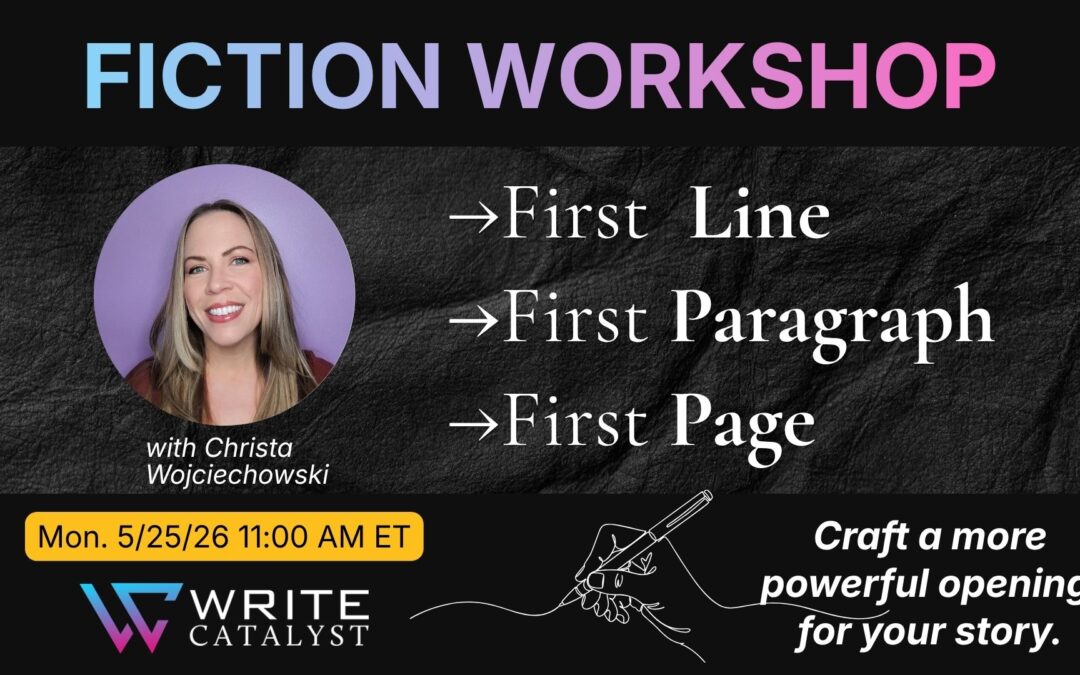
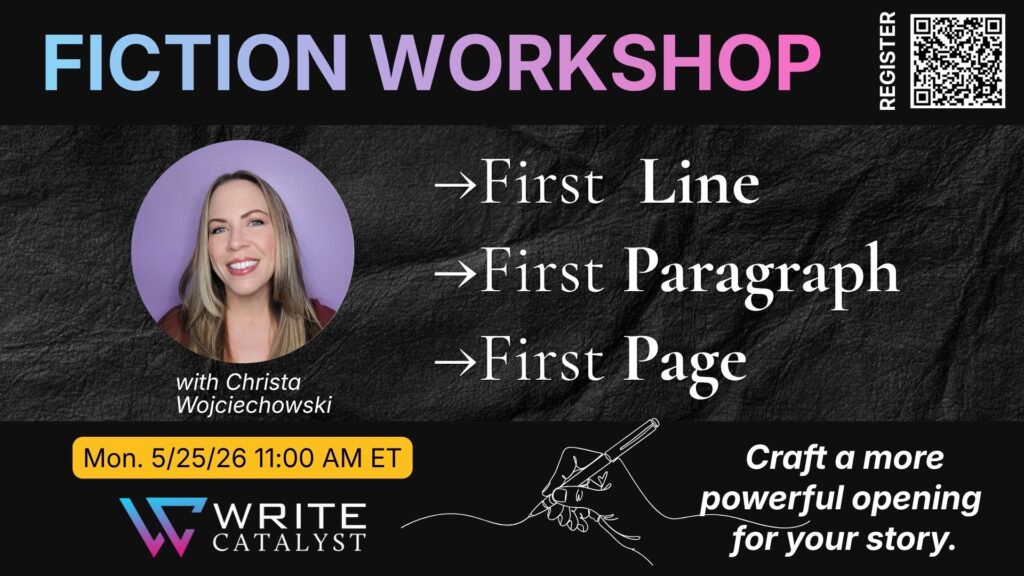
The First Line, First Paragraph, First Page Workshop
In the 1st Line, 1st Paragraph, 1st Page Workshop, each student will bring the first page of one story, novel, or work-in-progress to be shared and critiqued by the group. We will analyze the first line, then open up to the first paragraph, and expand into the first page to see where we are hooked as readers and what it is that makes us want to turn the page. We will discuss the context of the whole story to see what might improve the appeal of its beginning.
So look through your stories (can be published or unpublished). Let’s see where the reader takes the bait.
I’ve worked with many first-time self-published authors andall the writers I’ve met, I mean ALL, have stars in their eyes when they get ready to publish their first book.
Everyone has that feeling when they’ve created something special. Creativity is a divine force and we feel it’s destiny. The world has been waiting this book!
We imagine uploading our copy to Amazon and waking up in the morning with 10,000 downloads.
The truth is that, unless we have a large author platform and at least some basic PR skills, no one will even know we have a book out.
If we don’t know how to SEO our book for Amazon’s search engines, the likelihood of anyone stumbling across it are slim.
Do we have an eye-catching book cover?
Did we hire a professional editor?
Or did we just slap up our final draft and expect people to ignore any flaws because it’s The Book of Destiny?
I think every writer must to go through this.
It’s part of the process, and we have to try because, let’s face it, some writers do become overnight successes.
You can’t win the lottery if you don’t buy the ticket.
Still, I try to prepare my new author clients for the difficult road ahead. Even if your book is good, even if it’s extraordinary, you have to compete with the hundreds of thousands of other authors who have the exact same dream.
This is hard to explain to the first-time author. In my experience, they completely filter out my warnings and march ahead with a huge smile, ready for the confetti to fall and the champagne to pop.
At this point, I just wait and let them go through it. Once they realize it’s not likely they’ll become famous overnight, then they’re all ears and we can get to work.
So go ahead, choose your dream cast for the movie, visualize what you’re going to wear on Good Morning America, and practice your autograph.
Enjoy it.
Never stop dreaming about it.
Don’t give up!
Just keep in mind that it may not happen with your first book. Years later, you’ll probably be thankful it wasn’t your first book (I know that I don’t want the stuff I wrote years ago to ever surface).
Just trust that each challenge is a stepping-stone on your journey to becoming the writer you were meant to be.
Anyone can publish a book, but few authors are successful. Millions of titles come out each year. What can self-published authors do to compete in such a huge market?
Howard VanEs from letswritebooks.net talks about how to prepare and position our fiction books for self-publishing success on Amazon and other distributors (and even become a bestseller)!
Watch this presentation, plus get na free 30-minute private call with our guest speaker about how to market your book. Just start your free trial with the Writers’ Mastermind. JOIN HERE
Anyone can publish a book, but few authors are successful. According to this article on selfpublishingadvice.org, Worldometers says that 2.2 million titles were published globally in 2021. What can self-published authors do to compete in such a huge market?
Writing a fiction novel is an amazing achievement. Your future fans are waiting for your story, but your book needs to be strategically positioned and marketed to sell. However, many authors rush into self-publishing without proper research and planning.
Howard VanEs from letswritebooks.net talks about how to prepare and position our fiction books for self-publishing success on Amazon and other distributors (and even become a bestseller)!
Howard VanEs
Howard VanEs is President of Let’s Write Books, Inc., a company specializing in working with independent authors providing publishing and book marketing services. Howard has over thirty-five years of writing experience in every format imaginable, including writing thirty-three books of his own. Many of his books have been number one in their respective categories on Amazon.
Howard has also ghostwritten numerous books of others in a wide variety of genres ranging from non-fiction to books for kids to novels.
His experience includes the marketing and creation of information products: reports, eBooks, workbooks, DVD’s, audio programs, etc. Howard is also the former owner and creative director of an award-winning ad agency.
Here are some topics we’ll cover:
Is there a market for my book?
Getting titles and subtitles right
Descriptions (what’s the formula for a good description?)
Cover design
Interior design
Editing
Distribution and formats
Marketing
Bring your own questions for Howard
WHEN AND WHERE
Monday, May 23, 2022
11:30 AM EST – 04:30 LONDON
This will be a live Zoom Meeting. Recording will be available for replay.
*****
HOW TO ATTEND
Start your FREE 30-Day Trial with the Writers Mastermind to join the event. You will receive a link before the meeting.
How can you create characters your readers can’t stop thinking about?
We are excited to have writing coach, editor, and author,Joseph Sale, back to teach us a groundbreaking method that will help you create deep and believable characters. Instead of having to invent what happens next, your characters will act out naturally. This makes it easier to write incredibly compelling narratives that readers can’t put down!
What You’ll Learn
Why it’s important to determine the deeper psychology behind your characters’ behavior
Why you need to know the difference between objectives and motivations
Why Motivational Mapping is better than Myers-Briggs and other personality-based systems
How motivators create interesting conflict for stories
The importance of the lowest motivator and how to use it to create believable conflict between character
Self-knowledge will help you build better characters. Find out what your own motivators are!
Discover and Leverage The 9 Motivators of Your Characters
Candace Johnson is a professional freelance editor, writer, proofreader, and ghostwriter. She has worked with traditional publishers, self-published authors, agents, and independent book packagers in numerous fiction genres and nonfiction subjects. As an editorial specialist, she believes in maintaining an author’s unique voice while helping to polish every sentence to make it the best it can be.
INTRODUCTION
SELF-EDITING
Self-editing can be a daunting part of the publishing process, but it is a necessary skill set every writer must have.
WHEN TO DO YOUR SELF-EDIT?
Whether you’ve been self-editing your story/book along the way or have waited until you’ve typed “The End,” you will want to make sure your manuscript is as polished as you can possibly make it.
It’s important to emphasize that writers should not rely solely on self-editing before submitting or publishing. Getting the help of a professional editor is crucial to your success as an author.
However, if you know how to prepare your manuscript for your editor, you will save time, money, and frustration.
WHAT YOU’LL LEARN
In this masterclass, you will be guided through a thorough checklist of common issues in story structure, plot, characterization, grammar, sentence structure, punctuation, and formatting.
This will ensure that your self-editing process is efficient and that your manuscript is as tight and clean as can be before handing it off to your editor.
WHAT’S INCLUDED
6-Part Video Series
36-Page Self-Editing Workbook
Support, motivation, and advice in our private Facebook Group
Access to our live write-ins and all classes in the members area
Live Q&A with Candace Johnson from Change It Up Edit (replay available)
COST
FREE with your 30-Day Trial in the Writers’ Mastermind
Then $19 per month if you choose to stay (Sign up soon. Membership price goes up to $29 per month July 1st)
Last month, we enjoyed an insightful webinar with coach, podcaster, and author Christie Adams on Time Management for Writers. And in this post, I bring you a glimpse of the most valuable tips we learned from her.
At the Writers’ Mastermind Group, a new masterclass from experts and award-winning authors rolls out every month, bringing value and motivation to writers. So get ready to make the best of your time and energy as a writer.
A Writer’s Wellbeing
Although some of us have a primary job that helps us pay the bills, we consider writing our genuine work. We do all it takes to squeeze our writing into our busy schedule, even if it means writing late at night after finishing our house chores, helping our children with their studies, etc., or at dawn before the world wakes up.
However, we forget to nourish the most important part of this tapestry with all this hustle: ourselves, and we get lost among our responsibilities.
Firstly, we are so active with the many things we have to do that we take our physical and mental health for granted, expecting to be always resilient. But, if we don’t take care of ourselves and our precious minds, we can get burned out quickly and waste our creativity.
Secondly, our time is unproductive if we don’t organize our schedule by prioritizing our most urgent tasks. We must give our work a defined time because life is worth enjoying, and writing is a huge part of that.
Time Management Tips
Here are the 13 tips Christie Adams that we discussed in that mastermind session. I hope they will bring you the motivation to look after yourself as the creative jewel that you are and help you to manage your time more effectively.
Look after yourself. You guessed it. This is paramount since we are the main piece of this creative puzzle. Adopt healthy habits that will help you feel energized and strong enough to carry with your to-do list.
Don’t forget your fair amounts of veggies, proteins, fruits, and carbohydrates.
Exercise every day for a minimum of 20 minutes, or take short walks.
Listening to music while you take your daily showers will revitalize you.
Pay attention to your mental health as well, especially if you are passing through a difficult time. Instead of lamenting and questioning your luck, ask what this experience teaches you, what you need to see, and how you can solve this problem. When we shift our questions, we will see different perspectives of the same situation and choose the best solution.
Find the time when you can commit to writing. Perhaps you are a morning person, and you have no trouble waking up early when your mind is the most creative. Or you love writing at night with your coffee or a glass of wine while your muse visits you. Keep in mind that blogging, writing emails, and posting on social media are also writing work, so make space for these tasks in your schedule.
Prepare a schedule and stick to it. Organize each activity (like work, blogging, creative writing, household duties, family time, exercise) by giving each task a defined time. Start your day early and finish what’s most important first. Prioritizing tasks and being disciplined are paramount to productivity.
Set daily achievable goals. Choose three to four goals max so you can commit to them. Once you achieve your daily aims, you will feel empowered and motivated.
Close the door when you write. Set a “no disturb” time and let your friends and family know that. Don’t think of anything else other than writing when you enter this space of time. When others see how serious you are about your writing, they will respect it as well.
Create your personal writing space. Whether it is your study or a corner in your parlor or bedroom, prepare a particular environment that will inspire you every time you come to write.
Save the information you find which can help you with your writing. Write down any idea or tip you read or hear as a writing prompt. This will allow you to remember what to look for next time and the subjects you need to learn and consider.
Schedule time every week for studying and learning new writing skills or topics. Modern writers must know about marketing, networking, and personal branding. You can also learn by listening to podcasts and reading the latest literary articles that shed light on these subjects. It is never too late to learn new stuff.
Set boundaries for your sake! By organizing your time and setting a limited time for each activity, you avoid burning out. Otherwise, you will resent losing your creativity.
Don’t overwork. If you are a workaholic, set the alarm in your phone or a timer to take several breaks during your day. Give yourself time to stretch, exercise, go for a walk, or do some yoga. Even dancing can help you boost your metabolism, drop some stress, and strengthen your muscles, bones, and brain. It is also okay to give yourself a day off if you feel overwhelmed with work.
Celebrate every goal achieved. You deserve a reward after meeting a deadline. Mini presents to yourself are genuinely motivating, like a book you always wanted to buy, a new colorful notebook, a day out, favorite ice cream, etc. Enjoy because you deserve it!
Delegate some tasks and share responsibilities. The state of your mental and emotional health will allow you to write your best. Divide the house chores and other tasks between you and your partner or grown kids. If you have younger children, ask a relative to babysit them for a few hours each week. Outsource tasks that someone else can do.
Keep a positive environment around you. Don’t listen to negative news or gossip, stop watching violent or depressing stuff, and don’t get involved in other peoples’ drama. These are sources of an unhealthy mind and soul. Instead, listen to music or motivational podcasts. Spend time with people that inspire and encourage you. Read inspirational quotes. Do things that make you happy. Invest time in nourishing and enhancing your wellbeing.
These tips will help you improve your time management and your emotional, physical, and mental wellbeing. When you feel well, you will write well!
Connect with Cristia HJ
I write what I write to bring hope to the brokenhearted and ignite the passion for life in the sleeping soul. I want my readers to connect with my characters and free their imagination while the world is still spinning. Because no matter what we do or from where we come, we are all made of dreams and stardust.
Watch the replay of this mastermind session! Start Your Free-Trial at the Writers’ Mastermind Group and get access to our library of masterclasses and recordings.