I wrote with strict adherence to the five-act structure and classical ideals of storytelling. I always pushed myself towards greater and greater depths of emotional weight. I agonised over sentences, spent entire weekends devoted to single plot-points, refining and refining them so that they could land with maximum impact.
I know I am not alone in this. By definition, creativity is obsessive. To devote oneself to a single pursuit so completely is inherently compulsive. Sometimes, my obsessions even led to breakthroughs. But more often than not, they ended in burnout.
I have now come to realise that this was not a state of balance. A wise person once said, “Don’t let the perfect be the enemy of the good.” And that is precisely the trap into which I fell.
I wanted my work to be perfect. And while that never manifested as procrastination or avoidance of actually releasing my books, it certainly hampered my writing of them. What at first was one of the greatest pleasures of my life eventually became a torture-rack into which I would willingly insert myself, wringing every last ounce of craftsmanship out of my brain, until I was left nothing but a broken, hobbled husk.
What at first was one of the greatest pleasures of my life eventually became a torture-rack into which I would willingly insert myself.
This is the path so many authors take, but in the words of Tolkien, “Are you sure you do not suffer needlessly?” There is another path we might take.
Letting the goblin drive.
The irony of all this is that perfectionism does not just kill the joy of the creative act—it actually dampens your creativity.
If we look at some of the greatest works of literature—truly great works that have stood the test of time, and that are beloved of the people, not just the academics—we see a pattern. A pattern not of perfectionism but of imperfection.
J. R. R. Tolkien famously wrote, in a letter to W. H. Auden dated 1955:
“I met a lot of things on the way that astonished me. Tom Bombadil I knew already but I had never been to Bree. Strider sitting in the corner at the inn was a shock, and I had no more idea who he was than had Frodo. The Mines of Moria had been a mere name; and of Lothlorien no word had reached my mortal ears till I came there. Far away I knew there were the Horselords on the confines of an ancient kingdom of Men, but Fangorn Forest was an unforeseen adventure. I had never heard of the House of Eorl nor the Stewarts of Gondor. Most disquieting of all, Saruman had never been revealed to me, and I was as mystified as Frodo at Gandalf’s failure to appear on September 22.”
In other words, he was a “pantser”. The Lord of the Rings was not meticulously worked out—albeit, the languages and ancient lore of the setting might have been—but he was discovering it as a he went along.
You can tell from the wording of the letter that this process of discovery made the work exciting to write. And this excitement of course inevitably translates to the reader. Even after seventy years, reading The Lord of the Rings evokes this feeling of discovery, of newness, that around any corner there might be some new wonder to behold.
We see the same thing in a contemporary example.
In a 2024 interview with GrimDark magazine, Matt Dinniman—author of the smash blockbuster LitRPG series Dungeon Crawler Carl—was asked about how he created some of his zanier characters, including Samantha, a sex-doll head possessed by the spirit of a demon-god. His response was laconic and hilarious:
“I am what some people call a ‘pantser.’ That basically translates to ‘he makes it up as he goes along.’ I never planned on having a reanimated sex doll head a major, important character. But here we are.”
As if that is not enough, in an interview with Maude Garrett, he was asked about whether he knew how the whole DCC series ended. “Not a clue,” he responded, to laughter from the audience.
It would be easy to dismiss pantsing or discovery writing as mere laziness on the part of the writer, but I’ve come to believe it is a crucial part of the creative process. In allowing things to organically emerge, rather than pre-planning them, the creator delegates the work to their unconscious mind, rather than their conscious mind.
Our unconscious mind is scientifically proven to know more, perceive more, and understand more than our conscious minds by quite some margin. It is a pattern recognition machine that may even have access to a human-collective or at the very least DNA-derived intelligence. What our unconscious mind spontaneously produces from its chasmal depths will almost always be more interesting, more mythically charged, more idiosyncratic than anything we can rationally think up staring at a blank page.
On a personal level, I often find my unconscious mind is ahead of me in terms of plotting, meaning the more I trust my spontaneous decisions midway through writing a chapter, the more I see, ten chapters later, how I was actually planting a seed for something much bigger. At the time, I am “mystified,” to quote Tolkien, but in the long-run, it seems that my unconscious brain already grasped the whole tapestry.
The phrase “discovery writing” is very apt indeed, for it hints not that the writer is really creating the work, but that they are uncovering something that already existed, whole and complete. The process of uncovering always necessitates some loss of the original vision, just as archaeological digs cannot succeed in excavating tombs without some material damage. But in essence, to tell a story is not to really make something new, but to dig up a sculpture out of the sands of time.
Letting go of control is one of the hardest things to do in any situation, whether we’re talking about relationships, coping with loss or setbacks, or indeed the creative process. But without abdication to the higher power of the Muse, or our own unconscious intelligence, or however we want to say it, we are doing both our work and ourselves a disservice.
Last year, I made a conscious decision not to plan so meticulously. This was in part due to the fact I was taking on a 15-book series. You can plan a trilogy. You can plan a 5-book series. But you cannot plan 15 books. There has to be room for surprise, subversion, diversion, and general madness. Yes, there is an overarching theme, and a vague idea of the end-point, but the road to get there is by no means already paved. I am laying each stone as I go. And I have to say, I am not sure I can ever go back to planning; this process has revolutionised my writing.
I now sit down to write (three times a week) with an unprecedented sense of excitement. The joy of discovering something new. The thrill of what surprises might lie in store. It is like I am tuning into my favourite TV show of all time. I don’t know how it’s going to turn out—that is the joy.
And yes, of course, there is work to be done in the editing stage to smooth things out. Not every spontaneous decision works out for the best. Neither have I completely abandoned the five-act structure, which is an invaluable tool for noticing where your emotional beats might not be paying off. But the initial act has changed drastically. Where before it was measured, now it is bold and unmapped.
Another way to view this shift is play.
Tolkien was a playful man despite his immense erudition and learning and his position as an Oxford professor. Matt Dinniman, likewise, embodies that childlike energy. His books feel so energetic precisely because they are raw, and chaotic, and bristling with almost too many ideas.
There is a famous quote attributed to Ursula Le Guin, although she subsequently amended the wording: “The creative adult is the child who survived”. I personally think she was bang on the first time. Children continuously create, continuously play. It is their natural state. Ideas are fecund and spontaneous. Nothing bores them more than some meticulously worked out game with lots of rules. The best games and stories emerge in the moment, co-created, sometimes dazzlingly stupid, but always entertaining and memorable. If we want to write works that speak to the heart, and if we want to fall in love again with our own creativity, then we must learn to play again.
If we want to write works that speak to the heart, and if we want to fall in love again with our own creativity, then we must learn to play again.
So next time you sit down, say to hell with structure, and to hell with genre. Take your hands off the wheel for a moment and let the wild goblin of your inner child drive. You might be surprised, not only by how much fun you have, but also by how good the end result is.
Joseph Sale
Joseph is the author of more than 30 books, including The Book of Thrice Dead, Virtue’s End, Dark Hilarity, and The Claw of Craving. He is drawn to the baroque, the spiritual, and the mythic like a moth to flame.
He lives in the south of England with his wonderful family, where he obsesses over table-top RPGs, trading card games, book bindery, esoteric Christianity, and anime.
…I wrote an anticipatory piece about a little video-game called No Man’s Sky. Back then—ten years ago, eek!—No Man’s Sky seemed more of a vision of the future of video-games than something concrete. We were all enraptured by the idea of infinite exploration, a living universe populated by the unbridled creativity of algorithmic chance. And then came the fall—the disastrous release of No Man’s Sky that garnered it such negative reviews and perception.
It would be pointless for me to write about this, or indeed No Man’s Sky’s epic recovery and transformation into potentially the most beloved sci-fi exploration game of all time. Many other writers and journalists have covered this topic in extensive and sometimes hands-on detail with the developers, so there is very little I can add.
What I do want to share is how, ten years later, No Man’s Sky still manages to feel fresh. Slipping back into the game feels like walking back into a bright dream. There is an energy about it. A ferocious clarity of vision. And I think the core of this is something that we writers, artists, and creatives can learn from.
There are two intertwined elements that make No Man’s Sky such an immersive and, frankly, addictive experience.
The Glorious Vicissitudes of Chance
The first I have alluded to already: chance. The randomness of the worlds creates a feeling of personal discovery that is intoxicating. This is something we writers, in particular, often forget. The visual artist intuitively understands that the accident of a brushstroke, or a combination of colour, can create revelation. Glass-makers literally do not know how their final composition will appear, for in the firing process colours change, structures shift, and the whole warp and weft of the thing transforms. There is an element of randomness, of chaos, inherent in the art-form, and a part of its joy.
Rolling the Die
We writers, by contrast, tend to believe in working everything out logically. Yes, we receive surprises when our characters misbehave, but rarely do we leave anything to chance.
But sometimes, chance is what a story needs. Sometimes, rolling a die to see whether a character lives or dies, or where a party of explorers end up next, is exactly what a story needs to take some unprecedented leap into the unknown. I have used this technique, particularly with my GameLit / LitRPG series Levi’s Game, where certain locations and creations were procedurally generated.
We receive surprises when our characters misbehave, but rarely do we leave anything to chance.
Joseph Sale
I did this because the locations actually are procedural in the story, so it felt fitting to reflect this in the creative process and challenge myself—and my characters—with an unexpected outcome. Incidentally, if you’re curious about how this turned out, the first book in the series has recently been released on audiobook. Check it out here.
But procedural generation can be applied in any number of ways. Once you start thinking more like a Dungeon Master and less like a writer, you begin to realise that storytelling is pure play, and randomness becomes not your enemy, but a way of accessing previously inaccessible powers of surprise.
The Depth of Mystery
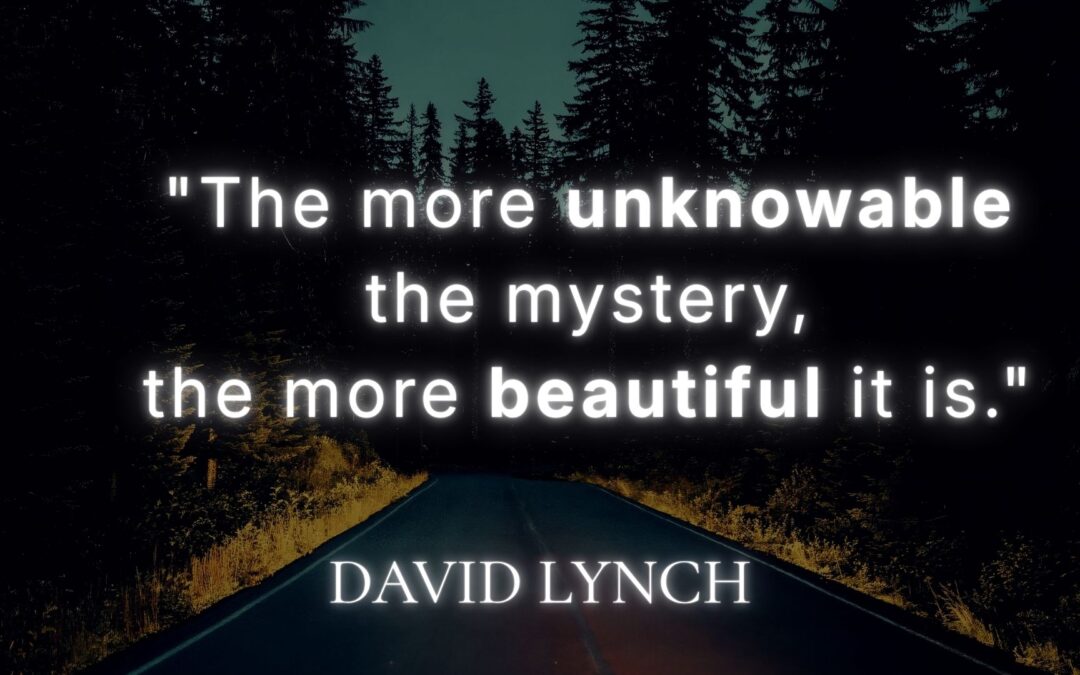
The great David Lynch once said, “The more unknowable the mystery, the more beautiful it is.” And he is absolutely right. Human beings are called by the siren-song of mystery. We yearn to know the unknowable. Nothing intrigues us more than a riddle that seemingly has no answer. It is why Mystery fiction will remain evergreen.
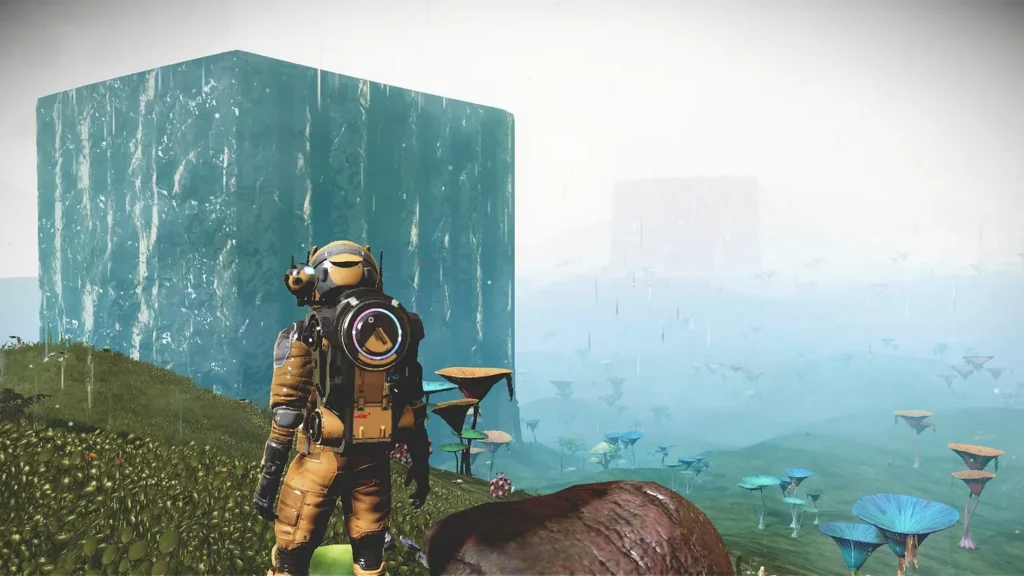
Mystery is the second—and far less talked about—element that No Man’s Sky gets right. We awaken on a strange world with no memory of who we once were, only the stark reality of a destroyed ship, limited supplies, and the will to survive. However, it seems there is some kind of benevolent force in the universe, for we are given clues in the form of cryptic messages, guiding us back to the true path and towards some ultimate destiny.
We know so little, at the start of our journey. And the more we find out, the less it seems we know. There is a species called the Gek who leave ancient standing stones, imparting knowledge of their language to explorers. Why? There are robotic sentinels patrolling some planets and protecting their bio-diversity. Why? Were they left behind by some colossal civilisation now undone? Every answer prompts a new question. But most mysterious of all is the question of our own nature of why we are called to strive, survive, and reach the stars. It is an unanswerable mystery. The heart of the human condition itself. And somehow, impossibly, No Man’s Sky captures this.
Stepping Into the Unknown
As writers, we tend to want to explain our reasoning, to provide motivations for our characters, to ensure our plots hang together logically. I am not advocating we abandon this entirely. But what No Man’s Sky—and indeed the great masters of literature—teach us is that mystery must prevail. Without mystery, there is nothing to compel the human imagination. The unknown is not to be feared; it is our natural habitat. If we are to inspire and ensoul the world, we must go forth into that vast dark without fear, without caution, and fully embrace the divine mystery of the universe, for it is only in embracing the mystery that we can finally embrace ourselves.
Joseph Sale
Joseph is the author of more than 30 books, including The Book of Thrice Dead, Virtue’s End, Dark Hilarity, and The Claw of Craving. He is drawn to the baroque, the spiritual, and the mythic like a moth to flame.
He lives in the south of England with his wonderful family, where he obsesses over table-top RPGs, trading card games, book bindery, esoteric Christianity, and anime.
The 2006 Christopher Nolan film The Prestige, based on the novel by Christopher Priest, has a lot to tell us about how to write compelling stories.
Though there are many things to learn from the way it presents us with a story of two rival magicians, perhaps the most important learning point is the concept embodied in the title itself.
For those who don’t know, “The Prestige” is the third act of any magician’s trick, in which what they previously destroyed, or made to disappear, returns – to the delight and adulation of the crowd. As Michael Caine’s character, Cutter, observes, “It’s not enough to make something disappear. You have to bring it back.”
“It’s not enough to make something disappear. You have to bring it back.”
Our mythologies and religions are full to bursting with gods and human beings who return from death. From the wounded King Arthur, who will one day come again from beyond the veils of Avalon, to the crucified Jesus who lay three days dead in the tomb yet rose, to the dismembered god Osiris, who was reforged from scattered body parts by his wife, Isis, the list goes on and on.
The recurrence of this image throughout history and across innumerable cultures is evidence that the idea of a “prestige” is hardwired into our deepest psyche. We yearn for what was lost to return to us. The concept has filtered through into modern-day popular culture too: The Return of the King, The Return of the Jedi, even Superman Returns. There is a sense that true heroes, true saviours, come back to us when we need them the most.
Of course, sometimes this deep human need is exploited for quick cash grabs, as in the “endless sequel” effect in which our favourite characters just keep coming back time and time again. In these instances, often it is the case that the story begins to lose all meaning, because there are no real stakes; the heroes are invulnerable, and even if they seem to die, they always come back without a scratch.
However, when this mythic principle is handled with sincerity and integrity, it can produce some of the most startling and moving moments in cinema, prose, poetry, indeed, any medium. The initial disappearance of the figure who is going to return need not even be via death; it can be just that: a disappearance.
Consider how Gandalf leaving Helm’s Deep in the second Lord of the Rings movie shapes the narrative. He leaves the story for some time, long enough we almost forget where he’s gone off to, but at the critical moment, when all hope seems lost, he returns to save the day (bringing with him the “lost” Rohirrim) in a sublime eucatastrophe.
I often hear writers talking about how they have “written themselves into a corner” by disposing of an artefact, character, or even a place. Many of these issues can be fixed by building the concept of a “prestige” into your fiction from the get go.
And on that subject, I always admire a writer who has the guts to kill their characters, and sometimes a character simply has to die, and die forever, for a story to end, for it to have any meaning. But whilst the bitter fruit of death, or loss, is sometimes what is needed to round out a tale, the far sweeter fruit of return also has its place. This is more true of horror, not less.
In Nolan’s 2010 film Inception, he remarked that “Positive emotion trumps negative every time”, and I also happen to agree with him on this front. A sad death at the end of a book can be devastating. But a “prestige,” a triumphant return, is infinitely more powerful; it shakes to the bone. Death, after all, is merely existential.
A return is transcendental.
In fact, it’s magic.
A sad death at the end of a book can be devastating. But a “prestige”, a triumphant return, is infinitely more powerful; it shakes to the bone.
Joseph Sale
Joseph is the author of more than 30 books, including The Book of Thrice Dead, Virtue’s End, Dark Hilarity, and The Claw of Craving. He is drawn to the baroque, the spiritual, and the mythic like a moth to flame.
He lives in the south of England with his wonderful family, where he obsesses over table-top RPGs, trading card games, book bindery, esoteric Christianity, and anime.
Unlock the Magical Creator Within – A Workshop for Fiction Writers with Joseph Sale
Unlock The Magical Creator Within is a workshop designed to help unleash your full creative potential using a mixture of psychological, spiritual, and most importantly practical techniques.
In this session you will explore the history of the “Muse”, the divine source of inspiration, and the first principles of establishing contact with the Muse; going back to early childhood experiences of beauty and how we can harness this in the now; practical exercises from yogic mudras (hand positions) to breathing techniques that centre the mind and open the channels of creative thought; and much much more.
Unlock The Magical Creator Within is your ticket to writing your best-ever story, one that is not only entertaining but also healing.
Your instructor: Joseph Sale
Joseph Sale is an editor and writing coach who’s published more than 30 books, including the acclaimed novel Dark Hilarity, the epic poem Virtue’s End, as well as ghost-written best-selling autobiographies and non-fiction books. As an editor, his clients have been nominated for the Bram Stoker and Splatterpunk Awards, been finalists in the National Indie Excellence and Eric Hoffer Awards, and even submitted to the Pulitzers.
Now, Joseph Sale is on a quest to manifest the beautiful and divine in the world, and wants to show other creators, editors, and writers how to do just that. This workshop is based on his new release, THE DIVINE: Unlocking the magical creator within.
Workshop Includes:
Free Paperback or eBook copy of The Divine: Unlocking the Magical Creator Within(Paperback options depend on Amazon shipping options to participant’s location. Shipping is free.)
A seat at the live Zoom Class on Monday, October 3rd, 2022
Unlimited access to replay and workshop follow-up notes
Access to instructor for private questions
Workshop Outline:
0. First Principle of the Muse
An overview of what the Muse is and why we need the Muse.
1. Early Experiences of Beauty
Why is Beauty important how does it influence us?
2. Invoking The Muse
Practical exercises to draw down the dew of inspiration.
3. The Cave of Ideas & Wonder
Journey into the hidden depths of your subconscious and find your cave of ideas and wonder.
4. The Shadow Self
Learn how to harness your Shadow Self to produce greater art.
5. Becoming Magical
Changing your creative practice will change you.
Details
Zoom link will be sent via email on day of event
Access to replays will be sent after the event
Books will be sent out upon registration. An email will be sent within 24 hours to confirm shipping details. (Shipping is free)
If paperback book cannot be delivered to participant within one week of the class, the eBook format will be sent.
How can you create characters your readers can’t stop thinking about?
We are excited to have writing coach, editor, and author,Joseph Sale, back to teach us a groundbreaking method that will help you create deep and believable characters. Instead of having to invent what happens next, your characters will act out naturally. This makes it easier to write incredibly compelling narratives that readers can’t put down!
What You’ll Learn
Why it’s important to determine the deeper psychology behind your characters’ behavior
Why you need to know the difference between objectives and motivations
Why Motivational Mapping is better than Myers-Briggs and other personality-based systems
How motivators create interesting conflict for stories
The importance of the lowest motivator and how to use it to create believable conflict between character
Self-knowledge will help you build better characters. Find out what your own motivators are!
Discover and Leverage The 9 Motivators of Your Characters