Brenda Wilkins reads an excerpt from Universal Justice, a thriller with a scifi twist.
Wrongly accused of murder and rape, Brian has been sitting on death row for three years. Once known as the black Walter Cronkite, he now recalls how his nightmare began.
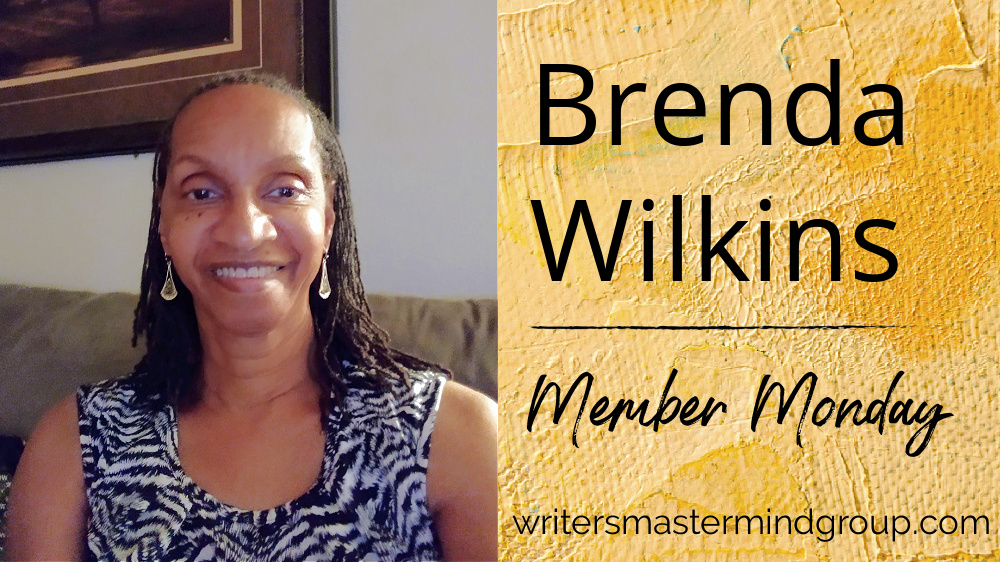
We have an amazing group of writers in the Writers’ Mastermind, and we love to find out more about them. Today, we talk to Brenda Wilkins, an aspiring lawyer turned writer who is now working on her first novel called Universal Justice.
Fiction allows the reader to see the world through the eyes of the main character with whom they can identify without being judgmental.
Brenda Wilkins
1. Tell us a little bit about yourself. Where are you from? Where are you now? What has your life been like?
I was born, Brenda Ann Roberson, in Savannah, GA in January of 1959. In 1960 my mother moved us to Brooklyn, NY where we lived until I was fourteen years old. Then my mother had to move back to her hometown of Homerville, GA in order to be closer to her family. I was not a fan of small town life so I promised myself that I would be making my exit as soon as I graduated high school.
I attended college at Mercer University in Macon, GA from 1977-1981, earning a bachelor’s degree in English with a minor in journalism. I’ve always had a pioneering spirit, so after graduating from college, I relocated to Fort Worth, TX where I currently reside.
I met Michael Wilkins in 1986 and we married in 1987. We have two sons who now each have one daughter…I love being Granny!
I am now retired but my past employments have mostly been in the area of clerk, Secretary and Administrative Assistant. I never thought of myself as a writer. I had always wanted to be a lawyer. But after college, I had no money for further education. I thought that I could work a couple of years and save money to attend law school. Well, a couple of years turned into a few years, then marriage, then kids, and so on, and so on.
When I was pregnant with my second child, I came up with an idea for the “perfect novel”. That’s when I knew that I wanted to be a writer. I read and studied everything that I could get my hands on about writing. The perfect novel that I was working on, I put it down after a few chapters with the intention of finishing it later. I found it many years later and read over what I’d written…it was awful! I’ve come a long way since then-thank goodness!
2. What kind of stories do you like to write?
I’m a fiction writer, for sure. Presently, I can’t say that my writing consists of any particular genre. I consider myself to be a character writer. I’m all about character development and progression. I like to know who the characters are and what makes them tick. I give them birthdays from which I choose traits based on their astrological chart. I know where they were born and their personal and family history. My stories are about how certain situations affect or change the characters involved.
3. What sets you apart from other writers in your space?
I am one who can see both sides of any argument. I have learned and have come to believe that there is no right or wrong when it comes to opinions or beliefs. It’s all about point of view. I have mine and you have yours. As a writer, it is not my job, or my desire, to change someone else’s opinion or convince them that what they believe in is wrong. My desire is to create a situation that will allow them to see, understand, and maybe even respect the viewpoint from the other side.
4. What drives your writing? What do you mean to accomplish with your stories?
I have read stories of fiction that have been written in such a way as to show an otherwise obscure situation or concept in a different light; whereby the obscurity dissipates and the situation/concept is now crystal clear. I call it an “aha! moment”. I want to write stories that will give someone that experience.
5. Who are your favorite writers and books? What are your other creative influences?
I can’t really say I have a favorite writer, although I do like John Grisham novels. I am a fan of the classics. I’ve read A Tale of Two Cities twice as well as Wuthering Heights. Those are two of the greatest love stories you could imagine. I really enjoy Arthur Conan Doyle’s Sherlock Holmes mysteries. I also love period pieces, especially from the 1800’s and early 1900’s. I’m also a fan of poetry. As a child, my mother read to us a lot. She had a book called “The Best Loved Poems of the American People”. I still have that book. The spine is taped together and the pages are faded but it’s still one of my favorite books. It includes the original version of, A Visit From St. Nicholas, which we now refer to as, “Twas the Night Before Christmas”.
6. Tell us about your writing space. When and where do you write? Do you work in silence? Or music?
When my sons moved away from home, we turned one of our three bedrooms into an office. This is my main work space. However, I sometimes work from the dining room table when I’m not working on the computer and I need space to work with lots of material. When I am contemplating a story idea I will sometimes grab a pen and pad and sit out on my patio. Nature is very inspiring for me. I do tend to work better when it’s quiet if I am in the process of writing, however, the creative process is different. Whether it’s an idea for a new story or a story that I am currently working on, ideas tend to come to me when I am busy. It can be driving, walking, making the bed, or folding clothes. If I can, I will stop and write them down.
7. What is your favorite thing to do when you are not writing?
I have a few television shows that I like to watch. I get some good story ideas from watching television. I also have a word game, a puzzle game, a coloring app, and Sudoku on my phone. It gives me a break while still allowing me to keep my brain active. But my favorite pastime is to sit quietly on my patio with a cup of tea and watch the birds and squirrels. It’s really relaxing.
8. Who or what is your current artistic muse?
I would have to say that life is my muse. It is when I am contemplating or reflecting on life that I get my most profound story ideas.
9. Why do you think it’s important to write fiction?
People can see flaws in other people that they can’t see in themselves. Fiction allows the reader to see the world through the eyes of the main character with whom they can identify without being judgmental. Once they recognize these flaws as being part of who they are, perhaps they can then be less judgmental and more understanding of the flaws in others.
Fiction allows us to experience what could be, and to live out the “what if” without having to personally experience those events.
10. Who would be the best writer, alive or dead, to tell the story of your life?
Me. No amount of research or interviews can get inside an individual’s true nature and motivation other than to hear it from them personally. You might think that extensive interviews can accomplish this, and in some cases, it can. But if I am to tell the story of my life, and have you understand the motivations behind my actions: and why I have done the things that I have done, it must be done in my own voice.
11. How had being in the Writers’ Mastermind helped you? What’s the best part of being with a writing group?
There is nothing more exhilarating than being in the company of people who get you! The Writers’ Mastermind is a community of writers from around the world representing nearly every segment of humanity. People of different nationalities, cultures, spiritual/religious beliefs, races, genders and orientations, who understand the writer’s life and the writer’s mind all coming together to encourage and support one another. It helps me to know that others are going through the same things that I am going through. Their advice and collective knowledge is invaluable. The best part of being with a writing group is that it serves as a sounding board. You can bounce ideas off one another and get honest and helpful feedback as well as present your work-in-progress to others without fear of being laughed out of the room!
12. What are you working on right now?
I am currently working on a novel entitled, Universal Justice. It involves an unjust execution and the Universe stepping in to balance the scales of Justice, while the main characters race to right this wrong by finding the true killer and clearing the name of the man wrongly executed. Once my works gets out there, you will find that most of my stories deal with the metaphysical, time travel, past lives, life after life and even a parallel Universe or two. I have several story ideas in the works. One of my biggest challenges is trying to stay focused on one story at a time in order to complete one novel. My second biggest challenge is to keep my stories from getting out of control. My stories are complete inside my head. I know my characters and their backgrounds. But, the more I write, the more ideas I come up with so I find myself having to reign the story in just to stay on task. I love coming up with story ideas!
Thanks to Brenda Wilkins for sharing her writing insights with us.We’ll keep you posted on Universal Justice!
Do you save a new document every time you do a major revision?
Or do you write over the same draft?
I have learned the hard way that, even with minor changes, it’s a huge mistake to rewrite and edit over the same document.
I’ll give you an example with my current WIP, a short story …
In the middle of revisions, I decided to move elements around. I cut a scene, planning to paste it in another area, but I got distracted editing other mistakes I caught along the way. I cut more sentences, never having pasted the first scene in its new spot (or at least a temporary spot).
I saved over the draft without realizing what I had done. When I looked for the scene later, it was long lost, and I didn’t have the original draft to get it back.
This is just one horror story about why writers need to keep all drafts and ideas, no matter how useless they seem. Here is an article from Self-Publishing News that outlines all the reasons you should keep everything you write and never delete your drafts.
***
Keep Everything You Write And Never Delete Your Drafts
Should you keep everything you write? Yes, definitely.
Words have value, even if you might not think so at the time.
If you are a new, young writer, make it a habit to save and store all your writing.
It doesn’t matter if it’s a half-finished poem, an introduction for an essay, or a failed attempt at a short story.
Why you should keep everything you write
Every writer has a file of unpublished work, often containing many more words than those published.
But just because writing is unpublished doesn’t mean it has no value.
Unfinished pieces of writing can sometimes become a source of ideas for you later.
Two verses of an incomplete poem might give you the inspiration for a short story or even a novel.
I often return to my writing archive for ideas or notes.
It saved me a lot of work recently. My publisher is producing an audiobook version of one of my earlier novels.
But the story involves quite a few characters, as it is set in different decades and countries.
Because of this, my publisher asked for a list of characters with a brief description to assist the narrator.
Within a few minutes, I found the list and accompanying notes from over ten years ago in my writing archive. It saved me days of work.
That’s one simple example of the value of keeping everything you write.
Never hit delete – hit save
You can recycle most rubbish. It applies aptly to writing.
You might think that what you write today is garbage. But it has value, and one day, you never know.
Some writers keep their work in notebooks, files, or journals. But most writers today store their work on a computer or online.
Storage space is of no concern to a writer. A full manuscript for a novel takes up far less space than one photo on your phone.
You don’t need to be pedantic like me. But I have all my writing in date-ordered files, with sub-folders for every project.
Yes, I keep everything and never trash a word.
Nothing you write is a waste
Every word you write counts.
Maybe not today. But when you need an idea or think you have writer’s block, your saved words can help you.
Reading some of your incomplete pieces of writing can give you a quick kickstart. You might even stumble upon a piece worth salvaging and start rewriting it again.
Dan Markowski is a fantasy and horror writer/reader and host of A Happy Moment Podcast. Today, he reads an excerpt from his dark fantasy tale, The Princess and the Spider.
How far would a caring mother go for the love of her husband and child? Perhaps too far? Today, Charlotta Amato reads her unsettling story, Glass Eyes, from her home in Norway.
Unlock the Magical Creator Within – A Workshop for Fiction Writers with Joseph Sale
Unlock The Magical Creator Within is a workshop designed to help unleash your full creative potential using a mixture of psychological, spiritual, and most importantly practical techniques.
In this session you will explore the history of the “Muse”, the divine source of inspiration, and the first principles of establishing contact with the Muse; going back to early childhood experiences of beauty and how we can harness this in the now; practical exercises from yogic mudras (hand positions) to breathing techniques that centre the mind and open the channels of creative thought; and much much more.
Unlock The Magical Creator Within is your ticket to writing your best-ever story, one that is not only entertaining but also healing.
Your instructor: Joseph Sale
Joseph Sale is an editor and writing coach who’s published more than 30 books, including the acclaimed novel Dark Hilarity, the epic poem Virtue’s End, as well as ghost-written best-selling autobiographies and non-fiction books. As an editor, his clients have been nominated for the Bram Stoker and Splatterpunk Awards, been finalists in the National Indie Excellence and Eric Hoffer Awards, and even submitted to the Pulitzers.
Now, Joseph Sale is on a quest to manifest the beautiful and divine in the world, and wants to show other creators, editors, and writers how to do just that. This workshop is based on his new release, THE DIVINE: Unlocking the magical creator within.
Workshop Includes:
Free Paperback or eBook copy of The Divine: Unlocking the Magical Creator Within(Paperback options depend on Amazon shipping options to participant’s location. Shipping is free.)
A seat at the live Zoom Class on Monday, October 3rd, 2022
Unlimited access to replay and workshop follow-up notes
Access to instructor for private questions
Workshop Outline:
0. First Principle of the Muse
An overview of what the Muse is and why we need the Muse.
1. Early Experiences of Beauty
Why is Beauty important how does it influence us?
2. Invoking The Muse
Practical exercises to draw down the dew of inspiration.
3. The Cave of Ideas & Wonder
Journey into the hidden depths of your subconscious and find your cave of ideas and wonder.
4. The Shadow Self
Learn how to harness your Shadow Self to produce greater art.
5. Becoming Magical
Changing your creative practice will change you.
Details
Zoom link will be sent via email on day of event
Access to replays will be sent after the event
Books will be sent out upon registration. An email will be sent within 24 hours to confirm shipping details. (Shipping is free)
If paperback book cannot be delivered to participant within one week of the class, the eBook format will be sent.