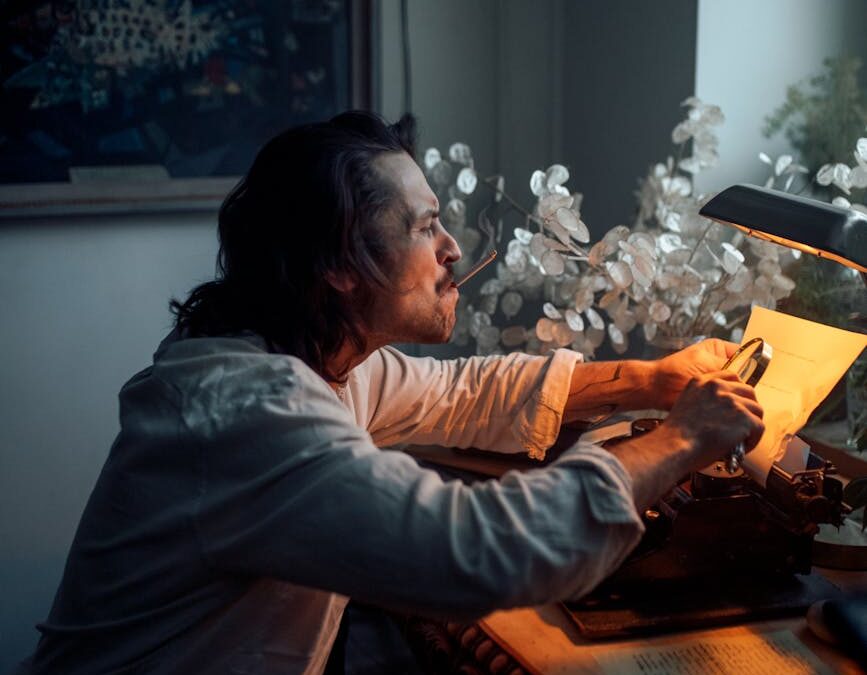
Writers are notorious for suffering from Imposter Syndrome, writers’ block, and chronic procrastination. I, myself, struggle with these neuroses every day. They never completely go away, but I have discovered how to become a more confident writer.
I started writing ten years ago, having virtually no idea what I was doing. Although I managed to finish a few novels and novellas, I knew there were issues with my writing. The problem was, I couldn’t tell what they were.
In 2019, I finally decided to take my writing seriously and signed up for my first writing class—Contemporary Dark Fiction with Richard Thomas. He’s the award-winning author of three novels, three short story collections, two novellas, and over 150 short stories.
Required reading for the class was four novels, sixteen articles, and sixteen short stories. The work included weekly writing assignments, four complete short stories (one per month), four analyses of the assigned novels, and critiques of the eight other student’s monthly stories. We also met once a week on video conference to discuss the week’s material.
I do not have a college degree. What little I knew about fiction I learned from reading my favorite authors and Google. To say this class was intimidating was an understatement!
But I dove into it and was amazed at my output. There was something about putting up my hard-earned money and being forced to deadlines that made me push myself beyond my perceived limits. The analysis of the stories, the exploration of what other writers were doing, and the giving and receiving of feedback from the students, especially from Richard Thomas himself, advanced me more in four months than all I’d learned on my own the seven years prior. I went into that class a bumbling novice and came out the other side feeling like, hey, I think I can do this!
Since working with Richard Thomas, I have fast-tracked my writing career and have accumulated a body of quality work. Four of the short stories I wrote in his classes have been accepted by notable anthologies. Now that I’ve earned professional rates for my stories, I was able to become an active member of the Horror Writers Association.
My writing style has gelled. I know what I can do, how I want to do it, and where my work belongs. I no longer look at other authors getting acceptances and being published, wondering what the secret is. When I think about how lost and unsure I was three years ago, I could kick myself for not investing in a serious writing class sooner. I’m now in my third class with Richard Thomas, his Advanced Creative Writing Workshop.
So, my advice to any new writers out there, or any writers who’ve been struggling for a long time, is to find a writing group, course, critique circle, or workshop. Do not keep doing the same things over and over again, wondering why you’re not getting anywhere.
Knowledge equals confidence. The more you know, the better you can wield your creative powers. Give your writing the chance it deserves. Keep learning, keep growing.
The beautiful thing about writing fiction is you’ll always be evolving, but it’s up to you to invest in yourself!
Sara Halabi reads from her short story, The Eyes of the Tower, a dark and creepy fairy tale that will leave you in a state of morbid dread. Sara is a storyteller and freelance writer who was born in Venezuela and lives in Lebanon.
Hello all! I hope you are having a productive creative week.
If not, I hope you are living to the fullest and taking notes until you get back to your WIP.
The Writing Cooperative published an article of mine last week. It is based on an essay I wrote for the virtual release event for Joseph Sale’s Dark Hilarity.
The transformational power of story fuels my writing as well as is the foundation for the Writers’ Mastermind.
This is for all the fiction writers out there.
You’re not mere entertainers.
You shape reality.
The Stories We Tell Ourselves
How fiction shapes reality for both writer and reader
If you tell some people you’re a fiction writer, they think you live in the land of make believe. You’re a dreamer, an entertainer at best. Yes, we fiction writers like to dream, both while we’re awake and asleep. Sure, we like to indulge in our fantasies. And of course, we like to escape. However, there is a much greater part of it that many don’t fully appreciate.
Fiction Teaches Us
Storytelling is humanity’s way of learning, or recording history, of remembering the great ones. It is our way to warn, to educate, and to inspire. We pass on our wisdom to the next iteration of humanity, so instead of everyone having to learn all life lessons from scratch, we don’t have to reinvent the wheel.
The Hero’s Journey, the 5 Acts, the Epic Quest — you see it in everything we do—in marketing, in conversation, in our entertainment. As an outside entity looking in, you would think we are obsessed with ourselves. We tell ourselves stories about ourselves over and over and over again. But we are just trying to figure it all out. We are trying to get it right.
As we move forward, evolving as a society, as a species, and as individuals, story shapes us. Fiction is the vehicle. Reality is too close to our noses to see. Story is easy to understand and an engaging way to learn. This is why the wise men of ancient times spoke in parables. Myths, fables, fairy tales. Which is more effective? Telling a kid not to lie, or reading him the story of a boy who cried wolf?
Think about the books that most impacted your life. Were they non-fiction or fiction? I bet the first story that swept you away when you were a child was a fairy tale or an adventure. You aspired to the qualities of your hero or heroine. Later you might find other literary heroes to follow, ones who answer the questions that no one in your circle has the answers to. These writers become just as much a part of who we are as our parents, friends, and siblings. They help raise us, in a way.
Fiction Tells Us Who We Are
I remember the first time I read Dostoevsky. I was maybe twenty, and I had never read anything like it before. An angsty and lost person, I couldn’t put my finger on why I was so miserable and frustrated with the way the world worked. He addressed my feelings with a story, lurking suspicions that I never knew I had until his words crystalized them for me. It was indirect, not accusing. I could absorb the ideas, any resistance or denial diluted by the narrative. As he put a name to this unease, it comforted me. It was okay. I was not the only one, even more than a hundred and fifty years later. Not wrong. Not crazy. Maybe I could pick up the baton and take his line of thinking further.
We can be a mystery unto ourselves until we find the right story to tell us who we are, how we feel, and why. The right book is like looking in the mirror. This can be unpleasant, curious, frightening, or exhilarating. It can be life changing.
Books are spooky in this way. They defy the laws of time and space. You can connect with an author’s mind from hundreds or thousands of years ago. You can read the stories of someone on the other side of the world. A tale can be transmitted through air in waves of sound as we read to one another, a message that encompasses the senses, emotions, space, and time, communicated by the vibrations in the throats of our fragile, degenerating bodies. Fiction allows you to transplant yourself into someone else. As the writer, it’s like taking possession of a body. As the reader, you are taking another’s thoughts inside your head. It is a conduit of empathy. It is telepathy … Read more.
Sam Szanto reads her short story, The Cleaner. Sam placed 2nd in the 2021-2022 Writers’ Mastermind Short Story Contest with her story, If No One Speaks. She has just published her debut short story collection by the same name, which also includes The Cleaner.
Writing, publishing, and selling a novel is challenging for anyone, but what is it like to be a blind writer? Think about composing, spotting errors, using track changes, and formatting.
Moreover, in today’s publishing world, a blind author must figure out how to build an author platform, run a blog, network on social media, manage an email list, and perform other marketing activities.
We talk to two blind writers in the Writers’ Mastermind to discover what it’s like to operate in the modern technological world without sight.
Today, we are excited to feature Clennell Anthony, a paranormal romance and fantasy author. She is a founding member of the Writers’ Mastermind and the host of our Saturday write-ins.
“Nell” is the author of Dark Brilliance, and is currently working on a multigenerational paranormal fantasy saga. She is a visually impaired author who recently appeared on The Writing Cooperative to talk about accessibility awareness.
Learn more about Miss Anthony and her work in this enlightening interview.
Meet Clennell Anthony
Clennell is a published author of short stories in literary magazines such as Southern Reflections and Short Fiction Break. She has a published Novella entitled, The Circle, the first book in her Draiocht Trilogy, available on Amazon.com. She writes romance in many of its subgenres: romantic suspense, fantasy/paranormal, and mystery/thriller.
Clennell has a long and winding background in writing, but she has interests in just about everything—from murder and mayhem in other authors’ novels, to magick and zoology, if that’s what her characters are into. She lives in Florida and enjoys being entertained by the Amazon Echo Dot and Show that are strategically placed throughout her home. She enjoys reading, writing, research, and coming up with new and interesting conflicts for her characters to resolve. At present, she is editing The Cursed and working on The Convicted, books two and three of her Draiocht Trilogy.
Clennell is a woman of many talents, but her first love is writing. She wants to welcome you into her strange and wonderful world. So step into her parlor, join the party, and discover magic.
1. Tell us a little bit about yourself. Where are you from? Where are you now? What has your life been like?
I live in Jacksonville, Florida now, but I’ve been a few places around the United States. I’ve lived in North Carolina and Georgia. I received an MFA in Creative Writing from the low residency program at Lesley University in Cambridge, Massachusetts.
Life has always been an interesting rollercoaster as a visually impaired individual. Even more so of late, since my vision insists on getting worse. I enjoy life as a mental health counselor, writer, and visually impaired woman. It’s just living and adapting, something we all do, but I feel as if I’m finally doing it well.
2. What kind of stories do you like to write?
I love to write stories that make people feel, even if all they’re doing is laughing or thinking about what’s motivating the character. I love magic, so I tend to write about it in many of its forms. I’m nosey and like to look up some of everything.
I like for characters to be well rounded, funny, interesting, and to do or say something that keeps the reader thinking. I hope that my stories get the chance to change someone’s outlook or at least make them laugh so hard they can’t breathe for a few minutes, or even sigh with relief or contentment. It doesn’t have to be complicated, but sometimes, I just can’t help myself.
3. What sets you apart from other writers in your space?
In truth, I’m not sure about this one. I don’t really look at another writer’s work and go, how am I different or the same? I tend to read books for the pleasure of it and think to myself, how did she accomplish this or that? I’ll read a book a second time, trying to understand how the writer created a setting, plot twist, or resolved a conflict. But, I’m truly unsure of what makes me stand out as unique or different.
4. What drives your writing? What do you mean to accomplish with your stories?
My motivation is usually concerned with good overcoming evil or the bad guy getting his comeuppance. I like to see the underdog triumph. I enjoy writing about love and survival, whether it’s the magical or the realistic.
My mission is to grip the reader with the motivation of the characters and make them root for that underdog, and hope that the nemesis of the piece gets their due, whether it’s going to jail, turning into ash and blowing away on the next breeze, or being killed to keep the good guys alive and gaining their happy ever after.
5. Who are you favorite writers and books? What are your other creative influences?
You don’t want me to start naming authors and books. We’ll be here all day and into a week from now. I can just see myself snapping my fingers and going, “Oh, yeah, and this author and that book.” So, I’ll spare you the long-winded answer and tell you my top three.
1. Nora Roberts – My favorite book by her is True Betrayals – genre romantic suspense.
2. Nalini Singh – My favorite book by her is Heart of Obsidian, book 12 of the Psy-changeling Series – genre paranormal romance.
3. Karen Rose – I Can See You, Book 1, Minnesota Duet – genre romantic suspense.
6. Tell us about your writing space. When and where do you write? Do you work in silence? Or music?
I write in a home office. I have two bookshelves full of books on everything from magic to police procedure. I have a corner desk, a computer, two printers, another desk, all my visual aids, and an Echo device I yell at for talking entirely too much even when no one is talking to her.
7. What is your favorite thing to do when you are not writing?
I know this sounds a little nutty, but read. I love to read. I don’t do much else. If I’m not at my day job or writing, I’m reading something, even if it’s the headlines in a newspaper update in my email. I prefer romance, though.
8. Who or what is your current artistic muse?
My current artistic muse lately has been from my dreams and the past. For some reason of late, I have found so many stories that I can tell from my past as a child, teenager, and young/new adult. Life is interesting and I’ve found that truth and reality can be far stranger than fiction can ever be. Well, unless you’re talking about magick, shapeshifting, and vampires. I enjoy things that go bump in the night in fiction, not so much in reality.
9. Why do you think it’s important to write fiction?
I think the writing of fiction is important because so much of reality draws us into stress and anxiety. Fiction gives the writer and the reader a bit of fun and pulls us out of our daily fight for survival, the chaos, and hum-drum living. It gives us something other than the next day to look forward to, and well, it’s just fun!
10. Who would be the best writer, alive or dead, to tell the story of your life?
When I first saw this question, I thought, I can’t think of anyone. Then, I thought through all the memoirs and autobiographies I’ve read over the course of my life. Frank Conroy, the author of Stop Time, one of the best memoirs I’ve read, came to mind. So, I say Frank Conroy because he wrote one of the most compelling and attention catching memoirs I had the pleasure of experiencing.
11. How has being in the Writers’ Mastermind helped you? What’s the best part of being with a writing group?
Being a part of the Writers’ Mastermind has made me truly feel like a writer. I struggled a lot with imposter syndrome before I joined the Writers’ Mastermind. Being a part of the group allowed me to see that I wasn’t the only one struggling with angst and the idea that being a writer was more than I was.
The thing is that, the only thing it takes to be a writer is to write, but so often we’re made to believe differently. The people in Writers’ Mastermind have given me a sense of belonging, helped me finish one novel and complete another, and have been the support system I’ve never had before.
If you’re a writer, find a writing group that you can identify with and full of people who make you feel like you’re exactly what you strive to be, even when you’re stuck or when you’re feeling your lowest. It’s the best place to be amongst people who accept you, understand where you’re coming from, and won’t judge you or try to force you to be someone you’re not.
I’ve received this and so much more from my association and membership in Writers’ Mastermind.
12. What are you working on right now?
Right now, I’m working on The Convicted the third book in the Draiocht Trilogy. It’s a little challenging for me because I’m also working on keeping up with blogging. I need to be a bit more consistent there, so I’ve taken to writing one blog per week. So, I write vignettes, short stories in series, prose pieces, and sometimes what I call “just because” pieces when I’m not working on The Convicted.
Dark Brilliance is a book of short stories. Each story has its moment that shines, though there is a darkness that persists, light shines through the flame of somber sadness, tortured occurrences, and hope threads through that lifts the darkness and turns it to brilliance.
The stories are grouped by the moment captured by the author. For example, “Endurance” focuses on the life of a home: the wars that were fought around it, the neglect it withstood, and how it waits for someone to come along and rebuild its grandeur.
Dark Brilliance contains stories that exhibit moments of love, life, sensuality, power, hope, and fulfillment. Come join in the journey this book of short stories will take you on.