Welcome to Cosmic Ink, a blog series with bits of fuel for a stellar creative life.
There are times when life goes according to plan, and everything I have scheduled falls into place. But, in recent years, this is steadily becoming a rare event.
I keep waiting for the space-time continuum to open up for me, a future when I can dedicate a solid scheduled block of time to work on the projects in my head, but conditions are not improving. And instead of getting little done, I’m getting absolutely nothing done.
Having a clear vision of what we want to create, why we want to create it, and a plan to accomplish this is the most fundamental part of making the untold stories in our heads a reality in the physical world. However, we must not toss the whole dream aside whenever things get hectic.
Creating is our life blood. It’s what keeps our fires alive. It gives our lives meaning.
It’s not always something that can be slotted in like a dental appointment, and it should not be treated as such. It is far more important than that.
So during those days when you feel you “don’t have the time” or have the perfect conditions, remind yourself that you don’t have time not to.
You can find twenty minutes, I assure you.
Do it. It’s not just for your benefit, but for everyone’s.
(I am writing this pep talk for myself as well as you guys)
In my last post, I talked about surviving criticism and disappointment. Today, we explore another way to grow from setbacks.
Case in point: I was so sure my WIP was a perfect fit for a certain small but prestigious publisher. This will be my big break!
Then I received the typical, canned auto-rejection.
At this point, I had barely submitted anything and was naive enough to believe that if you’re rejected by one or two publishers, you must be a hack.
The frustrating part of querying is that they never tell you exactly why it’s rejected. It may have nothing to do with your writing.
Maybe they just accepted a similar story. Maybe your story included elements that weren’t suited for their audience. Maybe the editor didn’t have their coffee yet. It’s like throwing darts in the dark.
But the next time I submitted the story:
About 6 months later, I got an acceptance from a cool indie publisher.
A year later, the story made it to the semifinals of two large competitions.
Last year, it was published with a cover by a wickedly talented designer and two blurbs from legendary writers.
This year, I published my first full-length novel called Oblivion Black. Members of the Writers’ Mastermind witnessed me slaving over this manuscript in our weekly co-writing sessions since our virtual writing group began two years ago. They also know that I have been “working on” this story since 2012.
Yes. TEN years.
It seems like an impossible amount of time to be sitting on a book. And yet, here I am in 2022 just releasing it. It staggers the mind (and also makes me feel old to have been an adult long enough to say that I spent a decade with the same damn novel).
I say “sitting” on a book, because most of time I spent changing things, and changing them back, overthinking and overworking everything instead of moving forward in the process of actually publishing a book. It was ten years wasted second guessing, self-doubt, and perfectionism.
So sadly as you can see, I am more than qualified to speak about today’s topic.
FROM THE ARTIST’S WAY by Julia Cameron
Perfectionism has nothing to do with getting it right. It has nothing to do with fixing things. It has nothing to do with standards. Perfectionism is a refusal to let yourself move ahead.
It is a loop—an obsessive, debilitating closed system that causes you to get stuck in the details of what you are writing or painting or making and to lose sight of the whole.
The Flip Side
On the other side of perfectionism is sloppiness, carelessness, and recklessness. Equally harmful, this is when we don’t take the time and energy to learn what we need to do and how to do it. The artistic wave is so exhilarating, we don’t think about whether or not our boat has any holes in it, and we sink before we reach the shore.
This comes in the form of impatience, self-importance, idealism, and ignorance. But some of this energy is needed to produce compelling work. We must find a balance. We can’t be be blindly confident or overly cautious.
So how do we strike this balance?
As a writer who struggled with crippling perfectionism, here are a few signs you have a problem.
7 Signs Perfectionism is Ruining Your Writing
1. You revisit the same material more than a reasonable amount of times.
2. The things you’ve changed, you change back to their original state, sometimes more than once (second-guessing).
3. You ask for feedback over and over again and shape your story to everyone else’s opinions
4. You don’t believe anyone when they say it’s good or great.
5. The story has lost its original urgency and rawness because of overediting.
6. It has taken you more than a few years to finish (I’ll give you one to three years for a novel, excluding those who have a demanding job or personal live. NOT 10 YEARS, unless you’re Proust!).
7. Your WIP has become such a burden, you struggle to breathe (either metaphorically or literally).
Be mindful and watch yourself for the neuroses of perfectionism.
At some point, have faith, be decisive, and move on.
*****
Do you struggle with perfectionism in your writing?
Or have you rushed into things and released them before they were ready?
Please reply/comment below.
And, may the muses be with you,
—Christa
WHAT’S INSIDE
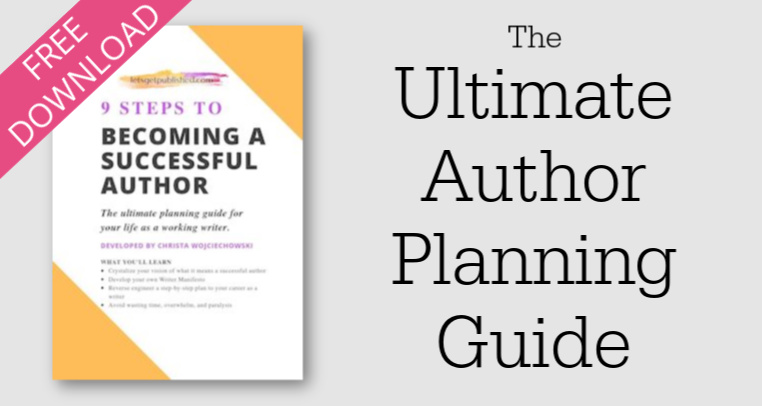
Crystalize your vision of what it means a successful author
Develop your own Writer Manifesto
Reverse engineer a step-by-step plan to your career as a writer
Writers are notorious for suffering from Imposter Syndrome, writers’ block, and chronic procrastination. I, myself, struggle with these neuroses every day. They never completely go away, but I have discovered how to become a more confident writer.
I started writing ten years ago, having virtually no idea what I was doing. Although I managed to finish a few novels and novellas, I knew there were issues with my writing. The problem was, I couldn’t tell what they were.
In 2019, I finally decided to take my writing seriously and signed up for my first writing class—Contemporary Dark Fiction with Richard Thomas. He’s the award-winning author of three novels, three short story collections, two novellas, and over 150 short stories.
Required reading for the class was four novels, sixteen articles, and sixteen short stories. The work included weekly writing assignments, four complete short stories (one per month), four analyses of the assigned novels, and critiques of the eight other student’s monthly stories. We also met once a week on video conference to discuss the week’s material.
I do not have a college degree. What little I knew about fiction I learned from reading my favorite authors and Google. To say this class was intimidating was an understatement!
But I dove into it and was amazed at my output. There was something about putting up my hard-earned money and being forced to deadlines that made me push myself beyond my perceived limits. The analysis of the stories, the exploration of what other writers were doing, and the giving and receiving of feedback from the students, especially from Richard Thomas himself, advanced me more in four months than all I’d learned on my own the seven years prior. I went into that class a bumbling novice and came out the other side feeling like, hey, I think I can do this!
Since working with Richard Thomas, I have fast-tracked my writing career and have accumulated a body of quality work. Four of the short stories I wrote in his classes have been accepted by notable anthologies. Now that I’ve earned professional rates for my stories, I was able to become an active member of the Horror Writers Association.
My writing style has gelled. I know what I can do, how I want to do it, and where my work belongs. I no longer look at other authors getting acceptances and being published, wondering what the secret is. When I think about how lost and unsure I was three years ago, I could kick myself for not investing in a serious writing class sooner. I’m now in my third class with Richard Thomas, his Advanced Creative Writing Workshop.
So, my advice to any new writers out there, or any writers who’ve been struggling for a long time, is to find a writing group, course, critique circle, or workshop. Do not keep doing the same things over and over again, wondering why you’re not getting anywhere.
Knowledge equals confidence. The more you know, the better you can wield your creative powers. Give your writing the chance it deserves. Keep learning, keep growing.
The beautiful thing about writing fiction is you’ll always be evolving, but it’s up to you to invest in yourself!