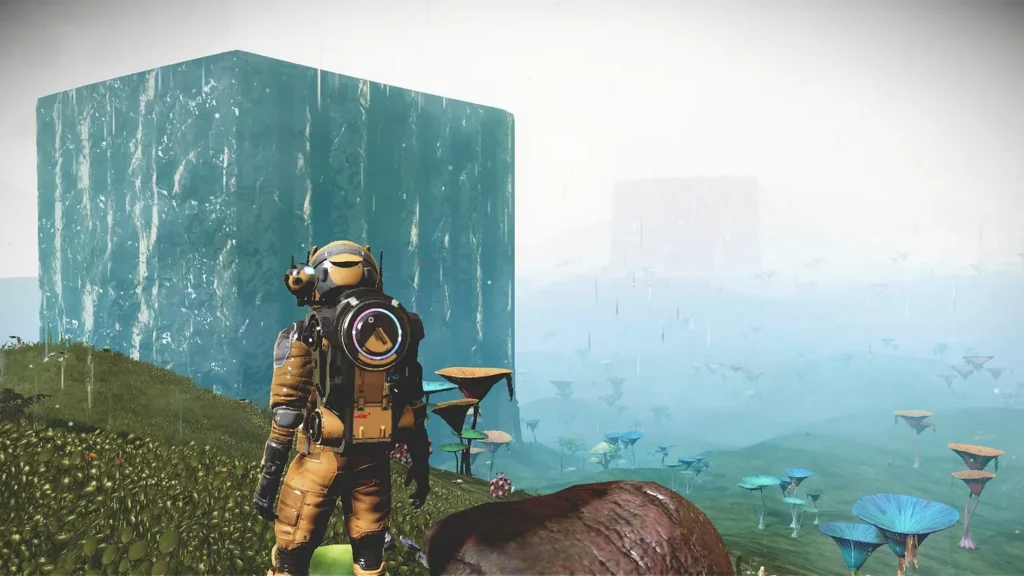
…I wrote an anticipatory piece about a little video-game called No Man’s Sky. Back then—ten years ago, eek!—No Man’s Sky seemed more of a vision of the future of video-games than something concrete. We were all enraptured by the idea of infinite exploration, a living universe populated by the unbridled creativity of algorithmic chance. And then came the fall—the disastrous release of No Man’s Sky that garnered it such negative reviews and perception.
It would be pointless for me to write about this, or indeed No Man’s Sky’s epic recovery and transformation into potentially the most beloved sci-fi exploration game of all time. Many other writers and journalists have covered this topic in extensive and sometimes hands-on detail with the developers, so there is very little I can add.
What I do want to share is how, ten years later, No Man’s Sky still manages to feel fresh. Slipping back into the game feels like walking back into a bright dream. There is an energy about it. A ferocious clarity of vision. And I think the core of this is something that we writers, artists, and creatives can learn from.
There are two intertwined elements that make No Man’s Sky such an immersive and, frankly, addictive experience.
The Glorious Vicissitudes of Chance
The first I have alluded to already: chance. The randomness of the worlds creates a feeling of personal discovery that is intoxicating. This is something we writers, in particular, often forget. The visual artist intuitively understands that the accident of a brushstroke, or a combination of colour, can create revelation. Glass-makers literally do not know how their final composition will appear, for in the firing process colours change, structures shift, and the whole warp and weft of the thing transforms. There is an element of randomness, of chaos, inherent in the art-form, and a part of its joy.
Rolling the Die
We writers, by contrast, tend to believe in working everything out logically. Yes, we receive surprises when our characters misbehave, but rarely do we leave anything to chance.
But sometimes, chance is what a story needs. Sometimes, rolling a die to see whether a character lives or dies, or where a party of explorers end up next, is exactly what a story needs to take some unprecedented leap into the unknown. I have used this technique, particularly with my GameLit / LitRPG series Levi’s Game, where certain locations and creations were procedurally generated.
We receive surprises when our characters misbehave, but rarely do we leave anything to chance.
Joseph Sale
I did this because the locations actually are procedural in the story, so it felt fitting to reflect this in the creative process and challenge myself—and my characters—with an unexpected outcome. Incidentally, if you’re curious about how this turned out, the first book in the series has recently been released on audiobook. Check it out here.
But procedural generation can be applied in any number of ways. Once you start thinking more like a Dungeon Master and less like a writer, you begin to realise that storytelling is pure play, and randomness becomes not your enemy, but a way of accessing previously inaccessible powers of surprise.
The Depth of Mystery
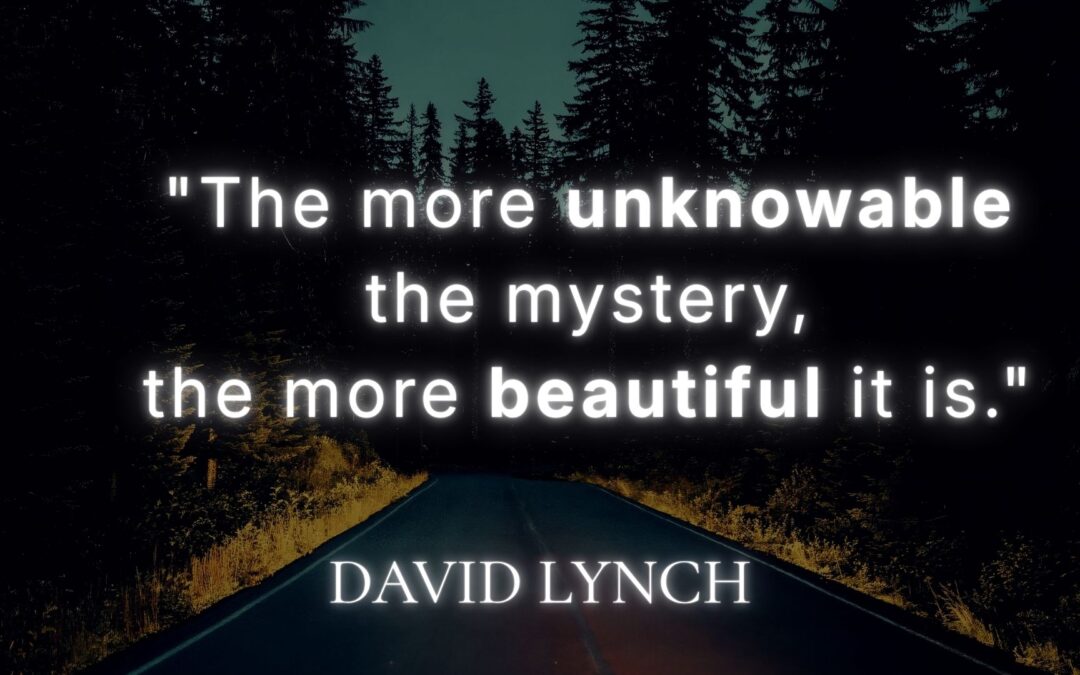
The great David Lynch once said, “The more unknowable the mystery, the more beautiful it is.” And he is absolutely right. Human beings are called by the siren-song of mystery. We yearn to know the unknowable. Nothing intrigues us more than a riddle that seemingly has no answer. It is why Mystery fiction will remain evergreen.
Mystery is the second—and far less talked about—element that No Man’s Sky gets right. We awaken on a strange world with no memory of who we once were, only the stark reality of a destroyed ship, limited supplies, and the will to survive. However, it seems there is some kind of benevolent force in the universe, for we are given clues in the form of cryptic messages, guiding us back to the true path and towards some ultimate destiny.
We know so little, at the start of our journey. And the more we find out, the less it seems we know. There is a species called the Gek who leave ancient standing stones, imparting knowledge of their language to explorers. Why? There are robotic sentinels patrolling some planets and protecting their bio-diversity. Why? Were they left behind by some colossal civilisation now undone? Every answer prompts a new question. But most mysterious of all is the question of our own nature of why we are called to strive, survive, and reach the stars. It is an unanswerable mystery. The heart of the human condition itself. And somehow, impossibly, No Man’s Sky captures this.
Stepping Into the Unknown
As writers, we tend to want to explain our reasoning, to provide motivations for our characters, to ensure our plots hang together logically. I am not advocating we abandon this entirely. But what No Man’s Sky—and indeed the great masters of literature—teach us is that mystery must prevail. Without mystery, there is nothing to compel the human imagination. The unknown is not to be feared; it is our natural habitat. If we are to inspire and ensoul the world, we must go forth into that vast dark without fear, without caution, and fully embrace the divine mystery of the universe, for it is only in embracing the mystery that we can finally embrace ourselves.
Joseph Sale
Joseph is the author of more than 30 books, including The Book of Thrice Dead, Virtue’s End, Dark Hilarity, and The Claw of Craving. He is drawn to the baroque, the spiritual, and the mythic like a moth to flame.
He lives in the south of England with his wonderful family, where he obsesses over table-top RPGs, trading card games, book bindery, esoteric Christianity, and anime.
Every other Monday, we introduce you to a writer from the Writers’ Mastermind. Today we are excited to have Patty Lesser. She has backpacked the world, plays Texas hold ’em, and writes everything from murder mysteries to scifi to dark paranormal fantasy and beyond.
Tell us a little bit about yourself. Where are you from? Where are you now? What has your life been like?
Four years ago, I moved to Brantford, starting over. I knew no one here or anything. Everything was new, but I made a life for myself along with four volunteer positions and playing in a local poker league. I grew up in Hamilton, Ontario, but when I was 19, I left Canada to backpack around the world for 25 years.
When I came back to Canada, I settled in Toronto before moving back to Hamilton. I moved around a lot before settling here. I love my new life.
2. What kind of stories do you write?
I think of a plot, work it around in my head, thinking of ideas for a story. If it works out, I write it down and start the novel. Then I think about the genre, so I end up writing various genres like mystery, fantasy, sci fi, adventure, thriller, etc.
3. What sets you apart from other writers in your space?
I write from A directly to B. My writing is direct and somewhat simple, and my stories are completely my imagination, so I find it hard to compare my books with other authors.
4. What drives your writing? What do you mean to accomplish with your stories?
I’m a storyteller. I like to tell stories that I want others to read to escape from reality for a while and enjoy someone else’s saga and my imagination.
5. Who are your favourite writers and books? What are your other creative influences?
My favourite authors and their books are: Ayn Rand’s Atlas Shrugged, Alexandre Dumas’ Count of Monte Crisco, and Thomas Hardy’s The Mayor of Casterbridge. When I need inspiration, I go back and read stuff I’ve written.
6. Do you write in silence? Background noise? What kind?
I always write with a movie playing on the TV. It’s always a movie I’ve seen many times, so I don’t have to watch. I can look up from time to time and just listen when I need a break from the writing.
7. What is your favourite thing to do when you are not writing?
I play tournament Texas hold’em no limit poker. I play in a local league, but of course we’ve been closed down because of Covid. I have been playing online for money since 2005.
8. Who is your current celebrity crush?
John de Lancie otherwise known as Q on Star Trek: The Next Generation. He’s an Australian actor.
9. Why do you think it’s important to write fiction?
People have been writing fiction since the beginning of time. The Bible is made up of fictional stories that someone put together in an anthology. Fiction is important to take us away from reality.
10. Who would be the best writer, alive or dead, to tell the story of your life?
Samuel Clemens/Mark Twain. I love the way he wrote his autobiography. He’s a great storyteller.
11. What are you working on right now?
I’m working on a murder mystery that takes place in a community centre. The subplot is all about the importance of volunteering. The interesting thing is I don’t know who the murderer is, but I guess I’ll just find out when the readers do. I volunteered at a community centre for 4 years, and my story mirrors this one. I was also the Volunteer Reporter and I wrote all the volunteers’ profiles, so I’ve got lots to draw from. I want people to read my book and then say, I should volunteer somewhere.
Devouring Time: A Race Against the Clock to Expose Shocking Secrets, Shameless Greed, and Murder
Marcus Tate doesn’t understand the odd request: leave London to deliver a small, carefully-wrapped box to a family in Canada? But his mentor, mother figure, and friend, Cathy Edwards, insists that Marcus is precisely the right person to deliver the important package that she has held onto for many long years.
Little does Marcus realize that his world is about to be turned upside down. In less than one day, Marcus learns not only the shocking truth about his mother, but also the real reason Cathy forged such a strong bond with him. And despite Marcus’s attempt to make a quick delivery and leave, the eccentric Blackbourne family insists that he stay to learn more about the contents of the mysterious box.
The Blackbournes can’t wait for Lillian, the family matriarch, to peel the brown paper wrapping from the package. To each family member, the package represents the promise of an even richer life. More money. Financial independence. Power. Freedom to travel the world.
But to the family’s surprise, the package is only one small piece of a much larger labyrinth of lies and betrayal, leading to the discovery of family secrets . . . and murder.
Time ticks away as the family attempts to solve the mystery of Lillian’s murder, all while trying to make sense of their past. Through it all, the Blackbournes and Marcus can’t help but wonder if the murderer is still lurking among them.
Join Marcus and the entire Blackbourne family on a whirlwind twenty-four hour adventure, through a world of insatiable greed, family secrets, forbidden love, and murder!
“The Writers Mastermind has been the leaping stone in my writing. Each month offers a new theme and focus towards the Writers’ Dream. I have found my voice, structure, and have gotten immeasurable feedback on my works.”
Charlotta Amato, Short Story Writer
“Ever since I joined Writers’ Mastermind, I have felt more like a writer and part of a writing family than I ever have before. I have gained confidence in my writing, learned who I am and how I want to be as a writer.”
Clennell Anthony, The Circle
“An empowering mastermind group, definitely the best I have ever been a part of. The warmhearted community is genuinely a reason to get excited and I learn as much from my peers as I do from the exceptional courses.”
Joseph Sale, The Black Gate Series, Save Game
“The classes are awesome. They offer perspective, as well as tips and tricks that many may not have thought of when it comes to not only creating their books, but promoting them. It’s worth much more than what we pay, and that is a total win-win situation.”
Sandra Hould, Future Novelist
“It’s been a boon for me to work and interact with this diverse range of authors. I’ve received fantastic constructive feedback, friendly motivation and support through the struggles in my writing process, and accountability to keep me focused on critical tasks.”
S.M. Fedor, Band-Aid for a Bullet Wound, Better People