Let’s Get Published is community of writers, and we’d love to get a conversation going. That’s why we’ll be posting a Writers Share every now and then to keep a pulse on the writers working their wordly magic all over the world.
Today we want to know about what you’re working on right now.
Tell us about yourself and your work-in-progress by responding by email, leaving a comment, or posting on our Facebook page.
Tag or share with your writing friends so they can join too.
1. What have you written?
2. What are you working on right now?
3. What do you plan to do with your current work-in-progress?
4. Where are you feeling good about your path to becoming a successful writer?
5. What are you struggling with?
As for me, I’m in the middle of Richard Thomas’s Contemporary Dark Fiction Class. Since the beginning of September, I have finished 8 short pieces of fiction, two 3,500-word short stories, and 2 essays analyzing books we read for the class. I have crammed more short fiction writing in the last two months than I can believe.
Yes, my brain hurts, but I’ve realized that I can make things happen even when I’m pressed for time and feeling uninspired.
I also feel empowered. I used to wonder why my work is not getting accepted. Rejection letters rarely come with an in-depth report about what’s not working in a manuscript. It’s a writer’s job to know that themselves. This class is teaching me the secret language of good writing (there is a language under the language).
Of course, now I want to take down everything I’ve ever written and rewrite it.
My article about author platform mistakes was featured in The Writing Cooperative, a writing community and publication focused on helping each other write better.
I develop author platforms for a living and have worked with all kinds of writers — from paranormal romance, to literary fiction, to children’s picture books. No matter the genre, the same basic rule applies.
The goal is to be found by your readers, and your author platform must make it easy for fans to engage with and share your content.
The issues I’m going to share with you might seem obvious, but I come across them daily, even with established writers. The smallest holes in your author platform cost you big time. The worst part is, you won’t even realize the connections, opportunities, and sales you’re missing out on.
Go through this checklist and make sure your author platform is working for you…
A professional Facebook Author page is a must-have for all writers. Though Facebook doesn’t offer the same organic results as they did in the past, they’ve created one of the greatest advertising platforms that is excellent for selling books.
You’ll want to make sure your page is complete before running any ad campaigns. Set up or optimize your Facebook Author Page with this tutorial.
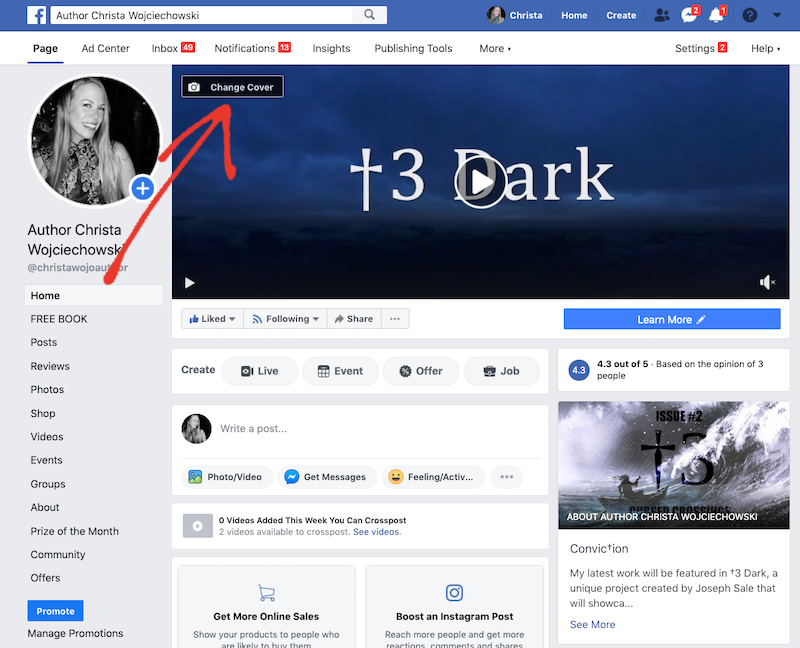
1. Facebook Cover
Your Facebook cover is a billboard where you can create a cover that promotes you and your books.
Design your own cover image according to the Facebook page cover dimensions. You can use a mobile app or web-based graphic designer like PicMonkey or Canva. Make it even easier by hiring someone on Fiverr to do it for you.
Otherwise, browse freelance sites for a video production specialist.
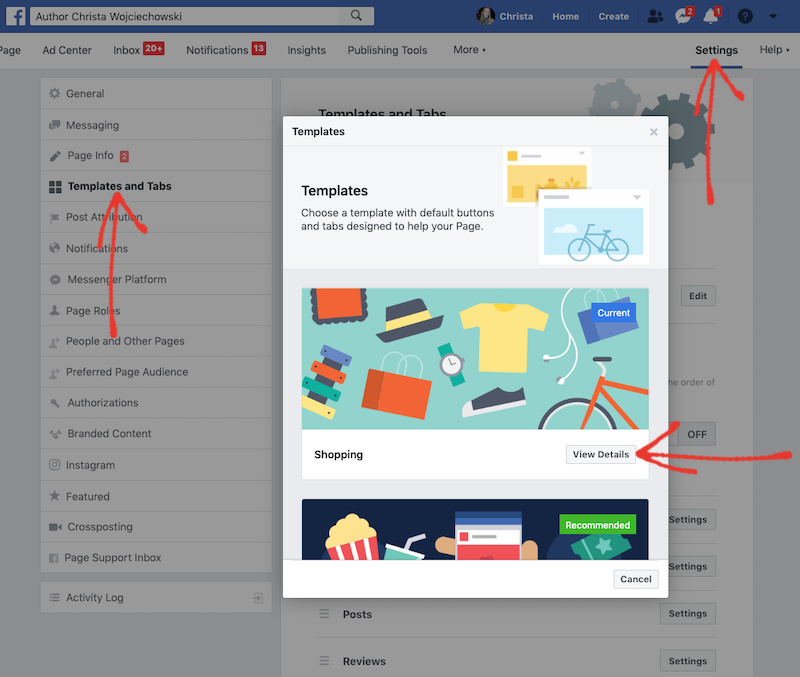
2. Use the Shopping Template
Facebook’s Shopping template will allow you to host a store on your author page. It’s the perfect place to showcase your books.
If you’re setting up your author fan page for the first time, you will be prompted to select a template.
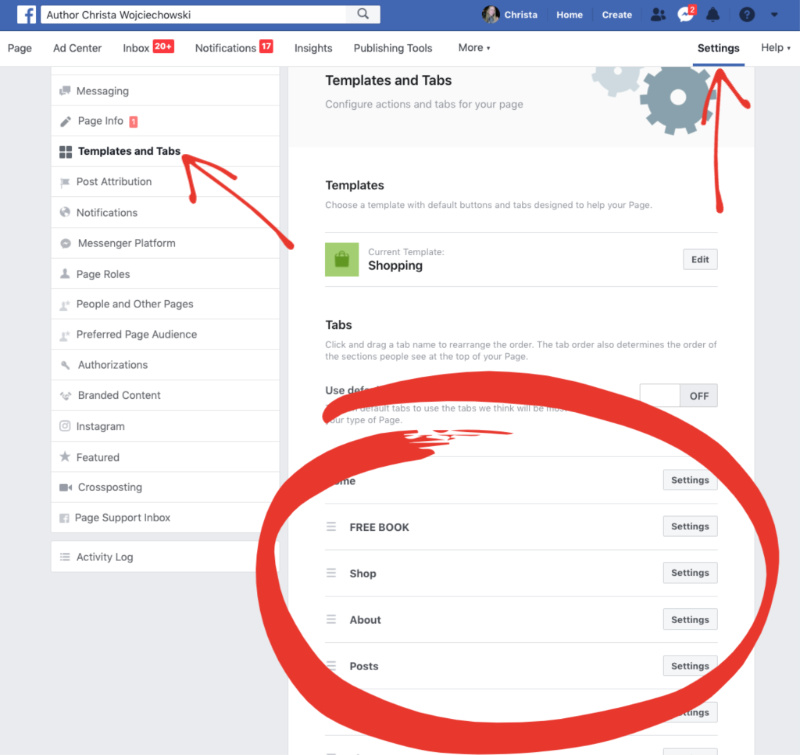
If you already have an author Facebook page, you can change to the shopping template in Settings under Templates and Tabs.
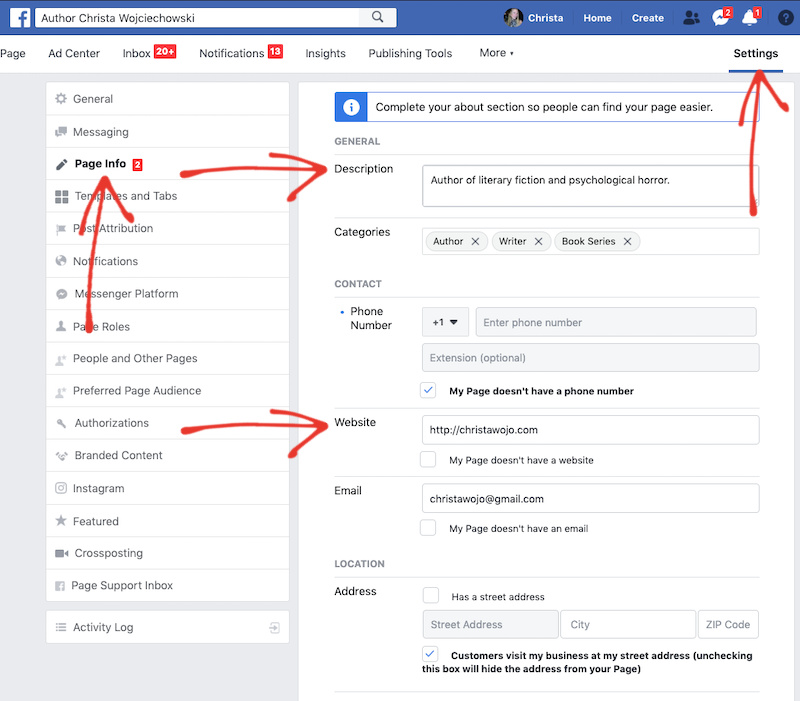
3. Fill out Your Page Info and Story Sections
I can’t tell you how many authors pages fail to include vital information, like bio and website. Fans are going to want to visit your blog, website, or Amazon page so be sure to add as much information as you can.
Page info settings
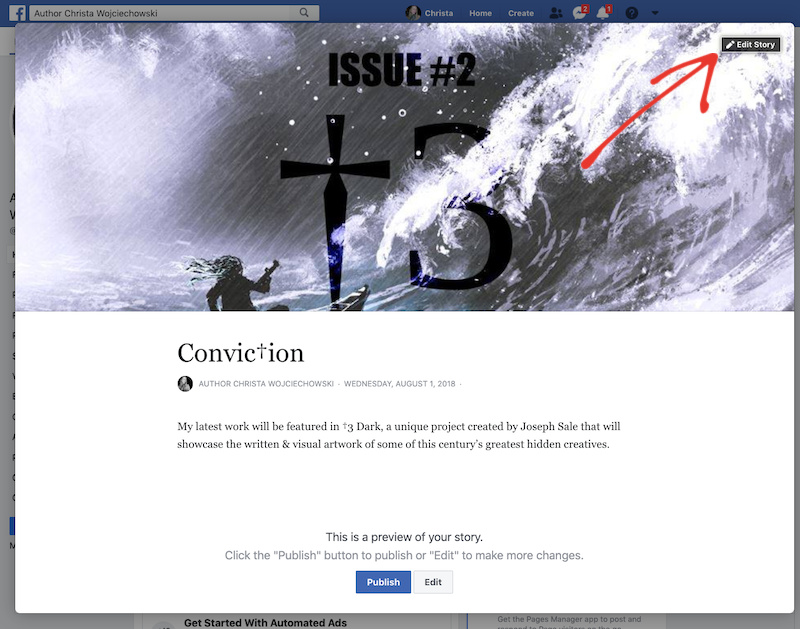
More free promotional real estate is offered in the Story section located in the right sidebar of your Facebook author page. This area features another image and a text area where you can include a live link.
Edit your Story Section
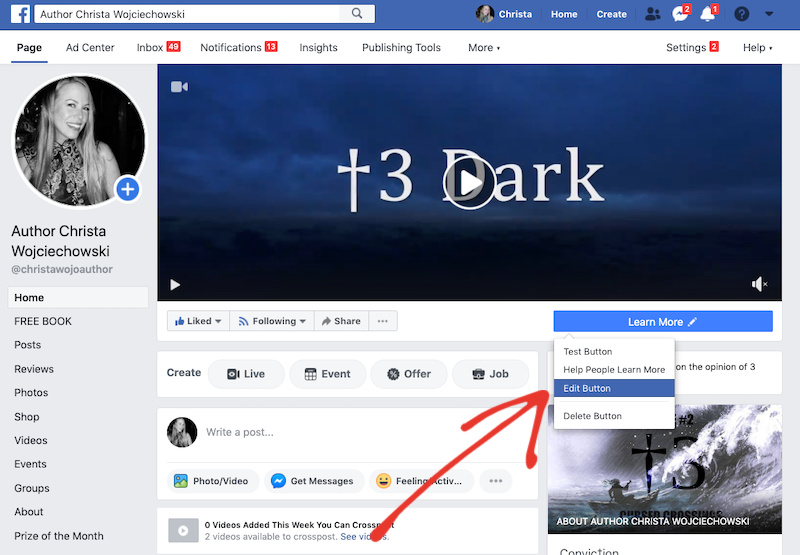
4. Activate Call to Action Button
This call to action button can be used to encourage fans to contact you, watch a video, shop for your books, and more. Click edit button and a box will pop-up with button options and settings.
5. Add Your Books to the Shop
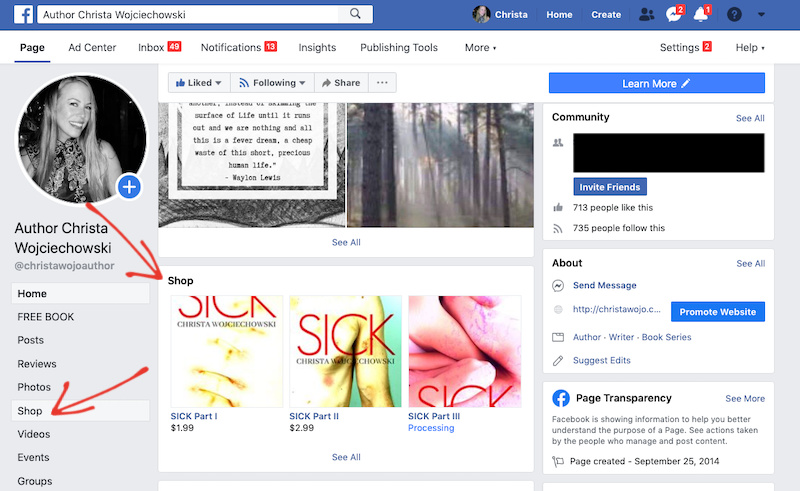
The Facebook shopping template is perfect for authors because you can feature a little bookshop right on your page.
What your shop area will look like.
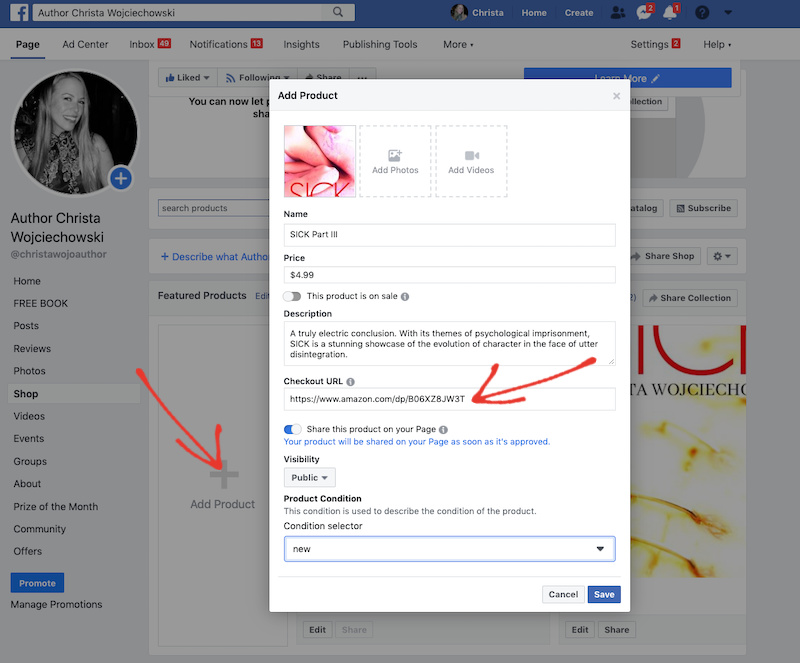
Click Shop in the left sidebar menu. You will see a box where you can Add Product. Click that area to add your book cover, buy link, and toggle the Share this product to your page if you’d like your book to be posted to your timeline.
Adding books to shopping template.
6. Embed a Mailchimp form
If you’re a Mailchimp user, you can grow your email list straight from your Facebook page. However, this must be done through your Mailchimp account.
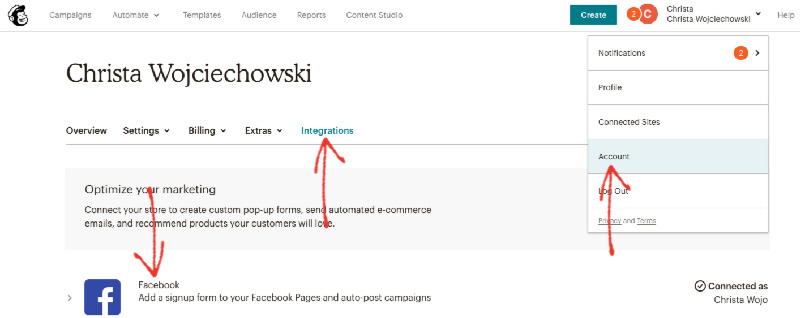
Log in to Mailchimp, click your username in the top menu bar to activate the dropdown menu. Click account and then click integrations. This is where you will find the option to add a tab with a Mailchimp form to your Facebook Author page.
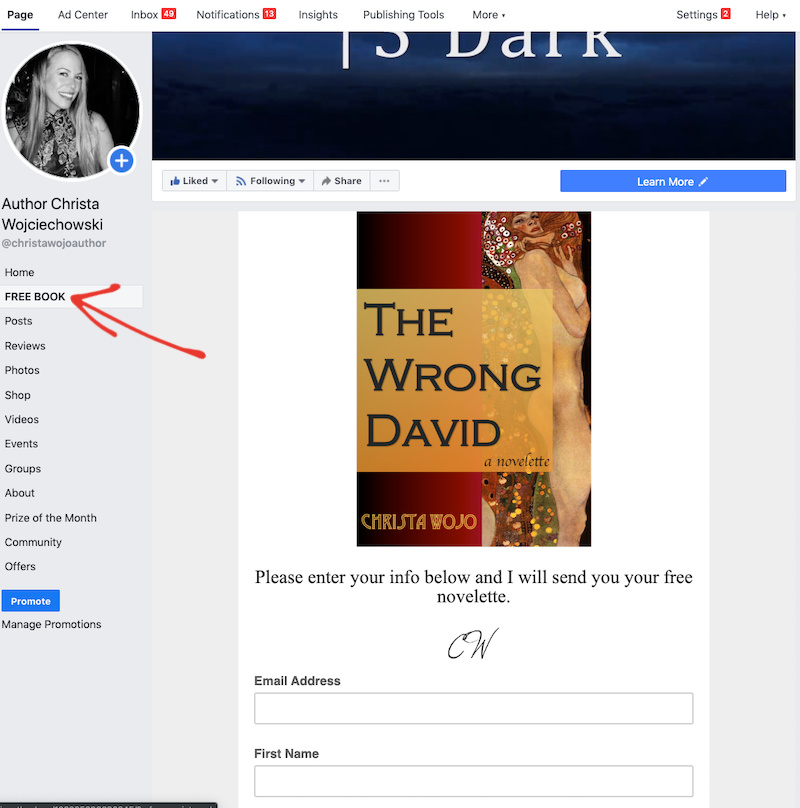
Locate the Facebook signup for option in your Mailchimp dashboard.Offer a free download with a Mailchimp form in a Facebook page tab.
You can reorder your tabs by returning to the Templates and Tabs section under Settings. Click and drag them to the desired spot.
7. Invite Your Friends
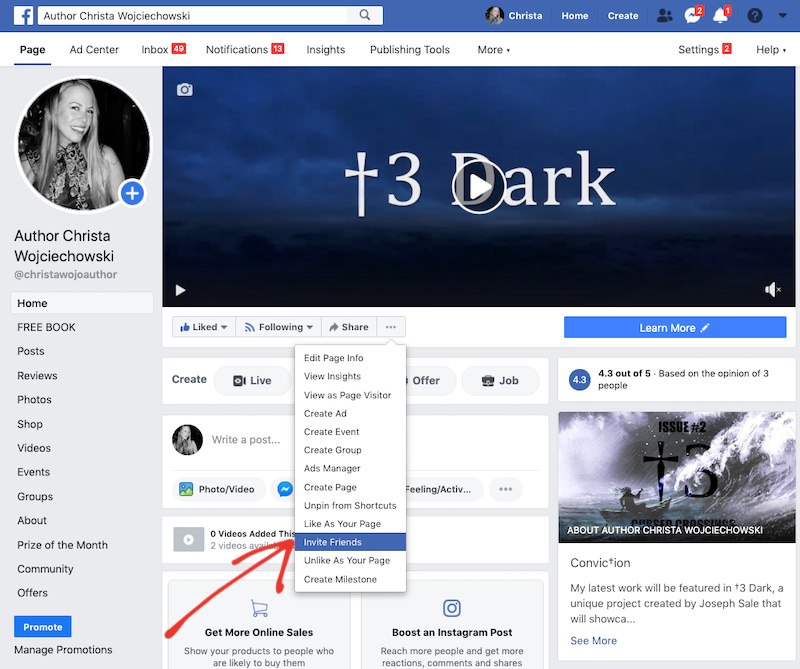
Use the handy Invite Friends button to get the first likes for you page. Click this button ever few months as you add new friends to your personal profile.
Invite friends!
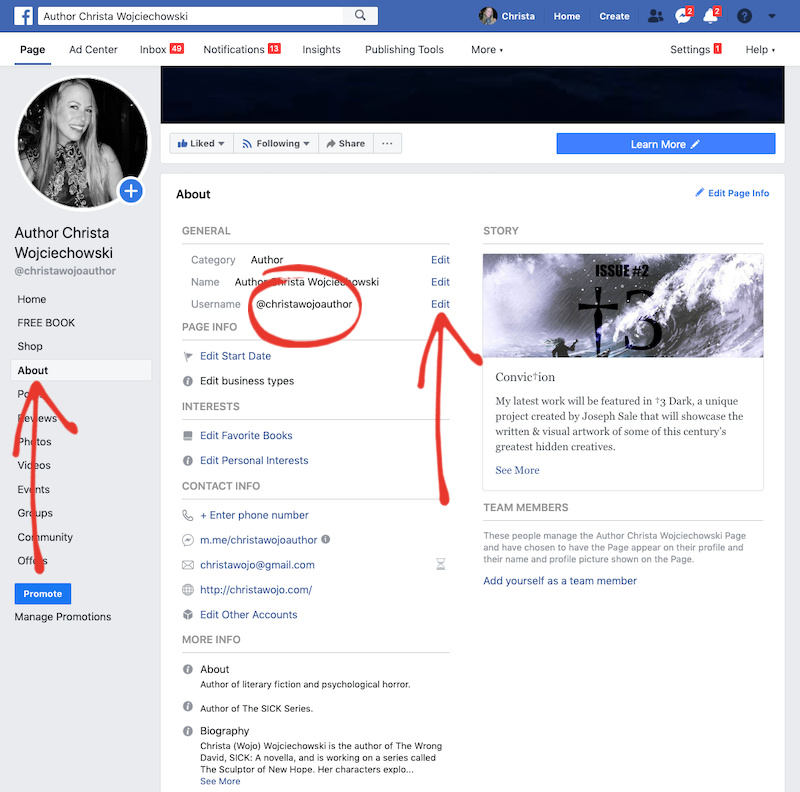
8. Claim Your Facebook Username
Once you get 25 likes on your Facebook author page, you can choose a username.
Try to find a username that is closest to your writing name or the same as your social media handles.
Choosing a username will also set the URL for your page, making a nice, neat address instead of the default jumble of words with numbers.
Check your username in the About tab.
9. Connect to Your Instagram
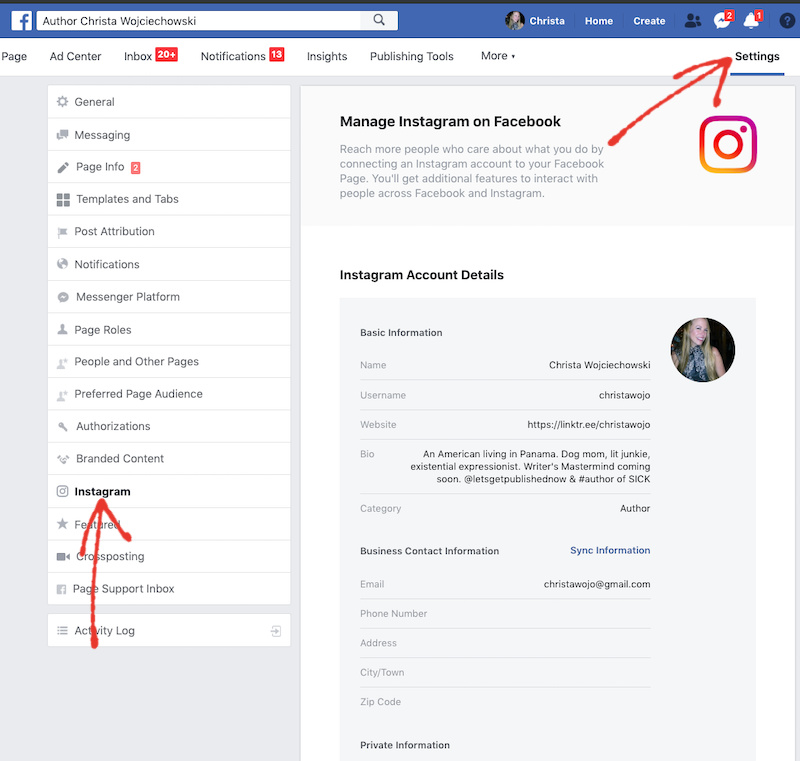
Connecting your Instagram account allows you to share Instagram posts to your Facebook Author Page. It also makes it possible to configure Instagram ads via Facebook in your browser, which is easier than doing it from a mobile phone.
Make sure your Instagram is connected by visiting the Instagram tab in Settings.
10. Use Offers
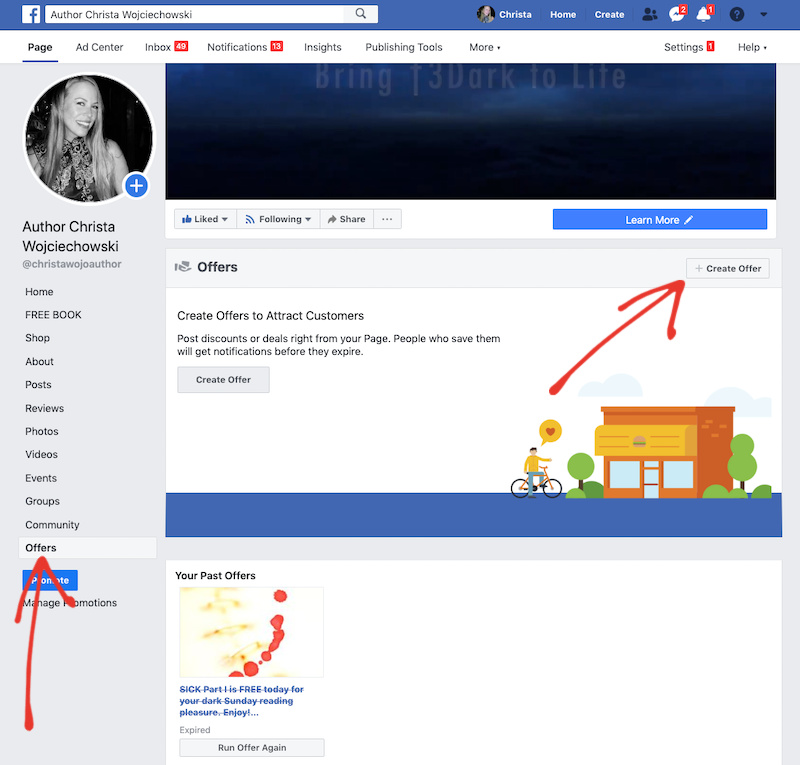
Whenever you want to promote your book, you can use Facebook Offers to stir up interest and urgency. Click offers in the left sidebar menu or in the posting options on your timeline.
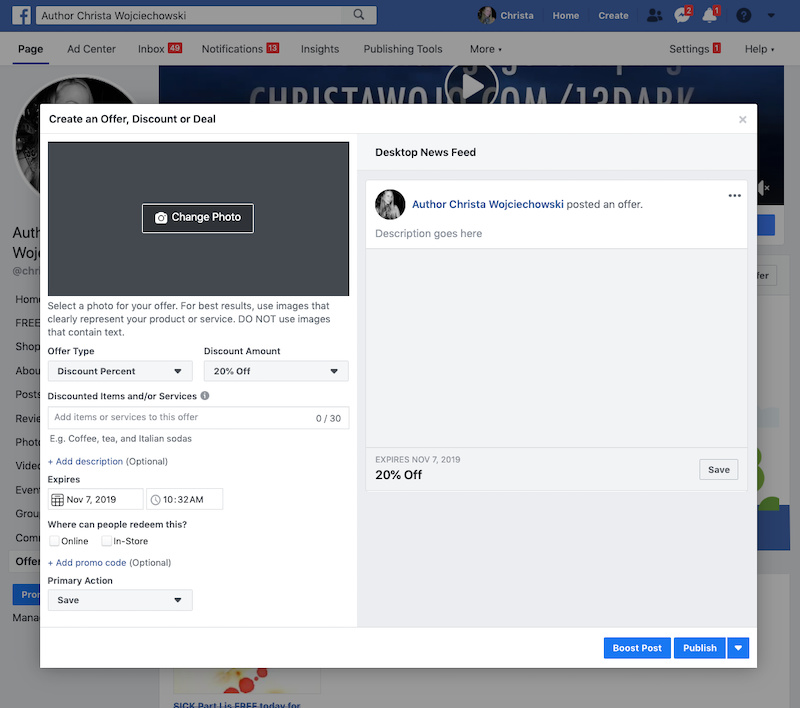
You can then add a photo, choose what kind of offer you want to post (coupon, discount, promocode, or other), and set the expiration date.
Offers tabCreating your offer
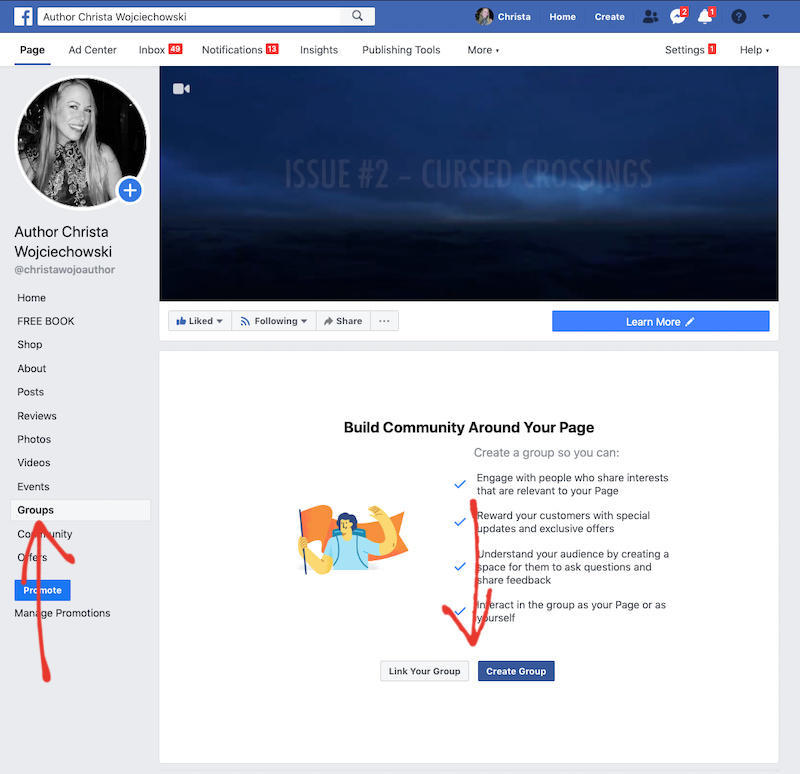
11. Create a Group That’s Connected to Your Page or Link Your Existing Group
Groups are an extremely effective way to stay engaged with your readers. Each time you post to a group, your members will get a notification, so unlike page fans, group members are more likely to see your posts.
A private group can also be a way to give members exclusive access to you. Just make sure you are prepared to invest time and thought into your group to make it a worthwhile endeavor.
If you already have a group, link it to your page so your brand is connected.
Link groups in the Groups tab.
Now You’re Ready to Go!
Your page is ready for using, sharing, and advertising.
Subscribe to Dear Writer for future posts on Social Media Optimization for authors, including Facebook Advertising for books. CLICK HERE.
When we don’t purposefully and deliberately choose where to focus our energies and time, other people—our bosses, our colleagues, our clients, and even our families—will choose for us, and before long we’ll have lost sight of everything that is meaningful and important. We can either make our choices deliberately or allow other people’s agendas to control our lives.
Greg McKeown, Essentialism: The Disciplined Pursuit of Less
When it comes to becoming a successful author, planning is 200% more valuable than writing. I’m not talking about outlining your stories and novels before writing them. That is important too, but I’m talking about planning on both macro and micro levels to reach your big picture vision of your life as a writer. Without planning ahead, we get distracted, sidetracked, and stray off task.
Aspiring writers are especially susceptible to writer’s drift, a state when we feel like life always gets in the way of our writing. There are several reasons we allow this to happen on a conscious or subconscious level.
1. Because we don’t earn a steady paycheck from writing yet, so we can’t justify spending time and energy on it.
2. We usually don’t have writing deadlines, except those we impose on ourselves. When we fail to meet them, who cares? No one knows but us. We have no one to hold us accountable.
3. We don’t know exactly what to do next, leaving gaps to be filled with interruptions, distractions, or someone else’s priorities.
We’ll get up for a job we’re not crazy about. We rearrange our schedule for our kids or significant other. We even drag ourselves out to walk the dog no matter how tired we are.
But how often do we take a stand for our writing?
The first chunk of time to be sacrificed when some unforeseen issue comes up is our writing time. Writing time is vague and unconvincing. People don’t respect it. Even we’re not sure what it is we’re not getting done when we’re not able to write. So it’s easy to dismiss it as no big deal.
The one person we fail is ourselves. And we don’t realize the impact it makes on our wellbeing when we’re constantly letting ourselves down by pushing aside our heart’s dream.
What would happen if you treated your writing with the same priority as other aspects of your life?
And how do we put ourselves into position to do that?
How do we do it without feeling guilty or self-indulgent?
Planning out your writer’s path to the smallest details will keep you committed to your writing. This means breaking things up in 5-year, 1-year, quarterly, weekly, and daily goals.
It’s not about finding time to write. It’s about making time to write.
Making sure you always have something scheduled to do next will ensure that you avoid wasting time, overwhelm, and paralysis. This will help you keep moving forward no matter what.
You’ll be able to ignore your fears and push past rejection. You’ll always be able to put one foot in front of the other by executing the next step in your plan.
Start Here
I’ve created a planning guide to avoid writer’s drift. You can download it for free using the link or form below.
How to find beta readers? It’s crucial for every writer to get honest and useful feedback, but it’s difficult to find beta readers outside of family and friends.
Today, we talk to Matt Brindley from fresh.ink, an exciting new platform that will match writers with unbiased beta readers. It will not only allow them to receive feedback, but also provide detailed analytics.
Ahead of its launch, fresh.ink is hosting a writing contest. $7,500 in prizes are available across 4 fiction categories: short story, novelette, novella, and novel. This contest is live.
Fresh.ink is also launching a digital literary magazine which will feature the best work across the platform and reprints from previously published literary works. All authors will be paid for their submissions.
This means writers can upload a story or novel for feedback, enter it into the writing contest, and possibly get published in the magazine all in one submission.
Read on to learn more about this amazing new tool for authors!
Whether an author plans to publish in a literary magazine, self-publish or traditionally publish, we envision fresh.ink as the connector between authors and agents, publishers and editors.
Interview with Matt Brindley, founder of fresh.ink
Tell us about yourself, Matt. You’re a product and software developer. What made you decide to make the transition to the publishing world?
The idea for fresh.ink was the result of many experiences and conversations over several years. I was first exposed to the writing world and the challenges writers and publishers alike face via my wife, Mary, who is a writer and editor.
While researching and evolving this idea, I met some brilliant people who were very generous with their time. One London-based editor took me to see her company’s office in a converted Victorian house. It was a beautiful building with a grand staircase, books lining every wall. She talked enthusiastically but realistically about working in the industry, the challenges and frustrations, the wins that made it all worthwhile, and the joy of reading. Another advisor, a literary agent, spoke of her passion for reading, of discovering authors, and her reasons for switching roles (she had recently moved from a senior editor position at Macmillan). Their passion was infectious!
I also had the opportunity to speak about the project with an author who had published a number of books with Hachette and was working on her latest novel. She walked me through her story of how she first found an agent, the ins and outs of working with a publisher and the feeling of seeing her book advertised on the subway for the first time.
I have a lot of respect for the publishing industry, for the decades of work it takes to succeed in it, but I was intrigued by the ways in which technology could be used to complement both traditional publishing and self-published authors. Writing great software is about empowering others with just the right amount of technology to improve their lives. I’m very excited that we’ve found a way to strike that balance here and genuinely help authors, agents and publishers.
I wish I had the skills and patience to write! I’m much more comfortable in a code editor than a word processor.
You love a good book, who are your favorite authors?
We Brits love a good murder mystery, so I’d be remiss not to mention the Agatha Christie books I grew up reading. More recently I’ve been reading through everything Ruth Ware has written, Anthony Horowitz’s Magpie Murders and The 7½ Deaths of Evelyn Hardcastle by Stuart Turton.
On those occasions I fancy fiction where the protagonist isn’t solving a whodunnit, I enjoy a pretty wide range of genres. I recently enjoyed reading Red Clocks (Leni Zumas), Goodnight Stranger (Miciah Bay Gault), Where the Crawdads Sing (Delia Owens) and Less (Andrew Sean Greer).
What gave you the idea to help writers with feedback on fresh.ink?
I’d like to claim it was a brilliant idea of mine that came in a eureka moment, but in reality, the idea was formed over many interviews, much research, and ongoing involvement in online writing communities. I was keen to contribute to the literary world, but the idea took multiple years to fully shape, and will continue to evolve.
How does the platform work for authors?
Authors submit their fiction (of any length) to fresh.ink. It should be a final draft, free of typos and mistakes and ready for beta readers.
If a story is accepted, we analyze it to match it to readers who we think we’ll enjoy it to give it the best chance of being well-received. Readers can only see stories they’ve been matched with, otherwise work remains private.
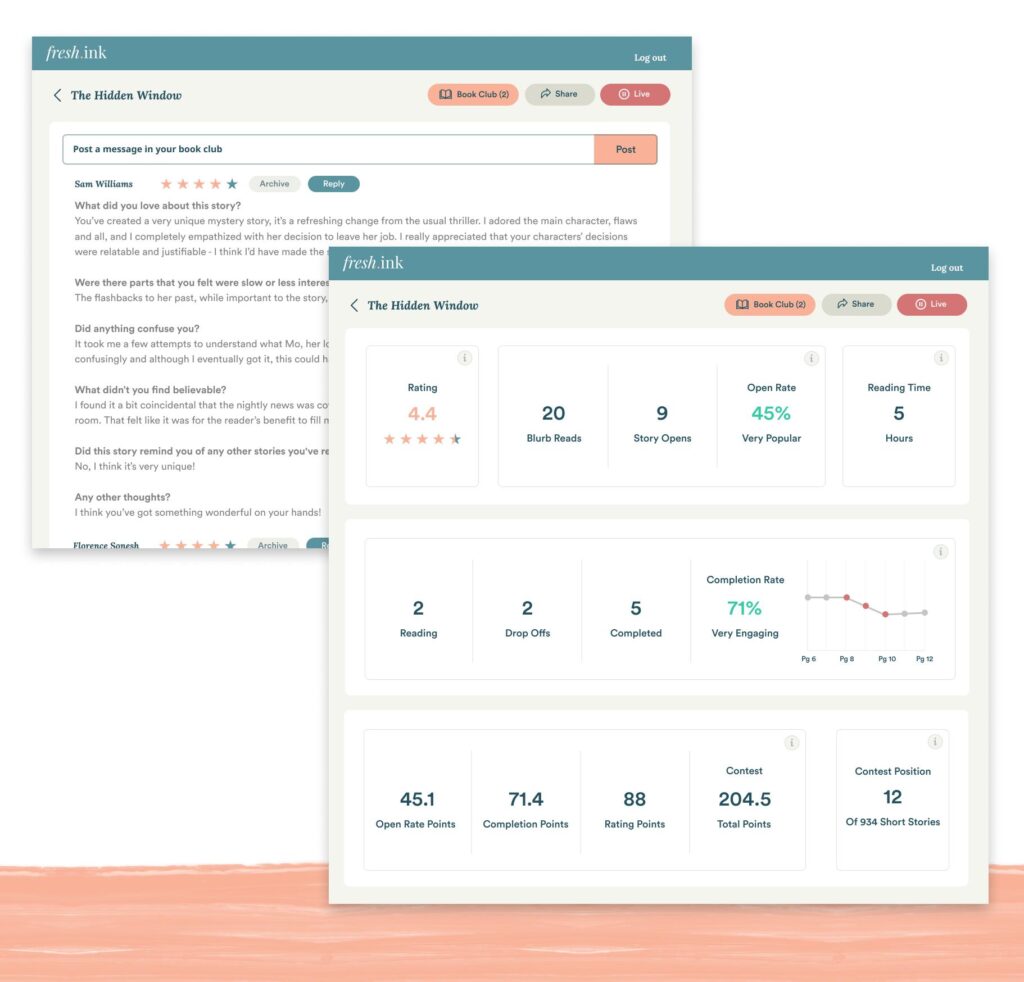
Once reading starts, authors receive detailed analytics on open rates, if and where readers drop off, and ratings. Much like test screenings in film and television, understanding a reader’s behavior can be hugely beneficial in understanding how to improve a story. Readers will also answer more detailed questions about what they liked and what they think could be worked on, as well as join a book club with the author for further discussion and commentary.
Preview of fresh.ink’s story dashboard
How does one become a beta reader on fresh.ink?
We’re aiming to open up to beta readers in mid-October, so sign up for the waiting list at https://fresh.ink/#readers now to be first in line!
Tell us more about fresh.ink magazine and the fresh.ink app.
Our reader app has two sections: reader matching and our premium section, fresh.ink magazine, of which Mary is the editor. At launch, fresh.ink magazine will feature hand-picked writing from around the world. After our contest concludes, the magazine will begin including the best work that has come through fresh.ink’s matching service. All authors who are invited and agree to be featured in our magazine are paid, either via payment upfront or via revenue-sharing.
When is the official launch date?
We’re open to author submissions now, and readers will be invited in mid-October 2019. Not long now!
What is the future vision for fresh.ink?
Our vision is to create the de facto process for getting great writing out into the world.
Publishing is a tough business, especially for smaller houses and literary magazines. We want to support them all and help them thrive, either by matching them with proven writing or providing additional readers for their own content.
Whether an author plans to publish in a literary magazine, self-publish or traditionally publish, we envision fresh.ink as the connector between authors and agents, publishers and editors.