I’m sure I’ve said this too many times in meetings, videos, blogs, and newsletters—once we stop having fun with writing, our reader stops having fun too.
Sure, we sometimes have to command ourselves to sit down and work on our stories, batting away distractions as if they were flaming Molotov cocktails.
But once we close the door and sit to write, are we enjoying it? Or are we grinding it out? Have we become so mechanical and rigid in our process, we’ve forgotten the wild enthusiasm that flooded us when we first felt the thrill of creating our own worlds and characters?
We must remember how it started. For must of us, writing fiction wasn’t a strategic decision. It was a compulsion.
For now, stop worrying about what the world will think or if your book will be a success.
Strap onto the sheer joy of creating and ride it till the end. If you’re tired and empty, look around you. The universe is bussing with enthusiasm. It surrounds us, and we can reach out for a hit whenever we need it. We can piggyback on the artistic boundlessness of others.
Artist dates are wonderful for reawakening creative enthusiasm. So is consuming others’ writing or other forms of art. For example …
Have you seen Everything Everywhere All at Once? It’s an A24 movie that is SO WILD, it will make your brain explode. There is no doubt they had a riotous good time while writing and filming it.
And it won 7 Oscars.
I am not ambitious enough to try to create anything like that yet (the screenplay must have been an insane amount of work!), but it opened me up to thinking beyond the limitations of what’s been done before.
Ask yourself:
Where can I surprise people?
How do I make their jaws drop?
Can I pass on the same enthusiasm my favorite writers and artists invoked in me?
We’ve talked about perfectionism, rejection, and the mysterious phenomenon of self-sabotage when it comes to committing to developing our creative potential.
But if we dig down to the core of most issues that keep us stuck, the culprit is fear.
Fear is insidious. It disguises itself. We will tell ourselves we are many things, but not afraid.
We might resort to drill sergeant tactics to force us to do what we need to do for our writing career. But ignoring or fighting fear costs more energy, and winning is unlikely.
Let us start with this fact—we will never get rid of fear. Don’t wait until you’ve mastered it to do what you’ve always wanted to do. You will wait forever. Feel the fear and move forward anyway.
Another trick is to transform fear into excitement. Do you feel sweaty, anxious, shaky, and unsure of what’s going to happen? Physical feelings of excitement are very close to those of fear. Reframe them and realize this is you taking risks and living your life fully, not hiding away and playing it safe.
Nothing paralyzes the mind like fear. So whenever you feel resistance or procrastination to putting yourself out there as an artist, look for the unconscious fear first. Unpack it, acknowledge it, and calmly move forward.
“I must not fear. Fear is the mind-killer. Fear is the little-death that brings total obliteration. I will face my fear. I will permit it to pass over me and through me. And when it has gone past I will turn the inner eye to see its path. Where the fear has gone there will be nothing. Only I will remain.”
What are the chances you’ll become a successful fiction writer?
In our last post, we talked about Turning Rejections into Success and surviving artistic losses by benefiting from what they force us to learn.
Today, we will talk about becoming mentally and emotionally strong enough to push through moments where the prospect of going for the writing dream is too much to contemplate.
WHAT ARE THE ODDS THAT I’LL BECOME A SUCCESSFUL WRITER?
This question is paralyzing.
We think:
How many writers are out there with the very same dream I have?
What makes me think I will be the one to break through?
I don’t have the time, energy, confidence, or freedom to go for it.
So many are more talented than me. This is a waste of time.
On the other side of the spectrum, sometimes the thought of success is scarier than failure.
What if this becomes a big deal?
Will my marriage survive it?
What will my parents think of what I wrote?
I’m terrified of public speaking. What if they ask me to make appearances?
Either outcome is enough to keep our wheels spinning until the end of our days.
The key to stop sabotaging yourself with thoughts is to practice self-awareness. When you feel resistance to moving forward on your project, ask yourself …
What is it exactly that I’m feeling? (fear, hopelessness, unworthiness, imposter syndrome)
Why do I feel this way? (my partner criticized my work. My savings is dwindling, I’m intimidated by another writer)
Is this true? (Not really. My partner’s criticism is unfounded. They don’t even like my genre. I can earn enough money to make this work. My writing is just as good as other writers for my audience.)
What is the next right thing to do to bring me closer to completion? (Check your author plan, do the next thing on your list. If you don’t have a plan, make one. Or just sit down and write as much as you can, whenever you can, until it’s done.)
You do the work.
The future will take care of itself!
*******
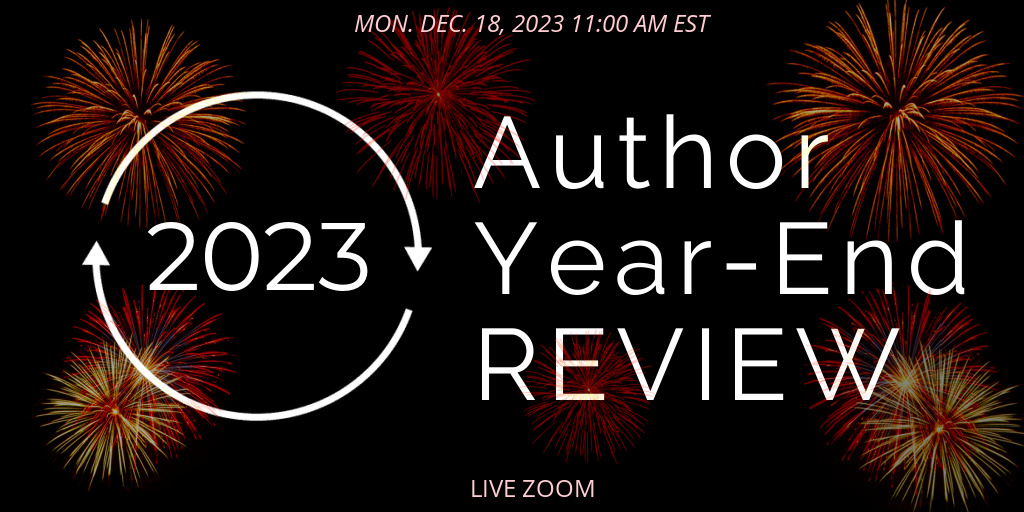
We are pleased to invite all fiction authors (published or unpublished) to our annual Author Year End Review for 2023.
Now that we’re about to close out 2023, it’s important to process all that happened (or didn’t happen) for us as writers this year.
We need to find out what worked and what didn’t, so that we can double down on the things that brought us results and eliminate whatever is draining our time, energy, and creativity.
When we write a book (especially if we did it right) we bare our hearts in it. So when someone criticizes our work, even if it’s unfounded, it wounds a deep part of us that doesn’t have the capability of rationalizing it away or laughing it off. It hurts.
Many people give up after receiving criticism, even whether it’s helpful or hateful.
Sometimes, the reviews are right. Maybe you are new at writing and still finding your voice. Maybe you neglected to develop your story properly or haven’t polished your sentence structure. Maybe it just isn’t the right time for a story like yours. In this case, the criticism points you in the right direction. You can digest it and use it to make you better.
On the other hand, stupid, condescending criticism with no foundation hits us in a way that makes us feel bullied and victimized. I remember I received a one-star review for my novella, SICK, that said “waste of time.” She didn’t say why she didn’t like it. Could it have no redeeming qualities whatsoever? I would love to know! It will always be a mystery, and those are the reviews that really get under your skin.
The worst is when it comes from a family member, friend, or partner whose approval is important to us. Nothing deflates us quicker and more thoroughly than the opinions of those we love.
Yes, we need feedback, and we need to listen to readers. But we have to keep ourselves grounded in our creative integrity. If we worry about what others will think while we’re writing, we will not be true to ourselves. Once through the fever dream of inspiration, we can calmly discern which feedback is useful and which is the backlash of pessimistic, bitter human beings.
If it turns out we truly flopped, it is important not to brush it off as if nothing happened. Your heart got crushed into the pavement. Acknowledge your disappointment, take some time to mope, and then get back to the page armed with the new knowledge you’ve acquired in your creative battle.
How do you want to change the way readers think, perceive, and feel?
Who are you speaking to?
It could be to make people laugh. It could be to make them realize who they are. It could be to inspire them to dream a little bigger, or help them to become aware of weaknesses they need to address. Maybe your mission is just to scare the pants off of them.
Remembering the big-picture reason you write will help you push through fear of criticism.
NOTE: These posts are inspired by The Artist’s Way, a 12 Step Process to recovering your creativity by Julia Cameron. You can read all about it here.
Today we talk about one of my favorite sections of The Artist’s Way—Recovering a Sense of Connection.
My first novel, Oblivion Black, is the timeless story of an artist and his muse. It’s about tapping into the creative source and trusting that your work already exists, in complete form, waiting for you to become the person to create it.
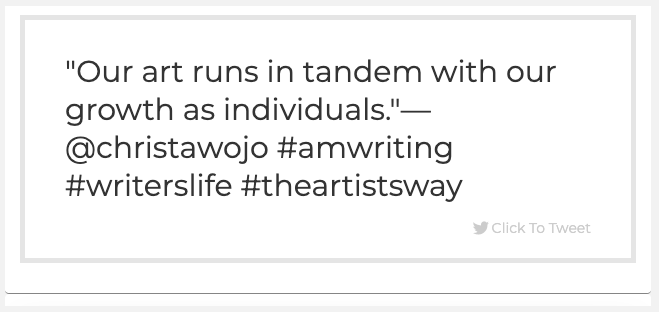
Likewise, your actualized self, who is a masterpiece of creation, is also waiting for you at the end of your artistic journey. Our art runs in tandem with our growth as individuals.
At the time I was writing this novel, I thought I was stumbling into artistic revelations no one had ever thought of. Little did I know, it had all been said and done before by countless others throughout time (including the Artist’s Way).
This only proves that there is a common source we are all connected to that expresses itself through us through our many different artistic lenses.
Where did that come from?
Have you ever written something that completely surprised you? That is a sign that you are connected. You are now at the depth of being that your conscious brain does not have access too, which means it won’t step in your way and say, don’t go there, don’t do that.
This is why Hemingway said, “Write drunk. Edit sober.” Drugs and alcohol are chemically induced ways to bypass the stodgy, reasonable, cautious mind and free the boundless, fearless, artist to do what it knows it’s supposed to do.
Your turn
Fortunately, you can safely connect to your creative source without going into into a chemically-induced trance.
Here are some ways to tap into your unconscious and increase your receptivity to the collective well.
Morning pages/journaling
Yoga
Meditation
Breathing exercises
Self-awareness/mindfulness
Listening to music in the dark
Physical exertion (e.g. trigger a runner’s high)
Therapy/psychoanalysis
Tantra
Hypnosis
Dance
Chanting
Religious practice/service
Massage
Sauna or steam room
Divination practice
Sensory deprivation (float tanks)
Challenge: try something new this weekend
Clear your creative circuits. Pick one or more of the above activities that you haven’t tried before. See what happens!
NOTE: These posts are inspired by The Artist’s Way, a 12 Step Process to recovering your creativity by Julia Cameron. You can read all about it here.
CREATIVE ABUNDANCE
In my post The Problem with Writers and Money, we talked about relinquishing the old poor, starving artist cliché. Today we talk about living a life of luxury.
And it’s not what you think…
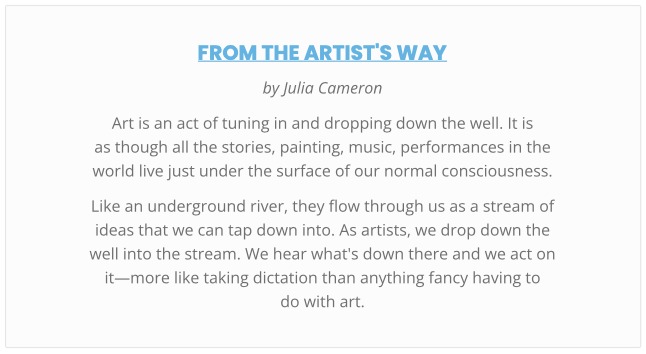
FROM THE ARTIST’S WAY
All too often, we become blocked and blame it on our lack of money. This is never an authentic block.
The actual block is our feeling of constriction, our sense of powerlessness.
Art requires us to empower ourselves with choice.
At the most basic level, this means choosing to do self-care.
by Julia Cameron
Authentic Luxury
We don’t have to book a 5 star hotel or buy the a $300 bottle of wine to get a sense of luxury.
We can take a mundane task and turn it into a moment of luxury.
Instead of rushing through your daily shower, bring a blue-tooth speaker and a scented candle with you.
It is surprising how adding a few more sensory delights transforms mindless routines into a luxurious experience. (You will probably get some great ideas too. Great ideas always pop up in the shower).
Or, try this—next time you’re at the store, buy one small thing for yourself that isn’t on your shopping list. Nothing practical or needed. Pick out something out of the ordinary and frivolous.
A while back, I bought a wine-colored wool fedora. Not practical in scorching Panama, but I like owning it, and it could be used for a future author photo.
Before that, I ordered two Klimt prints for my office from Great Big Canvas. I can’t tell you how luxurious and inspiring it is to write surrounded by my favorite fine art.
There are endless things you can order online purely for your own pleasure.
Ship them to your home, and it’s like receiving a gift from yourself. How thoughtful of you!
Your turn to luxuriate
You can create a sense of creative abundance all around you by becoming intentional about how you shape your experience.
Treat your life as a work of art. Get creative.
What would your weekend look like if you could design it?
Because you can.
Let’s do it right now.
CREATIVE LUXURY CHALLENGE
For this coming weekend, write a list of 10 things you could do to feel luxurious, like …
Order a fancy fountain pen.
Buy yourself a bouquet of roses.
Order new athletic gear.
Luxuriate in an afternoon of unstructured time.
Go out for a gourmet gelato.
Pick one or more items and enjoy.
Work your way down your list in the coming weeks.
Would you like to join us for more exercises like these? Treat yourself to becoming a better writer. Sign up here!