Welcome to Cosmic Ink, a blog series with bits of fuel for a stellar creative life.
There are times when life goes according to plan, and everything I have scheduled falls into place. But, in recent years, this is steadily becoming a rare event.
I keep waiting for the space-time continuum to open up for me, a future when I can dedicate a solid scheduled block of time to work on the projects in my head, but conditions are not improving. And instead of getting little done, I’m getting absolutely nothing done.
Having a clear vision of what we want to create, why we want to create it, and a plan to accomplish this is the most fundamental part of making the untold stories in our heads a reality in the physical world. However, we must not toss the whole dream aside whenever things get hectic.
Creating is our life blood. It’s what keeps our fires alive. It gives our lives meaning.
It’s not always something that can be slotted in like a dental appointment, and it should not be treated as such. It is far more important than that.
So during those days when you feel you “don’t have the time” or have the perfect conditions, remind yourself that you don’t have time not to.
You can find twenty minutes, I assure you.
Do it. It’s not just for your benefit, but for everyone’s.
(I am writing this pep talk for myself as well as you guys)
Writing is a creative activity—an art—and art is largely an intuitive process. We rarely get down to the bones of planning our writing lives. But if you don’t create a map to your vision as a successful author, you’ll be easily distracted.
I know this happens to me. If I have free time (if that ever happens) it usually gets filled with anything besides writing—even laundry or dishes or my dog’s insistence of going in and out every five minutes. There’s always something.
Furthermore, books are a product. We must think about actually selling the books we write. I, for one, have published books and then just let them sit there. We don’t like to approach writing like a business. It almost takes the magic out of it, crushing the romantic idea that intuitive creative geniuses cannot be bothered with all the drudgery. Don’t readers magically appear? If you write it, they will come. Right?
It rarely works like that. If you read my post on the lottery mindset, you will know it’s extremely rare that a book “goes viral” on its own.
So, you must not only have a clear vision of your best life as a writer, but also outline a detailed plan. Otherwise, you’ll find yourself drifting without making any actual progress toward that vision. An Author Plan is going to be your best weapon against distraction, procrastination, and those days when you’re just feeling “meh.”
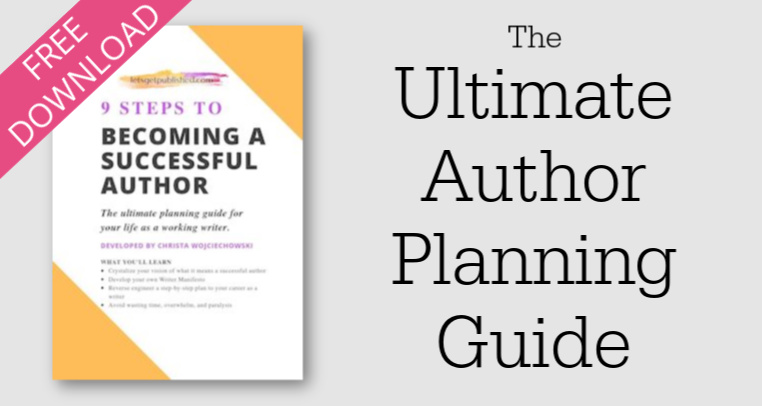
First, grab the Author Planning workbook. You can either print it out or grab a sheet of paper. I recommended writing by hand as opposed to typing or dictating into a device. There’s something about pressing pen to paper that activates your creativity, especially when casting intentions into the future.
What we’ll do:
Sketch out a map for five years into the future. This is wide in scope. Dare yourself to push the limits of what you think you can do (but remember to be realistic).
Next, dial down to one year in the future. What do you want to accomplish in the next 12 months?
After that, you will break these tasks down into quarterly goals, monthly goals, weekly goals, and determine what you will do daily.
What’s included in your author plan?
Everything. You will include your writing time and place, your word count or time limit. You will want to set aside time for rewrites and edits, for submissions and deadlines for the magazines, publishers, agents, and even contests you want to submit to.
You must schedule your marketing, blogging, publicity, and social media time. I always “squeezed” marketing and publicity in when “I had free time,” and I got lousy, sporadic results (of course, because I never had free time). You need to keep up with content, social media, email, and publicity consistently to get anywhere.
You will also desperately need time that’s unstructured to browse the internet for research, collect story ideas, and fill your creative well. For me, this includes reading others’ books or exploring other artists’ music. Maybe you want to go to the movies alone or try something weird. Plan an artist date, connect to the source, summon the muses, figure out a way to nourish the mysterious subconscious part that we write from.
Here are 10 areas to consider as you map out your year:
1. Define your writing schedule. Choose your time and place to plan. Stick to it. Set your time window or your word count. Systemize the routine so it become as automatic as brushing your teeth. This will train your brain to turn on for writing at that time of day.
2. Think about your reader and genre. Consult your manifesto from the Author Planning workbook. This is going to as be crucial to marketing efforts as developing your story. Who is your reader? What are you hoping to accomplish with your work? Why do you want to do this? You might even want to develop a reader persona. It’s like creating a character for a book. Who is this person or people, and how are you going to reach them?
3. Design and audit your author platform according to your reader. Where are they on the internet? Where are they on social media? What are they talking about? What are they doing? What causes do they care about? If you haven’t started seriously building your author platform, which is your website, your social media, your email list, and lead capture, you need to incorporate that into your plans for the year. Even if you’re not published yet, at least get the base established so that it’s there when you want to pitch to agents. If you already have an author platform, is what you’re doing bringing results? Audit periodically and make sure you’re still on track. (Download the Author Platform checklist here).
4. Make a list of your blog and newsletter topics for the next quarter. Brainstorm a list or make a mind map of topics you could possibly cover.
5. Think about your social media strategy. How many times a day or week will you post to Facebook, Instagram, or Twitter? I recommend not spreading yourself too thin. Pick one or two networks to be present on and just make sure you’re there consistently.
6. Plan book publicity.This is something you should be actively doing if you have books out. In my personal experience, my sales always go up when I’m doing guest posts, author interviews, pitching for reviews, and actively promoting the book.
7. Build a backlog of short stories. Even if you’re a novelist, writing short stories is an effective way to build your credibility. Not only does it expose you to readers in your genre, but it also gives you some cred so that when you pitch to a big publisher or agent, you’ve got published work to show. Find magazines, fanzines that cater to your reader, and seek out anthologies to submit to. Think about how many short stories you want to write this year. Realistically, how long will it take to complete them? For instance, I can write a short story quickly, but by the time I rewrite and edit, it can be months. On the other hand, I know people who write short stories every week. Then look, where can you write or fit your short story writing into your writing schedule? That little slot of time that we had already designated earlier.
9. Work on your novels if you’re a novelist. Think about the novel/novels you want to write in the next 12 months. What novel ideas are keeping you awake at night? Those are the ones that just spill out and the ones that you obsess over are usually more intense and impactful than ones you’re writing for profit. Having a mission with a story will make it flow easier, you’ll be more productive, and your writing will be better. Set a finish date. You might not keep it, but it will be there in the back of your mind when you’re writing. You need to have an editor to work closely with. If you don’t have one yet, you might want to try a few out with your short stories and see which one does the best job, making your writing better, cleaner, and more concise without taking away from your voice. Then polish your manuscript to perfection and get ready for the self-publishing or submission process.
10. Commit to an ongoing publicity strategy. While you’re waiting for responses on your submissions or for your self-published book, you are going to want to think about how you’re going to promote the new release. As I just said, are you going to pitch to podcasts, do guest posts, blog tours, book reviews, local news, and radio?
In the next post, we will discuss analyzing your results and retooling for the best outcomes.
The objective here is to make sure you always have something planned to do to avoid wasting time, becoming overwhelmed, becoming paralyzed. At the same time, hold your plan loosely. Adjustments will need to be made. Don’t be too hard on yourself if you fall off schedule. You have your writer’s manifesto, your vision. You have your plan. Nothing can hold you back …. except yourself.
“OMG. What if this all works out?”
Now that you’ve crystalized this vision and the path to it, it seems possible, even inevitable that you will achieve what you’ve written here. You might wonder if you will be able to rise up to meet it.
All the planning in the world won’t help if you have blocks against success.
Before executing your plan, ask yourself how you feel when you think of success?
Have you ever asked yourself this question and truly answered it?
This is important to define for yourself, the quality of your work. The past few years have been filled with chaos, fear, and upheaval. As things normalize, it’s the perfect time to let the dust settle and get laser-like focus on why you write and how you’re going to get your words into the world.
It’s not easy to be an aspiring writer. Just tell someone you want to become a successful fiction author and their reaction will be something like:
Laughs awkwardly until they realize you’re serious.Shows concern about your mental healthSays, “Really? Uhhh… Good luck with that.”
It’s the same look adults gave you when you were six years old and you told them you wanted to grow up to be a pegasus.
That’s because writing fiction is a time and energy-intensive pursuit that never guarantees a big material reward.
As a marketing strategist for authors, I see many writers approaching their writing career with a “lottery mindset.” They scribble out a book, feverishly upload it to Amazon, and wait for overnight success.
When they don’t wake up on the bestsellers list, they give up.
This the paradox:
Only by NOT writing for money or fame will you possibly become a successful author because once you begin writing for sales, your words will lose their magic.
You must have a deeper reason than to become wealthy and famous. You need to think about who you’re writing for and how you want them to think and feel after reading your work. Either that, or writing must be so satisfying for you that it is its own reward.
Maybe you write because it’s therapeutic, allowing you to express yourself and make meaning of your experiences. Maybe you want to make people laugh and forget their worries. Maybe you just want to scare the hell out of them.
Whatever the reason, I suggest you create your own writing manifesto that states your big-picture reason for writing. Rewrite it till it’s powerful and succinct. Read it each day before you begin working on your stories. Click here for an example of how powerful a writing manifesto can be.
Not only will a writing manifesto help you on the hard days when nothing is working, keeping your mission in mind will inspire you to produce stories that will impact your readers and the world.
Have you ever asked yourself this question and truly answered it?
This is important to define for yourself, the quality of your work. 2020 was a year of chaos, fear, and upheaval. As we begin the new year, it’s the perfect time to let the dust settle and get laser-like focus on why you write and how you’re going to get your words into the world.
It’s not easy to be an aspiring writer. Just tell someone you want to become a successful fiction author and their reaction will be something like:
Laughs awkwardly until they realize you’re serious.
Shows concern about your mental health
Says, “Really? Uhhh… Good luck with that.”
It’s the same look adults gave you when you were six years old and you told them you wanted to be an a pegasus when you grew up.
That’s because writing fiction is a time and energy-intensive pursuit that never guarantees a big material reward.
As a marketing strategist for authors, I see many writers approaching their writing career with a “lottery mindset.” They scribble out a book, feverishly upload it to Amazon, and wait for overnight success.
When they don’t wake up on the bestsellers list, they give up.
This the paradox:
Only by NOT writing for money or fame will you possibly become a successful author because once you begin writing for sales, your words will lose heart.
You must have a bigger reason than to become wealthy and famous. You need to think about who you’re writing for and how you want them to think and feel after reading your work. Either that, or writing must be so satisfying for you that it is its own reward.
Maybe you write because it’s therapeutic, allowing you to express yourself and make meaning of your experiences. Maybe you want to make people laugh and forget their worries. Maybe you just want to scare the hell out of them.
Not only will a writing manifesto help you on the hard days when nothing is working, keeping your mission in mind will inspire you to produce stories that will impact your readers and the world.
You got this!
Create your Writing Manifesto!
Join us for the Ultimate Author Planning Workshop in the Writers’ Mastermind.
Develop your own powerful Writer Manifesto.
Crystalize your vision of what it means to be a successful author.
Reverse engineer a step-by-step plan to your career as a fiction writer.
Avoid wasting time, overwhelm, procrastination, and paralysis.