An appositive is a modifier. It’s a noun or noun phrase that immediately follows another noun or noun phrase to further define it. You probably use appositives all the time without even realizing it. But are you punctuating them correctly?
Why am I devoting a blog to appositives? I’m so glad you asked!
Learning how to punctuate appositives—most often done with commas but sometimes with parentheses—isn’t difficult, but I see incorrect examples almost every day. The sad thing is that so many of this common appositive punctuation mistakes show up in Amazon book descriptions, websites, book reviews, and pretty much anywhere you find the written word.
So let’s review definitions, and then I’ll show you how easy it is to correctly punctuate whenever you use an appositive in your writing.
What Is an Appositive?
As a reminder, an appositive is a noun or noun phrase that provides additional information. Like other types of modifiers, an appositive can be essential (restrictive) or nonessential (nonrestrictive) to the sentence. Removing an essential modifier may cause confusion, but removing a nonessential one still leaves most of the meaning intact.
Essential: My cockatoo Snowflake attacked my computer.
Nonessential: My cockatoo, Snowflake, attacked my computer.
Snowflake’s handiwork the day she decided I was working too much.Snowflake the Cockatoo
What’s the difference, and why does it matter?
If I had more than one cockatoo, I wouldn’t use a comma—I’d want to make it clear that I’m discussing Snowflake and not another bird. I’m specifically throwing “Snowflake” under the bus (she deserves it, don’t you think?). If I delete her name (the essential modifier), I remove the clue that tells you which bird was the culprit, so I could be referring to one of several birds.
The second example is the one I personally would use because I only have one cockatoo, and her name is Snowflake. If I delete the appositive (her name), which is a nonessential modifier, you still know my only pet cockatoo created some trouble.
A good test is to use names of people you know. In this example, the writer has two daughters, so which example is correct?
My daughter Mary is ten years old
My daughter, Mary, is ten years old.
Answer: the first. The writer has another daughter, so removing the essential phrase in the second example creates confusion: “My daughter is ten years old” … but which daughter?
Appositives and Titles
The same principle applies when a proper name follows a descriptive title.
“Freelance editor, Candace Johnson, is writing this blog” is incorrect. Why? Remove my name and the sentence is confusing. No commas needed here: “Freelance editor Candace Johnson” is the noun phrase that is the subject of this sentence.
“Candace Johnson, freelance editor, is writing this blog” is correctly punctuated because “freelance editor” is not essential to the sentence’s meaning.
Here’s another example taken from something I read recently:
“The science fiction author, Philip Dick, may have said it best.”
You see the problem, right? By removing what the writer thought was an appositive (Philip Dick’s name), the sentence makes no sense. Correctly punctuated, this sentence should read,
“The science fiction author Philip Dick may have said it best.”
How to Avoid Appositive Confusion
When you’re writing an appositive noun or phrase, always ask yourself if removing the information between the commas creates confusion.
Remember: if a word or phrase is essential or restrictive, meaning that it provides essential information about the noun or noun phrase it refers to, don’t use commas.
QUIZ
Now it’s your turn: which of the following sentences are correctly punctuated?
Thanks to my fiancé Mark Jones for his support while I wrote this book. (She has not been previously engaged.)
Actress Kate Hudson recalled one of her favorite memories from giving birth to her son, Bingham. (She has two sons.)
Speaker, author, and consultant, Mary Smith, is revolutionizing hair care.
My favorite pie, cherry, is out of stock.
Answers:
Mark Jones is the writers only fiancé, so use commas before and after his name.
Kate Hudson has two sons, so no comma.
Mary Smith is a speaker, author, and consultant, so no commas before or after her name (but the Oxford commas after “speaker” and “author” are correct).
My favorite pie is out of stock whether I name it or not, so use commas.
Do you have questions about the correct way to punctuate an appositive, perhaps in your book’s acknowledgments or in a blog? Please post them in the comments, and let’s work together to make your writing shine.
Happy Writing, Candace
Candace Johnson is a professional freelance editor, proofreader, writer, and writing coach for fiction and nonfiction. She works with traditional publishers, self-published authors, and independent book packagers. As an editorial specialist, Candace is passionate about offering her clients the opportunity to take their work to the next level. Learn more at her website https://changeitupediting.com, and follow her on Facebook, Twitter, and LinkedIn.
Look forward to Candace Johnson’s upcoming class in the Writers’ Mastermind
I know how you’re feeling. You’re afraid to look at it. You’re afraid you won’t know how to fix it.
That draft. Yep, it’s a mess.
Plot holes, limp dialogue, caricatures instead of characters, and a shallow theme that plays like a bad soundtrack throughout the story.
This is impossible to fix, you think. You avoid it like it’s your snide mother-in-law, a Jehovah’s Witness at the door, or that colonoscopy you’re supposed to schedule.
Yes, your story could be bad. Maybe it sucks.
But is it beyond redemption?
No story is beyond redemption. “Drafts” (notice the word is plural) are called drafts for a reason. You will have multiple iterations of the same story. Accept it as part of the process. No one writes a perfect book the first time.
Instead of dreading your crude first draft, get excited about watching its evolution. Dig through your words and find the little pockets of goodness inside. Expand on them.
Stay curious. Ask your characters questions. Write down the millions of possibilities for them.
Read your draft over and over again (no matter how much it hurts) until something sparks against the flint of your mind. Sit quietly. Clear the inner badgering and follow your gut instincts.
Have you ever asked yourself this question and truly answered it?
This is important to define for yourself, the quality of your work. The past few years have been filled with chaos, fear, and upheaval. As things normalize, it’s the perfect time to let the dust settle and get laser-like focus on why you write and how you’re going to get your words into the world.
It’s not easy to be an aspiring writer. Just tell someone you want to become a successful fiction author and their reaction will be something like:
Laughs awkwardly until they realize you’re serious.Shows concern about your mental healthSays, “Really? Uhhh… Good luck with that.”
It’s the same look adults gave you when you were six years old and you told them you wanted to grow up to be a pegasus.
That’s because writing fiction is a time and energy-intensive pursuit that never guarantees a big material reward.
As a marketing strategist for authors, I see many writers approaching their writing career with a “lottery mindset.” They scribble out a book, feverishly upload it to Amazon, and wait for overnight success.
When they don’t wake up on the bestsellers list, they give up.
This the paradox:
Only by NOT writing for money or fame will you possibly become a successful author because once you begin writing for sales, your words will lose their magic.
You must have a deeper reason than to become wealthy and famous. You need to think about who you’re writing for and how you want them to think and feel after reading your work. Either that, or writing must be so satisfying for you that it is its own reward.
Maybe you write because it’s therapeutic, allowing you to express yourself and make meaning of your experiences. Maybe you want to make people laugh and forget their worries. Maybe you just want to scare the hell out of them.
Whatever the reason, I suggest you create your own writing manifesto that states your big-picture reason for writing. Rewrite it till it’s powerful and succinct. Read it each day before you begin working on your stories. Click here for an example of how powerful a writing manifesto can be.
Not only will a writing manifesto help you on the hard days when nothing is working, keeping your mission in mind will inspire you to produce stories that will impact your readers and the world.
I love to watch virtuosos on YouTube — pianists, violinists, dancers, and singers that seem to have supernatural abilities. They make their performances look effortless, but no one sees what it took for them to reach that level of mastery.
What about the hours of practice, the hundreds of times they got it wrong, and how they pushed forward despite the criticism? We don’t realize everything they sacrificed — family, friends, sleep, and fun — to become what they are. They remind me of the investment I need to make to become the best writer I can be.
Until recently, I’ve been a self-taught writer. I always thought that if I read enough books, followed enough writing blogs, and kept working hard, that I would get better. I did get better, a little bit at a time. Still, I sensed I was missing something.
I couldn’t put my finger on it, but the lackluster sales and rejection letters reaffirmed my suspicion. The feedback from family and friends said everything I did was great. So why was I stuck?
I figured what was needed was more effort. I wouldn’t become better just by wishing, right?
But working harder is not the answer.
As I browsed virtuoso videos, the algorithms directed me to a TEDx Talk, Become a Virtuoso by Mike Rayburn. I wasn’t planning to watch a Ted Talk, but of course I wanted to see if I could find out the secret not to becoming a good writer, but to becoming a writing virtuoso.
Mike Rayburn talked about how most of us coast, learning at a leisurely pace. We don’t actively seek out the most effective and efficient ways to develop our talent, so we hit a plateau and never discover what we’re truly capable of. It’s up to us to make the decision go beyond being competent to becoming the best.
Many of us pride ourselves on being self-taught. I always did. I thought I was making good progress, but what Mr. Rayburn says next was a bitter epiphany.
Here’s the problem about being self-taught: The teacher’s not that good.
Drop the mic right there. Would I presume to teach someone else how to become a virtuoso writer? What makes me think I’m qualified to teach myself how to become one?
The secret is, when you discover the stories of virtuosos, these geniuses didn’t do it alone. They had the best teachers and mentors to give them invaluable feedback and advice. This is what fast-tracked them to mastery, building a foundation on what’s already been done while cultivating the unique style that is each great artist’s signature.
It’s only after taking my first writing class that I’ve realized how much time I’ve wasted “teaching” myself. How would I know how to develop my strengths and work on my weaknesses when relying on feedback from everyday people who don’t even read in my genre? I’ve learned more in the past 2 months than in 7 years of struggling on my own.
My message to self-taught writers is this:
Invest in your dream. Seek out mentors. Budget for writing classes — online or in your local area. Find a tribe of knowledgeable writers in your genre.
You will be amazed at how quickly you improve, how confident you will feel, and how hopeful you’ll be about your future as a successful author.
Don’t waste another minute going it alone. You have no idea what a writing virtuoso you could be.
How to find beta readers? It’s crucial for every writer to get honest and useful feedback, but it’s difficult to find beta readers outside of family and friends.
Today, we talk to Matt Brindley from fresh.ink, an exciting new platform that will match writers with unbiased beta readers. It will not only allow them to receive feedback, but also provide detailed analytics.
Ahead of its launch, fresh.ink is hosting a writing contest. $7,500 in prizes are available across 4 fiction categories: short story, novelette, novella, and novel. This contest is live.
Fresh.ink is also launching a digital literary magazine which will feature the best work across the platform and reprints from previously published literary works. All authors will be paid for their submissions.
This means writers can upload a story or novel for feedback, enter it into the writing contest, and possibly get published in the magazine all in one submission.
Read on to learn more about this amazing new tool for authors!
Whether an author plans to publish in a literary magazine, self-publish or traditionally publish, we envision fresh.ink as the connector between authors and agents, publishers and editors.
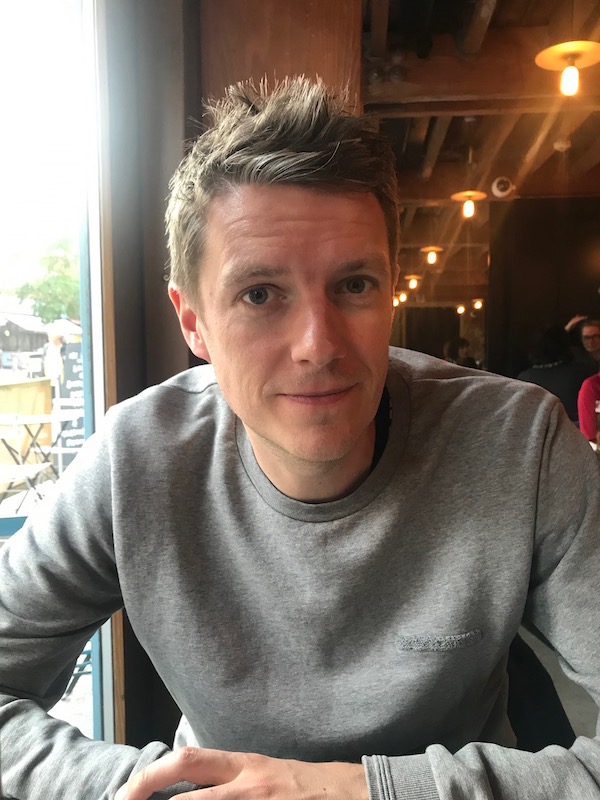
Interview with Matt Brindley, founder of fresh.ink
Tell us about yourself, Matt. You’re a product and software developer. What made you decide to make the transition to the publishing world?
The idea for fresh.ink was the result of many experiences and conversations over several years. I was first exposed to the writing world and the challenges writers and publishers alike face via my wife, Mary, who is a writer and editor.
While researching and evolving this idea, I met some brilliant people who were very generous with their time. One London-based editor took me to see her company’s office in a converted Victorian house. It was a beautiful building with a grand staircase, books lining every wall. She talked enthusiastically but realistically about working in the industry, the challenges and frustrations, the wins that made it all worthwhile, and the joy of reading. Another advisor, a literary agent, spoke of her passion for reading, of discovering authors, and her reasons for switching roles (she had recently moved from a senior editor position at Macmillan). Their passion was infectious!
I also had the opportunity to speak about the project with an author who had published a number of books with Hachette and was working on her latest novel. She walked me through her story of how she first found an agent, the ins and outs of working with a publisher and the feeling of seeing her book advertised on the subway for the first time.
I have a lot of respect for the publishing industry, for the decades of work it takes to succeed in it, but I was intrigued by the ways in which technology could be used to complement both traditional publishing and self-published authors. Writing great software is about empowering others with just the right amount of technology to improve their lives. I’m very excited that we’ve found a way to strike that balance here and genuinely help authors, agents and publishers.
I wish I had the skills and patience to write! I’m much more comfortable in a code editor than a word processor.
You love a good book, who are your favorite authors?
We Brits love a good murder mystery, so I’d be remiss not to mention the Agatha Christie books I grew up reading. More recently I’ve been reading through everything Ruth Ware has written, Anthony Horowitz’s Magpie Murders and The 7½ Deaths of Evelyn Hardcastle by Stuart Turton.
On those occasions I fancy fiction where the protagonist isn’t solving a whodunnit, I enjoy a pretty wide range of genres. I recently enjoyed reading Red Clocks (Leni Zumas), Goodnight Stranger (Miciah Bay Gault), Where the Crawdads Sing (Delia Owens) and Less (Andrew Sean Greer).
What gave you the idea to help writers with feedback on fresh.ink?
I’d like to claim it was a brilliant idea of mine that came in a eureka moment, but in reality, the idea was formed over many interviews, much research, and ongoing involvement in online writing communities. I was keen to contribute to the literary world, but the idea took multiple years to fully shape, and will continue to evolve.
How does the platform work for authors?
Authors submit their fiction (of any length) to fresh.ink. It should be a final draft, free of typos and mistakes and ready for beta readers.
If a story is accepted, we analyze it to match it to readers who we think we’ll enjoy it to give it the best chance of being well-received. Readers can only see stories they’ve been matched with, otherwise work remains private.
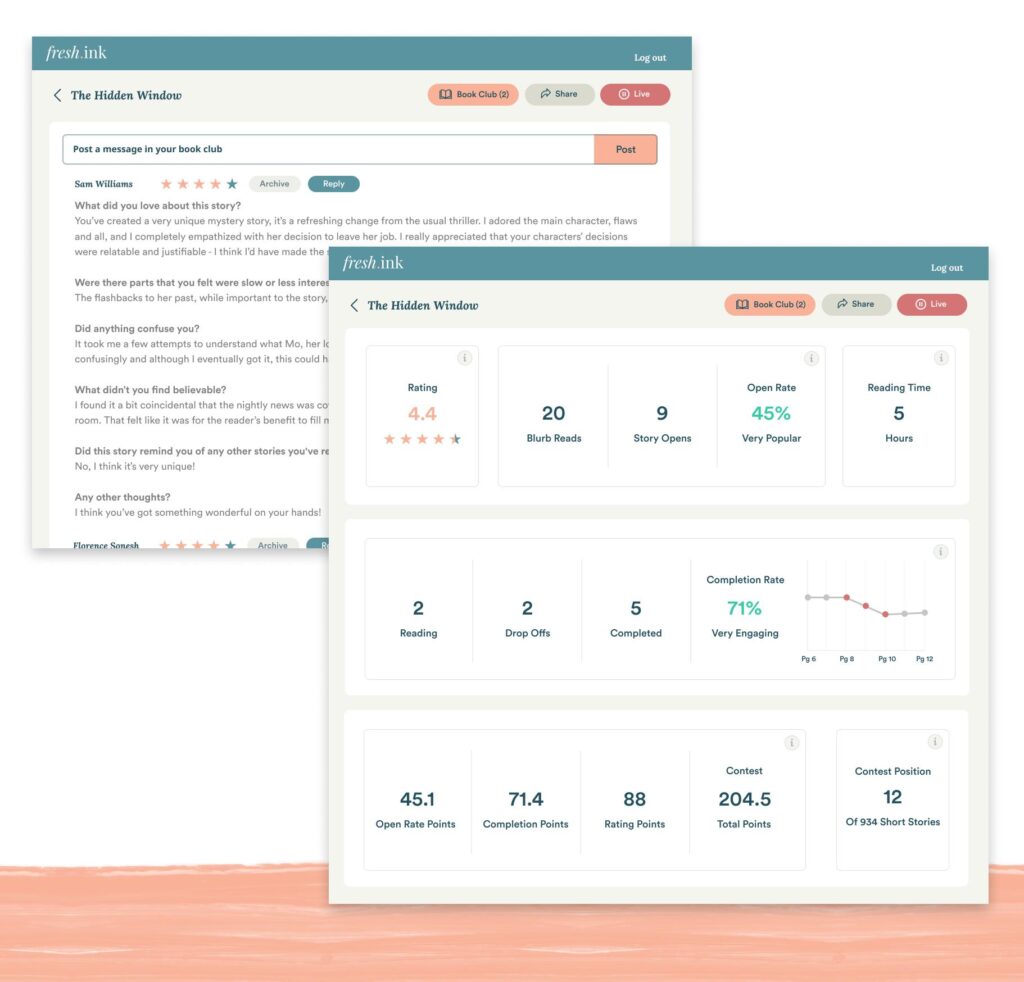
Once reading starts, authors receive detailed analytics on open rates, if and where readers drop off, and ratings. Much like test screenings in film and television, understanding a reader’s behavior can be hugely beneficial in understanding how to improve a story. Readers will also answer more detailed questions about what they liked and what they think could be worked on, as well as join a book club with the author for further discussion and commentary.
Preview of fresh.ink’s story dashboard
How does one become a beta reader on fresh.ink?
We’re aiming to open up to beta readers in mid-October, so sign up for the waiting list at https://fresh.ink/#readers now to be first in line!
Tell us more about fresh.ink magazine and the fresh.ink app.
Our reader app has two sections: reader matching and our premium section, fresh.ink magazine, of which Mary is the editor. At launch, fresh.ink magazine will feature hand-picked writing from around the world. After our contest concludes, the magazine will begin including the best work that has come through fresh.ink’s matching service. All authors who are invited and agree to be featured in our magazine are paid, either via payment upfront or via revenue-sharing.
When is the official launch date?
We’re open to author submissions now, and readers will be invited in mid-October 2019. Not long now!
What is the future vision for fresh.ink?
Our vision is to create the de facto process for getting great writing out into the world.
Publishing is a tough business, especially for smaller houses and literary magazines. We want to support them all and help them thrive, either by matching them with proven writing or providing additional readers for their own content.
Whether an author plans to publish in a literary magazine, self-publish or traditionally publish, we envision fresh.ink as the connector between authors and agents, publishers and editors.