Earlier this year, I was at Authorcon VI in Williamsburg and fortunate enough to share a table with one of my dearest friends and most admired writers of all time, Joseph Sale. Near the end of the convention, I decided to make my rounds and pick up a few books from authors unknown to me. As I returned to the table with haul, I showed Joseph my choices.
“I hope they’re good,” I said.
“Easy to tell,” Joseph said. “Did they pass the first line test?”
“What’s that?”
“I can tell if a book is going to be for me by reading the first line.”
I stood there a bit dumbfounded. So simple, and yet, I had not thought to open the books and read a few lines before buying.
So I looked at the first lines of the novels I’d purchased. Luckily, they were pretty good.
But what if they hadn’t been? What if I had spent money on them, opened them up, and immediately wanted to put them down?
And, then I thought … what if someone put my novels through the first line test?
My books happened to be stacked in front of me on display. I picked up each one and read the first lines.
For the most part, I was underwhelmed. They weren’t bad, but would they compel a person to read the whole book from just one sentence?
I wasn’t going to lie to myself—the answer was no. If I were a stranger, and read the first lines from a list books, mine would not be the must-reads out of the bunch.
That being said, I had written those books before I had ever taken a writing class. I didn’t think strategically about the first page. I didn’t understand why agents and publishers only wanted a few pages, or a few chapters. How could they tell if a story was any good without reading the whole thing?
Then in 2023, I had the amazing experience of working for Gamut, a speculative fiction magazine. As part of the editing staff, I learned from the other side of the game how crucial a good opening was.
I had to read 150 short stories per month, every month. If the first line wasn’t great, I would give the first paragraph a chance. If the first paragraph didn’t get me, I might read the whole page. If at the end of page one, the main character is still waking up and eating breakfast, it was a no go.
This is what I learned from my colleagues—if I started reading a story and didn’t feel like continuing, it meant our magazine subscribers wouldn’t either, and that would be the end of the publication.
A good opening doesn’t necessarily have to start off with an explosive scene, but it does have to have a hook. It can be a deftly crafted one-liner, but it also can be an extremely engaging character, a concept I haven’t encountered before, a dilemma that I can relate to. Even a slow burn can build enough tension and suspense to make a story impossible to put down. A seemingly benign beginning with just the right amount of foreshadowing will tip us off that something unsavory is about to go down.
As an editor, there were times I read through stories with sluggish beginnings because of a hint that it might become something greater. And often, lackluster openers ended up being a great story. But that doesn’t matter if no one finishes it.
Many readers won’t wait to see if a book gets better. Agents and publishers simply can’t afford to invest the time and money. If an author fails to get the story off the ground effectively, it will more than likely have to be rejected.
You don’t have to let this happen to your stories.
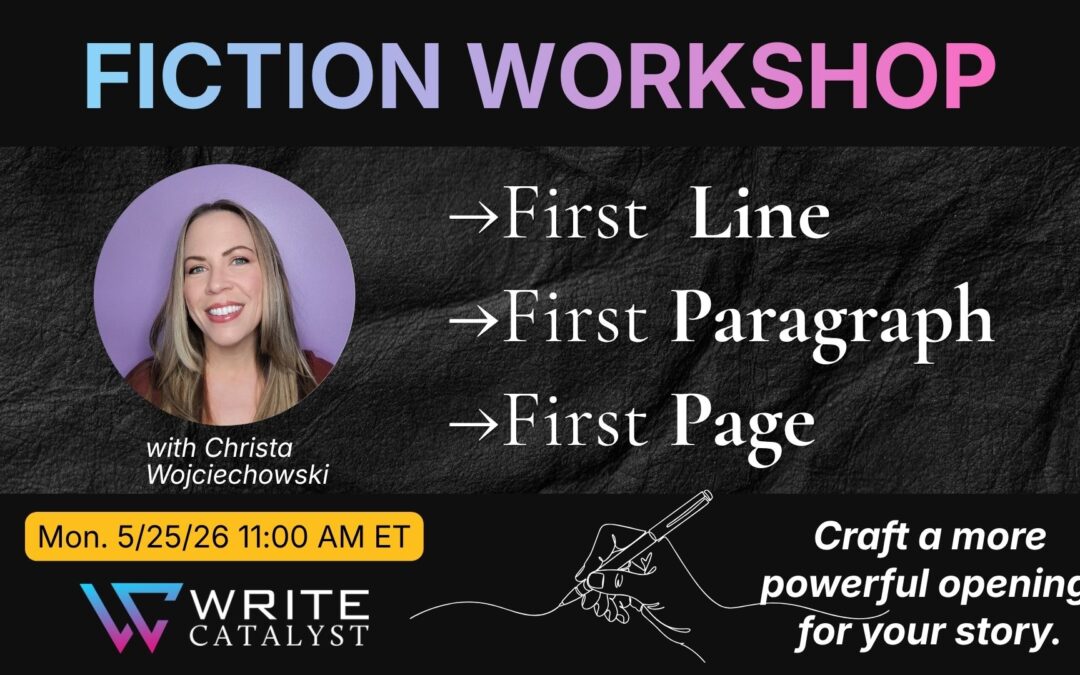
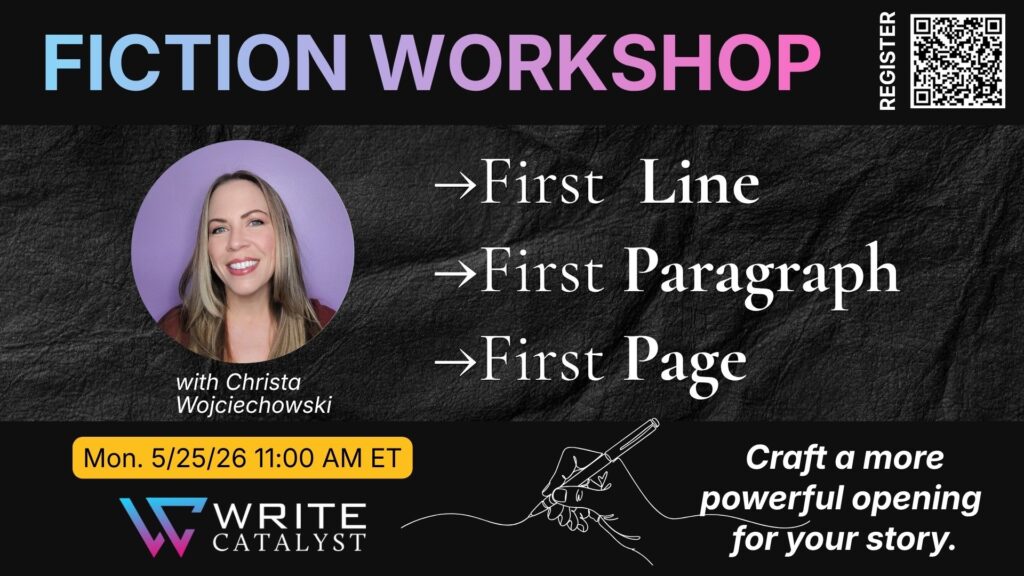
The First Line, First Paragraph, First Page Workshop
In the 1st Line, 1st Paragraph, 1st Page Workshop, each student will bring the first page of one story, novel, or work-in-progress to be shared and critiqued by the group. We will analyze the first line, then open up to the first paragraph, and expand into the first page to see where we are hooked as readers and what it is that makes us want to turn the page. We will discuss the context of the whole story to see what might improve the appeal of its beginning.
So look through your stories (can be published or unpublished). Let’s see where the reader takes the bait.
Especially now, when it’s almost impossible to disconnect from work, to get space in our day for quiet, to have a moment where there is nothing left on the to-do list and we can allow our minds to reset.
Even if we do step out for a walk, or escape to a hotel for a writing binge, we always have our phones. Which means that every friend, family member, boss, client, and work colleague comes with us.
They often join us in the bathroom. Not to mention notifications from complete strangers on social media.
Just imagine what it would look like if all those people were physically there, crowding around you as you tried to write.
When was the last time you were truly alone? With no way for anyone or anything to intrude on your thoughts?
It’s easier to remove ourselves from real people than it is from our endless virtual networks.
I used to just muddle through. But as I’ve become more aware of how the overstimulation taxes my neurons, I’ve learned that it’s my responsibility to carve out time to step away, take a breath, and let the dust settle.
Only then am I still enough to hear my own creative intuition. I show up better for my writing, as well as for my work, family, and social life.
I’m sharing this because, honestly, I’m at critical mass. My family is wonderful, but this is a very active household, and with work and writing, it’s a lot. My job as a digital marketing specialist means I am online all day, every day.
I’ve learned the signs that I need a break— feeling impatient, frazzled, overwhelmed, and blocked. The brain drain is poison to creativity, and the stress influences everyone and everything around me. My experience with digital burn-out inspired my novella, Popsicle, where the effects of internet overload end up with extreme consequences.
So for the next two weeks, I’ve planned a sabbatical. I’ll be alone — well, not totally alone. I’ll be with dogs, which is honestly the best company. My trick is booking nearby getaways on a pet-sitting app. I get a place to myself, and the owner gets someone to spoil their furbabies. Win-win.
I know we can’t always take off and leave our responsibilities behind, but even micro-getaways help. You can hide in a quiet corner at the local library. Put on headphones and lock yourself in a closet. Go to a park and wander around without a purpose. Sometimes I get into my car and drive to a nearby parking lot just to be in silence.
The crucial thing is to turn off your phone. Leave it at home, if you can. Not only do notifications interrupt you, the mere anticipation of getting messages puts you in a constant low-level alert mode. This steals bandwidth from your creative potential.
Notice how it feels to remove the possibility of being interrupted—to release the urge to send pictures, check email, or Google whatever random question comes into your mind.
Yes, it’s an uneasy feeling to be untethered.
But it’s so incredibly freeing.
Now, I ask you—what could you do to plan a small pocket of solitude?
May the muse be with you,
—Christa
P.S. Speaking of things worth your time—our short story contest is open for submissions, and we’re now accepting nonfiction essays on writing and creativity for publication on this blog.
All the details are on our submissions page. We’d love to read your work.
We have run this contest twice before under our former brand, the Writers’ Mastermind at Let’s Get Published, where it was recognized by Kindlepreneur as one of the best writing contests to enter.
Both times, we were genuinely moved by what writers sent in. The quality of the stories, the range of voices, the courage it takes to put your work out there — it reminded me why we started this writing community in the first place.
This time, there are cash prizes on the table, plus publication on the Write Catalyst blog/newsletter and promotion to the whole community.
Here’s what you need to know:
SHORT STORY CONTEST 2026 PRIZES
— 1st Place: $150 cash or gift card + publication + 1-year Write Catalyst membership
— 2nd Place: $50 cash or gift card + publication + 1-year Write Catalyst membership
— 3rd Place: $25 cash or gift card + publication + 6-month Write Catalyst membership
(All placing stories receive mailing list and social media promotion)
SHORT STORY CONTEST 2026 DETAILS
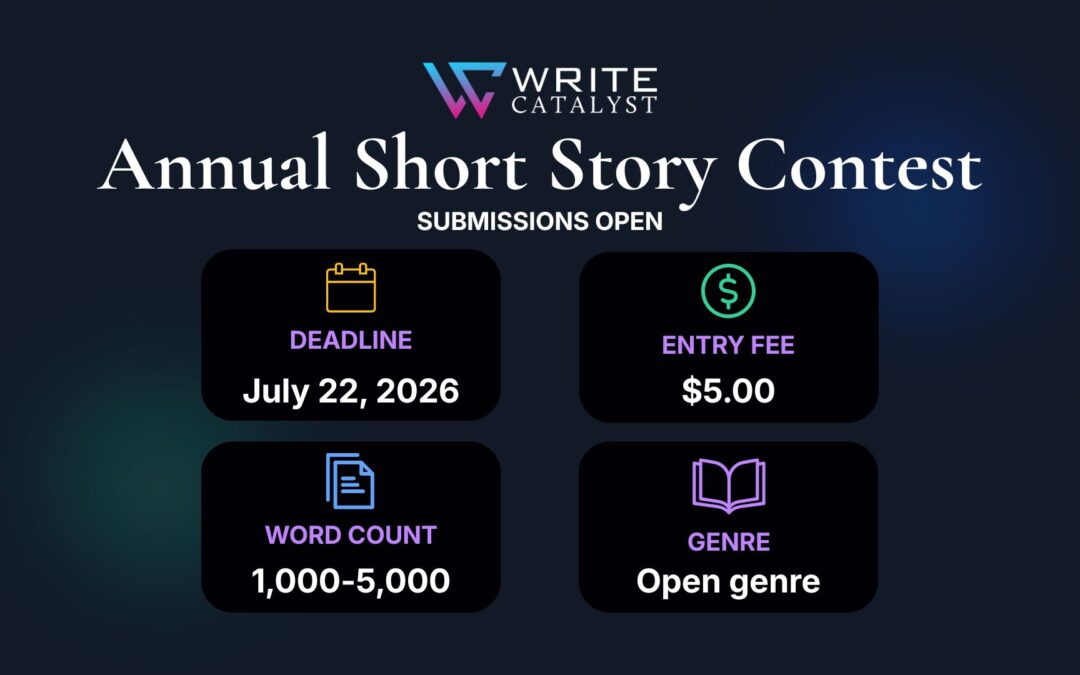
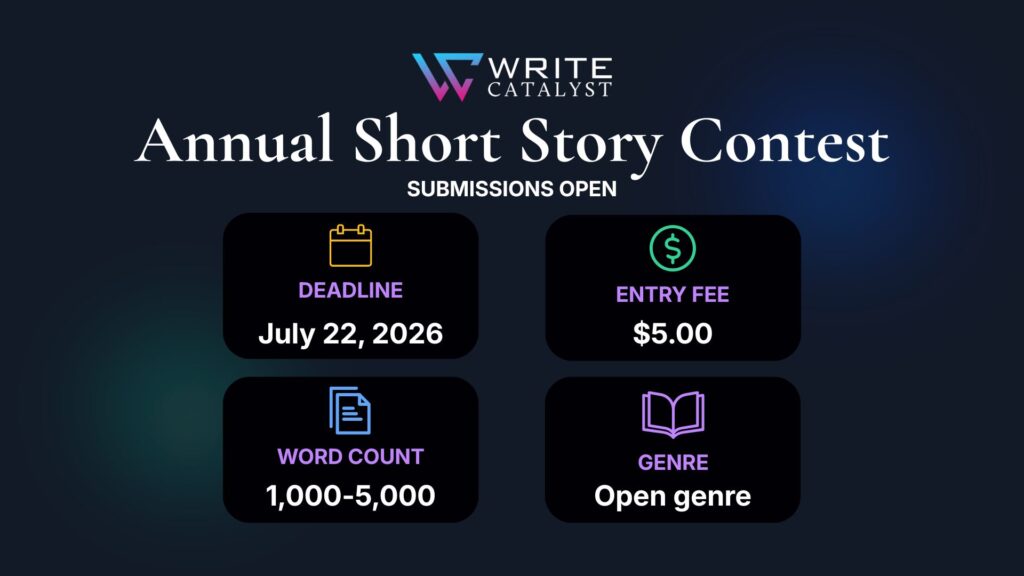
— Entry fee: $5 per story (multiple entries welcome)
— Word count: 1,000–5,000 words
— Genre: Open — write what you love (excluding extreme horror and gratuitous erotica)
— Format: 12pt font, double-spaced, 1-inch margins. Include word count on first page. No self-identifying info.
— Deadline: July 22, 2026 at 12:00 AM EDT
A panel of judges will evaluate each submission for plot, theme, structure, characterization, atmosphere, originality, prose, and overall impact.
Note: In the past, members of the Write Catalyst community were not permitted to enter our contests. I’m happy to announce that we have changed that this year as our new submissions system allows for blind reading (meaning we can’t see the name of the story’s author).
Members may now enter stories as long as their submission is not one they have shared with the group before (as in getting any type of feedback during a write-in, Facebook group, or privately via email) or has used any part of the story in one of our live reading events.
If you’ve been sitting on a story — half-finished in a drawer, waiting for the right moment — this is it.
To submit, just click the link and upload your story.