When we don’t purposefully and deliberately choose where to focus our energies and time, other people—our bosses, our colleagues, our clients, and even our families—will choose for us, and before long we’ll have lost sight of everything that is meaningful and important. We can either make our choices deliberately or allow other people’s agendas to control our lives.
Greg McKeown, Essentialism: The Disciplined Pursuit of Less
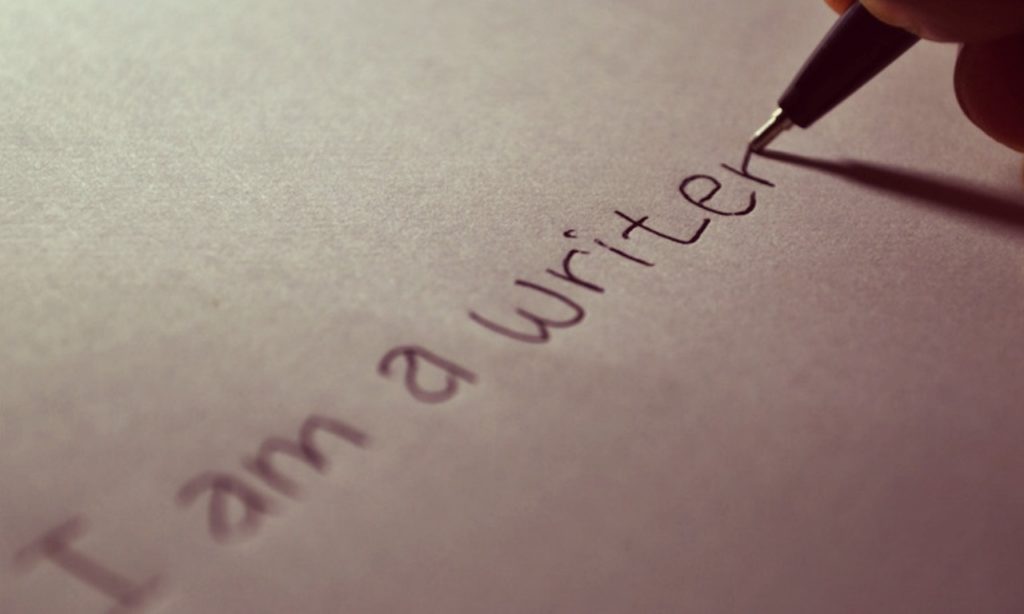
When it comes to becoming a successful author, planning is 200% more valuable than writing. I’m not talking about outlining your stories and novels before writing them. That is important too, but I’m talking about planning on both macro and micro levels to reach your big picture vision of your life as a writer. Without planning ahead, we get distracted, sidetracked, and stray off task.
Aspiring writers are especially susceptible to writer’s drift, a state when we feel like life always gets in the way of our writing. There are several reasons we allow this to happen on a conscious or subconscious level.
1. Because we don’t earn a steady paycheck from writing yet, so we can’t justify spending time and energy on it.
2. We usually don’t have writing deadlines, except those we impose on ourselves. When we fail to meet them, who cares? No one knows but us. We have no one to hold us accountable.
3. We don’t know exactly what to do next, leaving gaps to be filled with interruptions, distractions, or someone else’s priorities.
We’ll get up for a job we’re not crazy about. We rearrange our schedule for our kids or significant other. We even drag ourselves out to walk the dog no matter how tired we are.
But how often do we take a stand for our writing?
The first chunk of time to be sacrificed when some unforeseen issue comes up is our writing time. Writing time is vague and unconvincing. People don’t respect it. Even we’re not sure what it is we’re not getting done when we’re not able to write. So it’s easy to dismiss it as no big deal.
The one person we fail is ourselves. And we don’t realize the impact it makes on our wellbeing when we’re constantly letting ourselves down by pushing aside our heart’s dream.
What would happen if you treated your writing with the same priority as other aspects of your life?
And how do we put ourselves into position to do that?
How do we do it without feeling guilty or self-indulgent?
Planning out your writer’s path to the smallest details will keep you committed to your writing. This means breaking things up in 5-year, 1-year, quarterly, weekly, and daily goals.
It’s not about finding time to write. It’s about making time to write.
Making sure you always have something scheduled to do next will ensure that you avoid wasting time, overwhelm, and paralysis. This will help you keep moving forward no matter what.
You’ll be able to ignore your fears and push past rejection. You’ll always be able to put one foot in front of the other by executing the next step in your plan.
Start Here
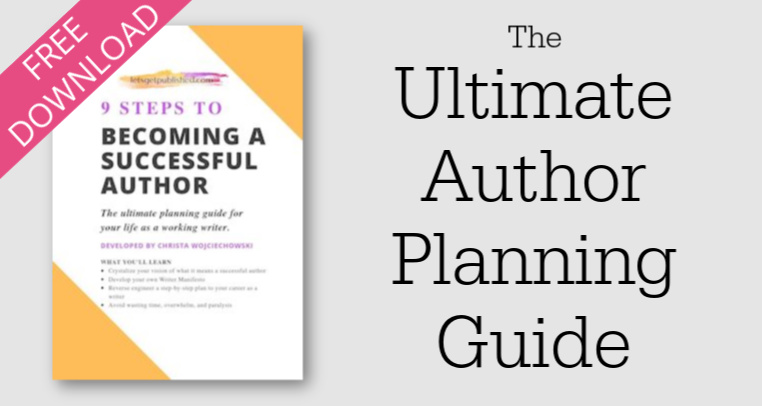
I’ve created a planning guide to avoid writer’s drift. You can download it for free using the link or form below.
How to find beta readers? It’s crucial for every writer to get honest and useful feedback, but it’s difficult to find beta readers outside of family and friends.
Today, we talk to Matt Brindley from fresh.ink, an exciting new platform that will match writers with unbiased beta readers. It will not only allow them to receive feedback, but also provide detailed analytics.
Ahead of its launch, fresh.ink is hosting a writing contest. $7,500 in prizes are available across 4 fiction categories: short story, novelette, novella, and novel. This contest is live.
Fresh.ink is also launching a digital literary magazine which will feature the best work across the platform and reprints from previously published literary works. All authors will be paid for their submissions.
This means writers can upload a story or novel for feedback, enter it into the writing contest, and possibly get published in the magazine all in one submission.
Read on to learn more about this amazing new tool for authors!
Whether an author plans to publish in a literary magazine, self-publish or traditionally publish, we envision fresh.ink as the connector between authors and agents, publishers and editors.
Interview with Matt Brindley, founder of fresh.ink
Tell us about yourself, Matt. You’re a product and software developer. What made you decide to make the transition to the publishing world?
The idea for fresh.ink was the result of many experiences and conversations over several years. I was first exposed to the writing world and the challenges writers and publishers alike face via my wife, Mary, who is a writer and editor.
While researching and evolving this idea, I met some brilliant people who were very generous with their time. One London-based editor took me to see her company’s office in a converted Victorian house. It was a beautiful building with a grand staircase, books lining every wall. She talked enthusiastically but realistically about working in the industry, the challenges and frustrations, the wins that made it all worthwhile, and the joy of reading. Another advisor, a literary agent, spoke of her passion for reading, of discovering authors, and her reasons for switching roles (she had recently moved from a senior editor position at Macmillan). Their passion was infectious!
I also had the opportunity to speak about the project with an author who had published a number of books with Hachette and was working on her latest novel. She walked me through her story of how she first found an agent, the ins and outs of working with a publisher and the feeling of seeing her book advertised on the subway for the first time.
I have a lot of respect for the publishing industry, for the decades of work it takes to succeed in it, but I was intrigued by the ways in which technology could be used to complement both traditional publishing and self-published authors. Writing great software is about empowering others with just the right amount of technology to improve their lives. I’m very excited that we’ve found a way to strike that balance here and genuinely help authors, agents and publishers.
I wish I had the skills and patience to write! I’m much more comfortable in a code editor than a word processor.
You love a good book, who are your favorite authors?
We Brits love a good murder mystery, so I’d be remiss not to mention the Agatha Christie books I grew up reading. More recently I’ve been reading through everything Ruth Ware has written, Anthony Horowitz’s Magpie Murders and The 7½ Deaths of Evelyn Hardcastle by Stuart Turton.
On those occasions I fancy fiction where the protagonist isn’t solving a whodunnit, I enjoy a pretty wide range of genres. I recently enjoyed reading Red Clocks (Leni Zumas), Goodnight Stranger (Miciah Bay Gault), Where the Crawdads Sing (Delia Owens) and Less (Andrew Sean Greer).
What gave you the idea to help writers with feedback on fresh.ink?
I’d like to claim it was a brilliant idea of mine that came in a eureka moment, but in reality, the idea was formed over many interviews, much research, and ongoing involvement in online writing communities. I was keen to contribute to the literary world, but the idea took multiple years to fully shape, and will continue to evolve.
How does the platform work for authors?
Authors submit their fiction (of any length) to fresh.ink. It should be a final draft, free of typos and mistakes and ready for beta readers.
If a story is accepted, we analyze it to match it to readers who we think we’ll enjoy it to give it the best chance of being well-received. Readers can only see stories they’ve been matched with, otherwise work remains private.
Once reading starts, authors receive detailed analytics on open rates, if and where readers drop off, and ratings. Much like test screenings in film and television, understanding a reader’s behavior can be hugely beneficial in understanding how to improve a story. Readers will also answer more detailed questions about what they liked and what they think could be worked on, as well as join a book club with the author for further discussion and commentary.
Preview of fresh.ink’s story dashboard
How does one become a beta reader on fresh.ink?
We’re aiming to open up to beta readers in mid-October, so sign up for the waiting list at https://fresh.ink/#readers now to be first in line!
Tell us more about fresh.ink magazine and the fresh.ink app.
Our reader app has two sections: reader matching and our premium section, fresh.ink magazine, of which Mary is the editor. At launch, fresh.ink magazine will feature hand-picked writing from around the world. After our contest concludes, the magazine will begin including the best work that has come through fresh.ink’s matching service. All authors who are invited and agree to be featured in our magazine are paid, either via payment upfront or via revenue-sharing.
When is the official launch date?
We’re open to author submissions now, and readers will be invited in mid-October 2019. Not long now!
What is the future vision for fresh.ink?
Our vision is to create the de facto process for getting great writing out into the world.
Publishing is a tough business, especially for smaller houses and literary magazines. We want to support them all and help them thrive, either by matching them with proven writing or providing additional readers for their own content.
Whether an author plans to publish in a literary magazine, self-publish or traditionally publish, we envision fresh.ink as the connector between authors and agents, publishers and editors.
Have you ever asked yourself this question and truly answered it?
This is important to define for yourself, the quality of your work. 2020 was a year of chaos, fear, and upheaval. As we begin the new year, it’s the perfect time to let the dust settle and get laser-like focus on why you write and how you’re going to get your words into the world.
It’s not easy to be an aspiring writer. Just tell someone you want to become a successful fiction author and their reaction will be something like:
Laughs awkwardly until they realize you’re serious.
Shows concern about your mental health
Says, “Really? Uhhh… Good luck with that.”
It’s the same look adults gave you when you were six years old and you told them you wanted to be an a pegasus when you grew up.
That’s because writing fiction is a time and energy-intensive pursuit that never guarantees a big material reward.
As a marketing strategist for authors, I see many writers approaching their writing career with a “lottery mindset.” They scribble out a book, feverishly upload it to Amazon, and wait for overnight success.
When they don’t wake up on the bestsellers list, they give up.
This the paradox:
Only by NOT writing for money or fame will you possibly become a successful author because once you begin writing for sales, your words will lose heart.
You must have a bigger reason than to become wealthy and famous. You need to think about who you’re writing for and how you want them to think and feel after reading your work. Either that, or writing must be so satisfying for you that it is its own reward.
Maybe you write because it’s therapeutic, allowing you to express yourself and make meaning of your experiences. Maybe you want to make people laugh and forget their worries. Maybe you just want to scare the hell out of them.
Not only will a writing manifesto help you on the hard days when nothing is working, keeping your mission in mind will inspire you to produce stories that will impact your readers and the world.
You got this!
Create your Writing Manifesto!
Join us for the Ultimate Author Planning Workshop in the Writers’ Mastermind.
Develop your own powerful Writer Manifesto.
Crystalize your vision of what it means to be a successful author.
Reverse engineer a step-by-step plan to your career as a fiction writer.
Avoid wasting time, overwhelm, procrastination, and paralysis.
Does life somehow always get in the way of your writing?
This is Writer’s Drift.
And guess what?
It’s completely in your power to change.
In fact, it’s your responsibility alone.
Life is not going to realize how badly you want to become a
successful author and suddenly hand you the time and resources to sit alone in
a room and finish all the stories you wish you could write.
And the longer you wait to dominate this problem, the faster time slips by. The more hopeless you will feel as nothing happens for your writing career.
The reason I know is that I’ve been living it.
I write when I “find the time.” I submit or publish whenever I “get around to it.” I sporadically post to my blog, newsletters, and social media.
And I’m increasingly resentful about the fact that I have to put my writing aside for work, family, and all the other interruptions that come with life. Why can’t everyone just leave me alone?
But I’m going to be tough here, because I had to be tough on myself.
This is playing the victim.
This is feigning helplessness.
This is downright self-sabotage.
If you think you have so many things going on that you can’t
buckle down and finish your stories, you’re consciously or unconsciously
letting yourself off the hook.
When you tell yourself you “never had the time” or energy to commit to becoming a writer, then it won’t be your fault if you fail. Right?
Am I hitting a nerve?
If so, then call yourself on that bullshit today.
If you truly love writing…
If you really feel like you have something to offer the world…
If you want to feel satisfied on your deathbed knowing you gave it your all, then I will tell you what you need to do…
First:
Think about why you are writing. Is your reason big enough to help you push through the everyday distractions and obligations of life?
If not, there’s nothing wrong with writing in your free time
for your personal enjoyment.
But if you want to make a name as an author, then you need to have a big reason.
This reason should be bigger than to make money or become
famous.
Your readers need to feel that reason. So do agents and publishers. And it needs to have depth so you can write through the lean times as you carve out your place in the literary world.
You also must get clarity around what you want.
What is your vision of being a successful author?
This is different for every writer. Is it to earn your living solely by writing fiction? Or is it more than that? Imagine the details of this life and what it will take to get there. Create a writer manifesto.
Second:
Recommit to your writing. Make a vow that starting right now, you are going to do what you need to do to make things happen.
This will require self-discipline, setting boundaries with
your family and friends, and making sure you bring your best self to the desk.
No more excuses to anyone, especially yourself, about why you can’t produce all the stories and books that are churning in your brain.
Then declare it.
Take it step further and announce your commitment to your family. Post your vow on social media. Letting others know will mean you’ll be less likely to back out.
Third:
Create a solid map that encompasses everything about your successful career as an author. Draw out a detailed plan for writing, editing, submitting, publishing, marketing, and creative nourishment.
I know. This is SO simple, but the main cause of writer’s drift is not having a detailed short-term and long-term plan.
If you don’t plan what you’re supposed to do next, you’ll likely do anything except work on your writing career.
Start Here
I’ve created a planning guide to avoid writer’s drift. You can download it for free using the form below.
[et_bloom_inline optin_id=”optin_12″]
Join us in the virtual Author Planning Masterclass 2020!
I’m thrilled to announce that the first masterclass for LGP’s Writers’ Mastermind will be an Author Planning Workshop.
We will reverse-engineer a step-by-step plan to your making your dream life as a writer come true.
Get on the Waitlist and reserve your spot for only $9. Click here.
Let’s Get Published is proud to reveal the Grand Prize winner of our inaugural short story contest, The Nostradamus Cookbook by Lawrence Jay Switzer!
Lawrence Jay Switzer will receive a $100 grand prize and a free membership in our upcoming Writers’ Mastermind Group.
The Nostradamus Cookbook by Lawrence Jay Switzer
For the record—except in the mind of the person who felt compelled to “cook” it up—The Nostradamus Cookbook does not exist. Not that it has anything to do with the events that follow, it surprises one to learn that Nostradamus actually did write a cookbook which contained his recipes for various jams (and cosmetics), which is called Traité des fardemens et confitures. Considering that he was a wandering apothecary, among many other things (they say necromancer and astrologer, too)—which in the early 16th-century was as good as being an alchemist, but without the notoriety or the threat of being immolated by the Inquisition for heresy—to concoct recipes for la confiture des guignes seems a rather timid use of talent for the man who accurately predicted the reigns of Napoleon and Hitler, both world wars, the atomic bombs that fell on Hiroshima and Nagasaki. One must note, parenthetically, that Nostradamus rarely predicts anything Ozzie and Harriet would wish to find in their Christmas stockings or would enjoy reading about in the Sunday newspaper. For example, the development of the polio vaccine and mankind’s first steps on the moon are exactly the sort of things that fly under his cosmic radar with regularity. For Nostradamus, happiness was clearly a pimple-free face and a teaspoon of his homemade jam on buttered toast; all else was noise and sturm und drang.
How Mildred Bathbaum ever came up
with the idea of The Nostradamus Cookbook is anybody’s guess, but the need for
such an essential reference book is easy to explain. In her late seventies, and
frail, Mildred feared icy sidewalks more than the fires of Hell. If the
weatherman predicted bad weather (there’s the iffy Nostradamus connection), bad
enough to keep her trapped in her walk-up apartment, unable to get groceries,
she would have to make do (and here’s where the Cookbook gets its foot in the
door) with whatever scraps of this and that she could find in her kitchen. To
complete the picture, there was Mildred’s ne’er-do-well, lazy, nudnik son,
Morris.
“Ma, where’s dinner? I’m starving
in here,” his voice would waft out of the living room, where he was still
growing, at the age of 52, bathing himself in the blue, radioactive television
rays, like a potted plant from another galaxy. Add Maury and you have—or
certainly need—The Nostradamus Cookbook, and its principal Page One recipe—the
reason the book was conjured from wishful thinking to begin with—a recipe
entitled “How Do I Shut Him Up?” Behind that sentiment lurked a stronger, more
maternal instinct which was totally predictable. She just wanted Maury to be
happy. Who can blame a mother for that? Mildred Bathbaum, was an innocent,
loving mother. If she created a lazy, fat monster, it was an unintentional
artifact borne of a maternal love that had run amok.
“Ma, make me an egg cream. I could
really go for an egg cream,” his voice floated from inside the radioactive
television cloud, accompanied by the sound of The Honeymooners theme song and
the announcer intoning (with Maury moving his lips like a ventriloquist)
“…with the stars Art Carney, Audrey Meadows…and Joyce Randolph…” Then she
heard him say the same thing he said every weeknight at exactly ten seconds
past 11 p.m.: “Joyce Randolph? Some star! Oh brother! Boy oh boy! Ha ha ha ha
ha! I’m glad someone told me. I had no idea. Ma, I could really go for an egg
cream!”
His words—“go for an egg
cream”—were, simultaneously, a figure of speech and a figment of his
imagination. Maury wasn’t going anywhere. Maury did not go to the egg cream.
Someone would have to bring the egg cream to Maury. Mohammed had more patience
waiting for his followers to bring him “the mountain” than Maury did waiting
for Mildred to bring him “an egg cream.” Admittedly, a mountain is much bigger
than a drinking glass—mountain-moving has some fearsome logistics to be dealt
with by the movers—but there are millions of Moslems to schlep for Mohammed,
and only one Mildred Bathbaum to cater for Maury.
An egg cream? How was that supposed
to happen? There was no seltzer, there was no chocolate syrup, there was no
milk—so, without the three essential ingredients on hand, there would be no egg
cream. Period. Maury had seen to that. Mildred had implored him over and over
again to make a trip to the grocery. “After my show,” he said. Too bad his
show—followed by four more mandatory shows—ended after midnight with the
Star-Spangled Banner and the buzzing blue dot in the middle of the TV screen,
when the grocer already had his iron gate down for two hours. Then the snow.
The snow. The snow. Then more snow. Quick, Millie, get the The Nostradamus
Cookbook off the dusty Maury-Wants-Something shelf in your brain. Maybe you can
make an egg cream out of wallpaper paste and left-over brisket gravy, and then
you can blow bubbles into it with a straw.
“Maury, we’re out of toilet paper.”
“It’s snowing, Ma.”
“Am I blind? I can see the snow.
It’s up to my bellybutton. We still have no toilet paper.”
“Use a paper towel,” he shouted
from the living room.
“We’re out,” she shouted from the
kitchen.
“We probably have coffee filters.
Take a look.”
“We’re out of those.”
“Okay, when my show is over, I’ll
dig up some hanger shrouds and shoebox tissues.”
“Why don’t you tear some pages out
of your diary—you know, the secret book you have where you record all the
marvelous things you do to help me. There should be at least one page, because
five years ago you took down the garbage.”
“After my show,” he shouted
explosively. “I’m watching here.” A metallic banging sound was heard. “What’s
that racket? I’m watching.”
“Mrs. Shrebnic is banging on the
radiator pipe with one of her pots because you’re screaming.”
“She can go to Hell and give my
regards down there to Mr. Shrebnic.”
“There’s too much snow for her to
go anywhere—even to go visiting in Hell she would need a snowmobile.”
“Shall I go downstairs and give her
a piece of my mind?”
“No, Maury. Go apologize, and maybe
she’ll make you an egg cream.”
“Quiet, quiet, Ma,” he said
urgently. “Shush! Shush! The good part is coming now. Joyce Randolph is going
to do her star turn. She’s going to put her hands on her hips and roll her
eyes. Oh, boy, her mother must be kvelling! I hope her husband is watching. God
forbid he should miss this. Ha ha ha ha ha!” He abruptly stopped laughing.
“What now? Again with the banging? If she bangs that pipe one more time, you
have my permission to go downstairs and tell that midget to go screw herself.”
Mildred sat down at the kitchen
table and put her hands on her forehead. I’m not going anywhere, she thought. I
have an egg cream to make, and it’s going to take the rest of my life to figure
out how the hell I am going to do it.
After ten minutes of contemplating
her options, Mildred came to the conclusion that she couldn’t just sit idly by
while the egg cream issue remained unresolved. This was a weather emergency,
the fulfillment of a predicted Nostradamic disaster, like the birth of Hitler,
requiring her to resort to an imaginary cookbook for a solution. Oh great, wise
Nostradamus, she thought, if you know so much about jam, show me how to get out
of the one I’m stuck in.
She put her coat on over her
housedress and wrapped a scarf around her neck. She pulled a knitted cap over
her rollers and slung the strap of her pocketbook over the crook of her elbow.
“Shrebnic, it’s Millie Bathbaum,”
she said, after surreptitiously tiptoeing down one flight of stairs and
knocking. Mrs. Shrebnic opened her door. She was four-and-a half-feet tall and
ninety years old. Maury called her the Incredible Shrinking Refugee and the
Polish Kosher Shrimp when he wasn’t calling her worse things.
“Nu?” the old lady said, looking up
at Mildred, her arms folded over her chest. “What’s up with you, Bathbaum?
Nothing is wrong, God forbid, that you should come out of nowhere to knock on a
door that my own daughter hasn’t walked through in six months.”
“Shrebnic, dear, I just came from
the lobby,” she lied. “It’s terrible outside. A person could get killed just
looking out the door.”
“Who’s going anywhere? Are you
crazy? What are you dressed up for? A broken hip?”
“I wish I was coming here to ask
you if you needed anything, but—I’m sorry to say—it’s me that needs something
for my Morris.”
“What’s wrong with that bumitshkeh
that he can’t do a little shopping for his mother? And the shouting? Is he
crazy or what?”
“I’m so sorry, Shrebnic. He has a
terrible cold and can’t go out in this weather. And his ears, so stuffed up! He
can’t hear, so he doesn’t know how loud he’s talking. You know what it’s like,
you’re a mother, too. He’s like a baby when he’s not well.”
“That’s some baby you’ve got on
your hands, Bathbaum. I would love to see the diaper you put on him. That must
really be a sight. A diaper like that probably has to be sent on a freighter to
China, to the birthplace of laundry, for a washing by experts.”
Mildred expected this. The salt
being poured on her wounds was part of Nostradamus’ recipe—it clearly said: Add
salt as needed. She bit her tongue and plunged ahead.
“So maybe you have some seltzer, or
some chocolate syrup…?”
“That sounds like it would be
excellent medicine for a cold and gebuttled ears! Just what the doctor ordered.
But, you’re out of luck. I don’t have a supply of soda fountain ingredients
here. As you can see, if you look over my shoulder, I live in an apartment, not
Schraffts. Would you like a tea bag and some lemon? or a couple of aspirin? or
something else that’s good for a cold in a normal person? You know, Mildred, I
would help you if I could. I’m not a rich woman—my Simcha, he should rest in
peace, left me gornisht—but I’m willing to make a contribution if you want to send
Morris on a pilgrimage to Lourdes.”
They both heard the sound of Maury
laughing at the television upstairs. “Ha ha ha ha ha! This is what I call a
star! How did Jackie Gleason ever find her? That’s what I want to know. He must
have looked far and wide for such a talent.”
“Heat the bottle—the baby’s up,”
Shrebnic said stoically.
“Ha ha ha ha ha!” Foot stamping
punctuated the distant laugh.
“Maybe you have an extra roll of
toilet paper for us?” Millie asked sheepishly.
*
Now it was time for Millie Bathbaum
to work her magic, to cast her spell as outlined in her imaginary
cookbook. She was going to transform
household items into something special for her Maury.
Behind the closed bathroom door,
she started preparing the egg cream. She laid out one bottle and two packages
along with a soda glass and a long ice-cream soda spoon. She was in the habit,
as a time-saving measure, of opening all the bottles and jars and packages of
her ingredients before she began to cook. It actually saved no time at all, but
it was an excuse to step back and smoke a cigarette, while contemplating the
components of the adventure that was about to begin. This time was no
exception.
Carefully following the instructions
given in the Nostradamus Cookbook, she filled the glass with cold water and
dropped in two Alka-Seltzer tablets. The water began to fizz immediately. Not
wanting the drink to go flat before she had a chance to serve it, she rushed
with the rest of the preparation. She quickly crushed two servings (oddly, the
packaging referred to them as doses, which didn’t agree with the language in
the cookbook) of chocolate-flavored ExLax with the back of a spoon and threw
the resulting brown mush into the fizzing water. Then, the last step: following
the instructions carefully, she added some Milk of Magnesia—little by little—to
the mixture and then, after that looked right to her eye, she stirred the
concoction vigorously with the spoon until it was nice and frothy—just the way
Maury liked his egg creams. Knowing Maury, he would drink the whole glass in a
single gulp, too fast to even taste it!
Thank God! she thought as she ran with it, still fizzing quite convincingly, to her son in the radioactive TV cloud, Yes, thank you, God, for the ever-reliable Nostradamus and—in case it might be needed—for Shrebnic’s extra roll of toilet paper.
Congratulations to Lawrence Jay Switzer and to all of our finalists!