I love to watch virtuosos on YouTube — pianists, violinists, dancers, and singers that seem to have supernatural abilities. They make their performances look effortless, but no one sees what it took for them to reach that level of mastery.
What about the hours of practice, the hundreds of times they got it wrong, and how they pushed forward despite the criticism? We don’t realize everything they sacrificed — family, friends, sleep, and fun — to become what they are. They remind me of the investment I need to make to become the best writer I can be.
Until recently, I’ve been a self-taught writer. I always thought that if I read enough books, followed enough writing blogs, and kept working hard, that I would get better. I did get better, a little bit at a time. Still, I sensed I was missing something.
I couldn’t put my finger on it, but the lackluster sales and rejection letters reaffirmed my suspicion. The feedback from family and friends said everything I did was great. So why was I stuck?
I figured what was needed was more effort. I wouldn’t become better just by wishing, right?
But working harder is not the answer.
As I browsed virtuoso videos, the algorithms directed me to a TEDx Talk, Become a Virtuoso by Mike Rayburn. I wasn’t planning to watch a Ted Talk, but of course I wanted to see if I could find out the secret not to becoming a good writer, but to becoming a writing virtuoso.
Mike Rayburn talked about how most of us coast, learning at a leisurely pace. We don’t actively seek out the most effective and efficient ways to develop our talent, so we hit a plateau and never discover what we’re truly capable of. It’s up to us to make the decision go beyond being competent to becoming the best.
Many of us pride ourselves on being self-taught. I always did. I thought I was making good progress, but what Mr. Rayburn says next was a bitter epiphany.
Here’s the problem about being self-taught: The teacher’s not that good.
Drop the mic right there. Would I presume to teach someone else how to become a virtuoso writer? What makes me think I’m qualified to teach myself how to become one?
The secret is, when you discover the stories of virtuosos, these geniuses didn’t do it alone. They had the best teachers and mentors to give them invaluable feedback and advice. This is what fast-tracked them to mastery, building a foundation on what’s already been done while cultivating the unique style that is each great artist’s signature.
It’s only after taking my first writing class that I’ve realized how much time I’ve wasted “teaching” myself. How would I know how to develop my strengths and work on my weaknesses when relying on feedback from everyday people who don’t even read in my genre? I’ve learned more in the past 2 months than in 7 years of struggling on my own.
My message to self-taught writers is this:
Invest in your dream. Seek out mentors. Budget for writing classes — online or in your local area. Find a tribe of knowledgeable writers in your genre.
You will be amazed at how quickly you improve, how confident you will feel, and how hopeful you’ll be about your future as a successful author.
Don’t waste another minute going it alone. You have no idea what a writing virtuoso you could be.
Anna David is a NY Times Bestselling and her new company, Launch Pad Publishing, is all about helping business owners position themselves as leaders in their industries by launching bestselling books.
Likewise, my goal for Let’s Get Published and the upcoming online Writer’s Mastermind is to help fiction writers position themselves for success in the fiction market.
But first, dear writers, you must get past everything that’s holding you back from realizing your best work.
I wrote this list for anyone who’s ever dreamed of creating something new but always talks themselves out of it.
(You’ll also get the scoop on how honestly scared I am about launching the Writer’s Mastermind!)
Where I live in the mountains of Panama, the only change of season we see is from rainy to dry. This begins to take place in November. There’s a shift in the wind and the town braces itself for the Fiestas Patrias (Panama’s Independence Days). Strings of small plastic flags crisscross the streets and flap as if applauding you whenever you drive beneath them. Grey clouds hover above the town as barjareque, (not quite rain, but heavier than mist) falls on the tourists and marching bands, covering them with a sparkling layer of microscopic droplets.
November also signals National Novel Writing Month, which I first participated in 2012. I had been wanting to write a novel my whole life, and the only thing that forced me to get a book started and finished was NaNoWriMo.
I completed my first ever book, surprising myself and triggering an addiction to finishing books ever since. Now when the winds of November change and I hear the echoes of the marching bands practicing for the Independence Day parades, I feel like a horse at the starting gate ready to race to my word count with all the other bucking writers.
I think anyone who’s participated in National Novel Writing Month start to look forward to it as a yearly tradition. It’s something to get excited about, and you are not alone in your enthusiasm and anxiety. You can connect with other writers who are on the same crazy train. NaNoWriMo helps to stop the usual procrastinating and put writing first for a whole month.
Unfortunately, I haven’t been able to participate in the last few years. My job consists of mostly writing now and my writing fuel and tolerance for sitting at the computer are wiped out by the time I finish my work for the day. I’m often traveling during this time for the holidays, which makes it difficult to scurry off to some quiet place to write.
I also don’t allow myself to participate because have to stop piling up manuscripts. It’s becoming a problem. I wrote three novels in a mad dash and they are still left rumpled up and tossed aside like piles of dirty laundry on the floor. I have no business writing more Nano novels until I clean these up, right?But I wonder… just because I wrote them, does that mean they should be published? Is it worth salvaging them? These were my first practice novels, before The Sick Series, when I had no idea what I was doing. Hell, I still don’t know.
Then, I decided to revisit the books to do a damage assessment. The story is about two artists – Antoni, who can’t stop the creative outpouring of his soul, and Ona, who is creatively stunted. They frequently talk about the reasons behind making art and what it means to them.
Their wisdom baffles me (did I actually write that?). In the very book I was going to chuck to the side, I received message from my characters. My voice came through them to tell me that maybe the world doesn’t need these books, but that doesn’t matter, because I do. I must finish what I started.
NaNoWriMo has taught me to get the book out. I’m so used to making the 50K a month word count that to this day I write in 1,667 word spurts. But it’s time to face reality and learn how to clean up the messes. Those of you who’ve followed this blog are sick of hearing it. I know a few of you are ready to clobber me over the head if I keep dragging on about The Sculptor.
Believe me, I attempted to revise several times. I did a lot of work and still didn’t get the desired results. I’ve realized that the most important part of writing is rewriting. No matter how experienced a writer is, no one writes a perfect first draft (or second … or third).
All the rewriting and revising methods I’ve tried helped so much, but they still left something missing. Even worse, sometimes I over-rewrote and the story it lost its raw core. That’s because I was trying to control it. Then I ended up completely lost.
Update Nov. 2019:
Another two years has passed since this original post above. November is here, with its cloudy, breezy days and the sound of snare drums ricocheting through the valley.
And no, my NaNoWriMo Novels are still not published.
And yes, I have new ideas for books that I’m dying to put on the page.
But I am restraining myself from NaNoWriMo this year again. No more new novels until my work on The Sculptor, which will resume in 2020.
In the meantime, I completed three new short stories which I am happy to announce will come out in an anthology with three other super-talented writers. It’s called Lost Voices and will be published by The Writing Collective.
As writers, we all have times of confusion, self-doubt, and setbacks. The important thing is to adapt as circumstances change, keep moving forward, and never give up on a story you believe in.
Are you doing NaNoWriMo this year?
What are your plans for the NaNo novels you wrote?
Let’s Get Published is community of writers, and we’d love to get a conversation going. That’s why we’ll be posting a Writers Share every now and then to keep a pulse on the writers working their wordly magic all over the world.
Today we want to know about what you’re working on right now.
Tell us about yourself and your work-in-progress by responding by email, leaving a comment, or posting on our Facebook page.
Tag or share with your writing friends so they can join too.
1. What have you written?
2. What are you working on right now?
3. What do you plan to do with your current work-in-progress?
4. Where are you feeling good about your path to becoming a successful writer?
5. What are you struggling with?
As for me, I’m in the middle of Richard Thomas’s Contemporary Dark Fiction Class. Since the beginning of September, I have finished 8 short pieces of fiction, two 3,500-word short stories, and 2 essays analyzing books we read for the class. I have crammed more short fiction writing in the last two months than I can believe.
Yes, my brain hurts, but I’ve realized that I can make things happen even when I’m pressed for time and feeling uninspired.
I also feel empowered. I used to wonder why my work is not getting accepted. Rejection letters rarely come with an in-depth report about what’s not working in a manuscript. It’s a writer’s job to know that themselves. This class is teaching me the secret language of good writing (there is a language under the language).
Of course, now I want to take down everything I’ve ever written and rewrite it.
My article about author platform mistakes was featured in The Writing Cooperative, a writing community and publication focused on helping each other write better.
I develop author platforms for a living and have worked with all kinds of writers — from paranormal romance, to literary fiction, to children’s picture books. No matter the genre, the same basic rule applies.
The goal is to be found by your readers, and your author platform must make it easy for fans to engage with and share your content.
The issues I’m going to share with you might seem obvious, but I come across them daily, even with established writers. The smallest holes in your author platform cost you big time. The worst part is, you won’t even realize the connections, opportunities, and sales you’re missing out on.
Go through this checklist and make sure your author platform is working for you…
A professional Facebook Author page is a must-have for all writers. Though Facebook doesn’t offer the same organic results as they did in the past, they’ve created one of the greatest advertising platforms that is excellent for selling books.
You’ll want to make sure your page is complete before running any ad campaigns. Set up or optimize your Facebook Author Page with this tutorial.
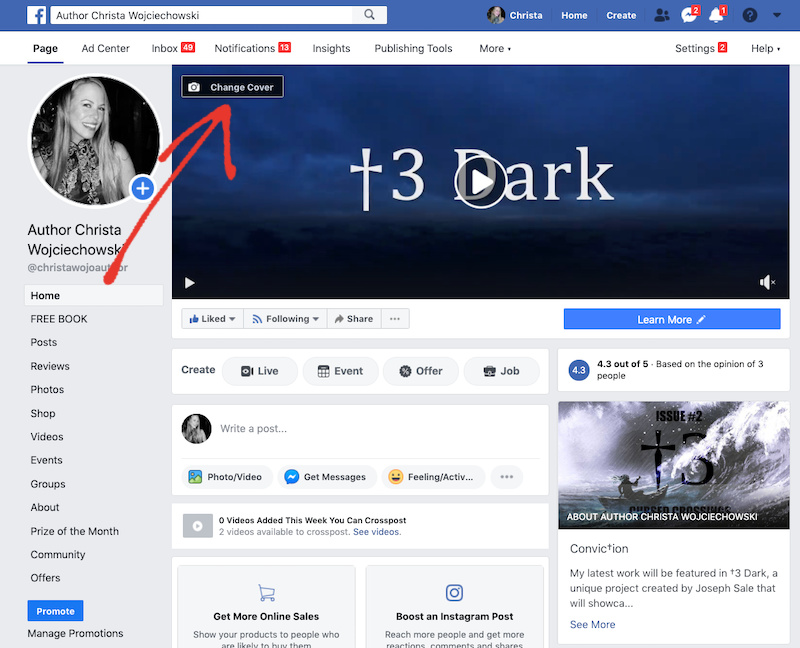
1. Facebook Cover
Your Facebook cover is a billboard where you can create a cover that promotes you and your books.
Design your own cover image according to the Facebook page cover dimensions. You can use a mobile app or web-based graphic designer like PicMonkey or Canva. Make it even easier by hiring someone on Fiverr to do it for you.
Otherwise, browse freelance sites for a video production specialist.
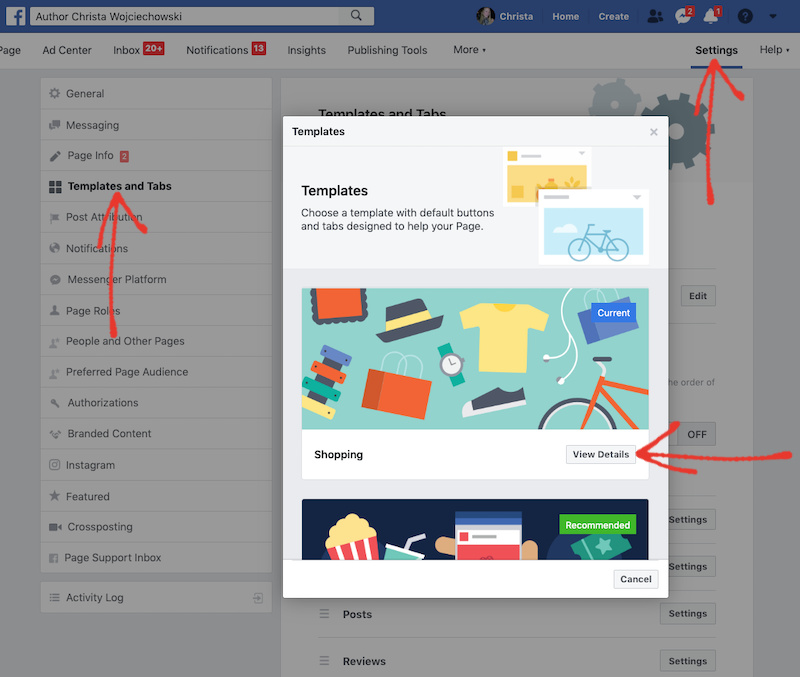
2. Use the Shopping Template
Facebook’s Shopping template will allow you to host a store on your author page. It’s the perfect place to showcase your books.
If you’re setting up your author fan page for the first time, you will be prompted to select a template.
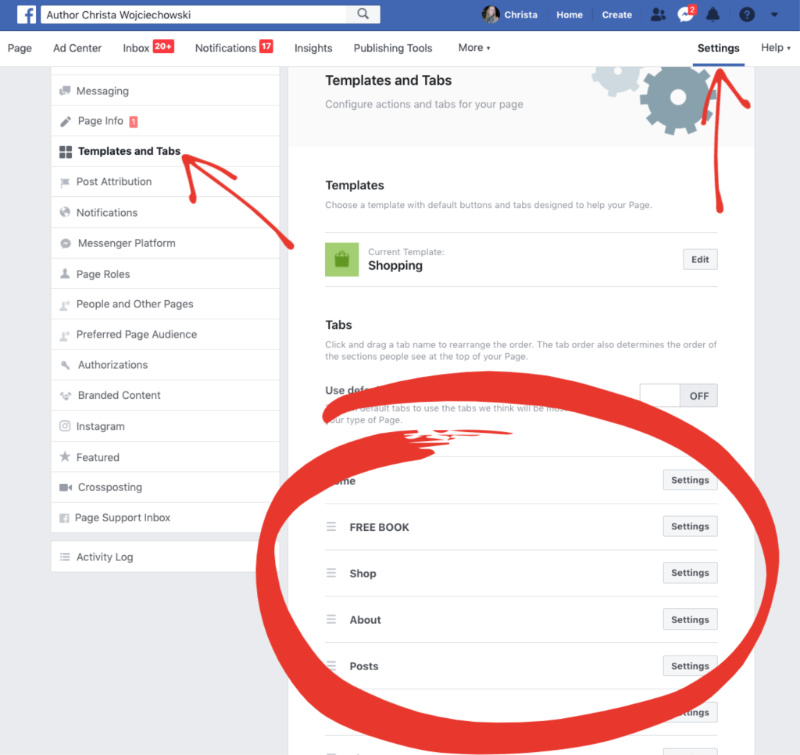
If you already have an author Facebook page, you can change to the shopping template in Settings under Templates and Tabs.
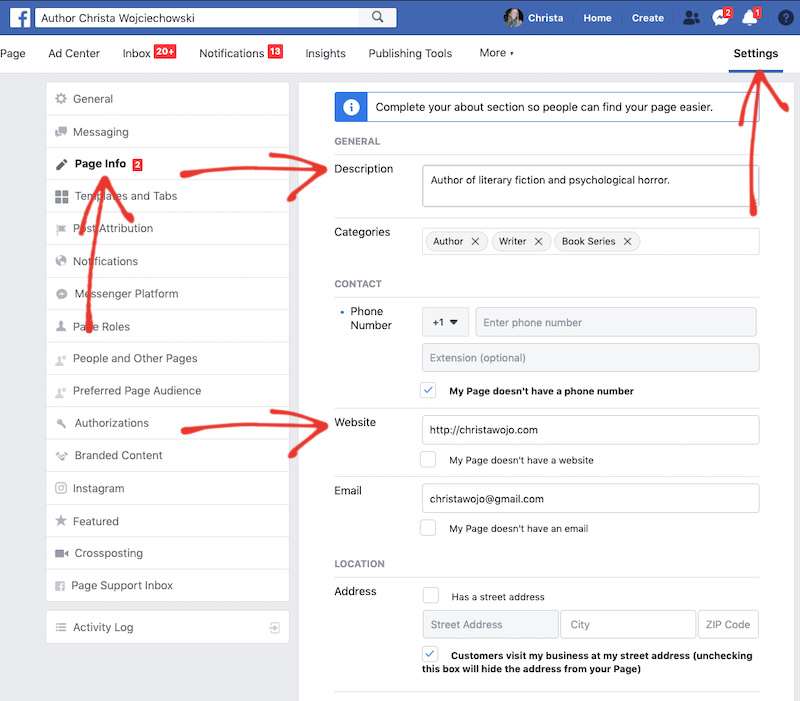
3. Fill out Your Page Info and Story Sections
I can’t tell you how many authors pages fail to include vital information, like bio and website. Fans are going to want to visit your blog, website, or Amazon page so be sure to add as much information as you can.
Page info settings
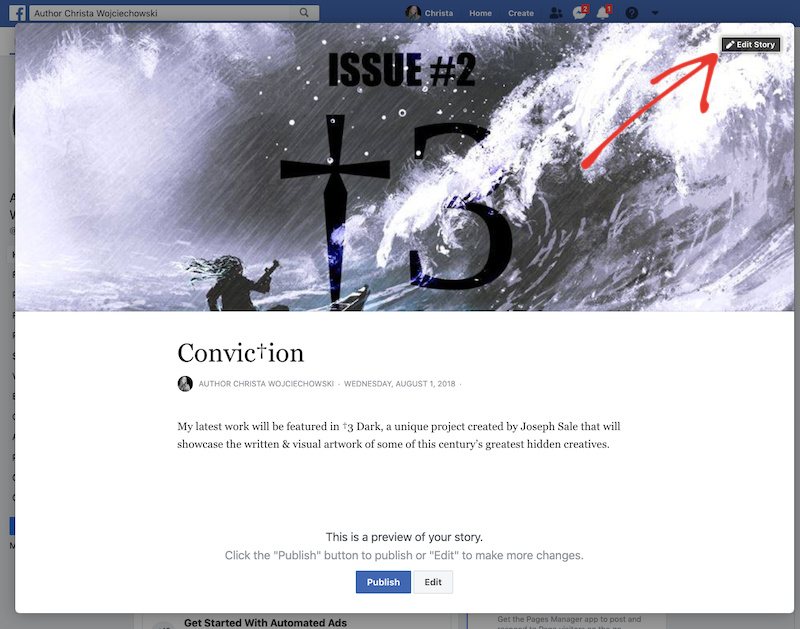
More free promotional real estate is offered in the Story section located in the right sidebar of your Facebook author page. This area features another image and a text area where you can include a live link.
Edit your Story Section
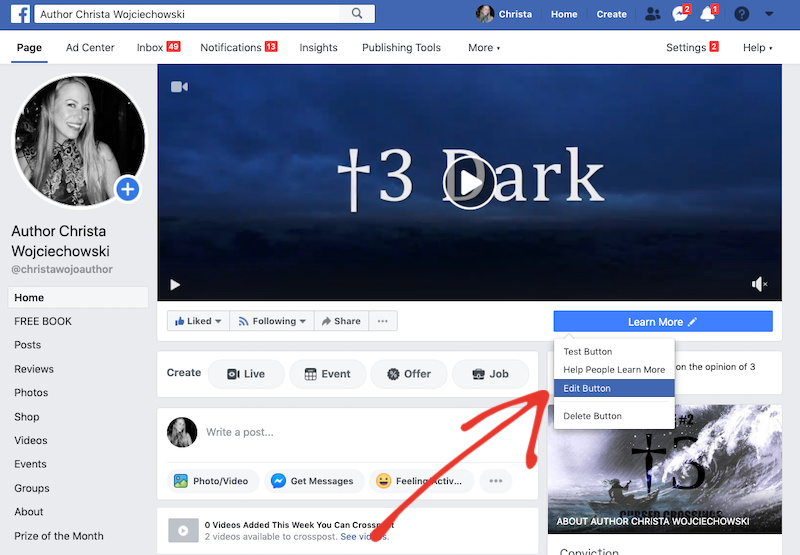
4. Activate Call to Action Button
This call to action button can be used to encourage fans to contact you, watch a video, shop for your books, and more. Click edit button and a box will pop-up with button options and settings.
5. Add Your Books to the Shop
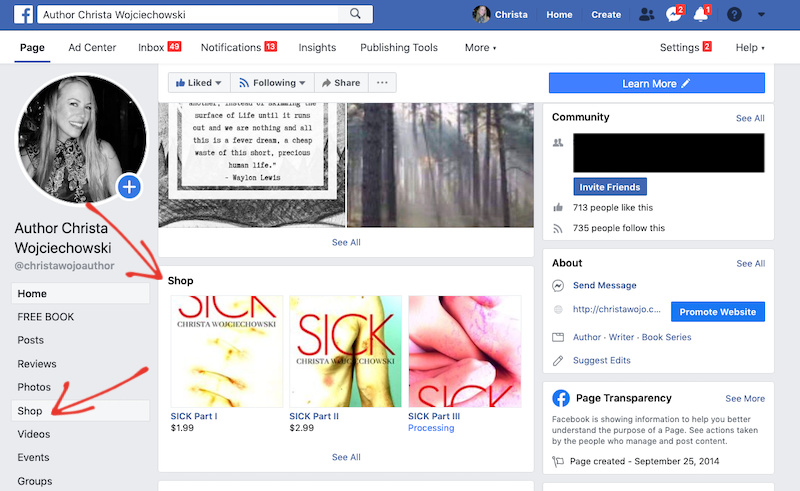
The Facebook shopping template is perfect for authors because you can feature a little bookshop right on your page.
What your shop area will look like.
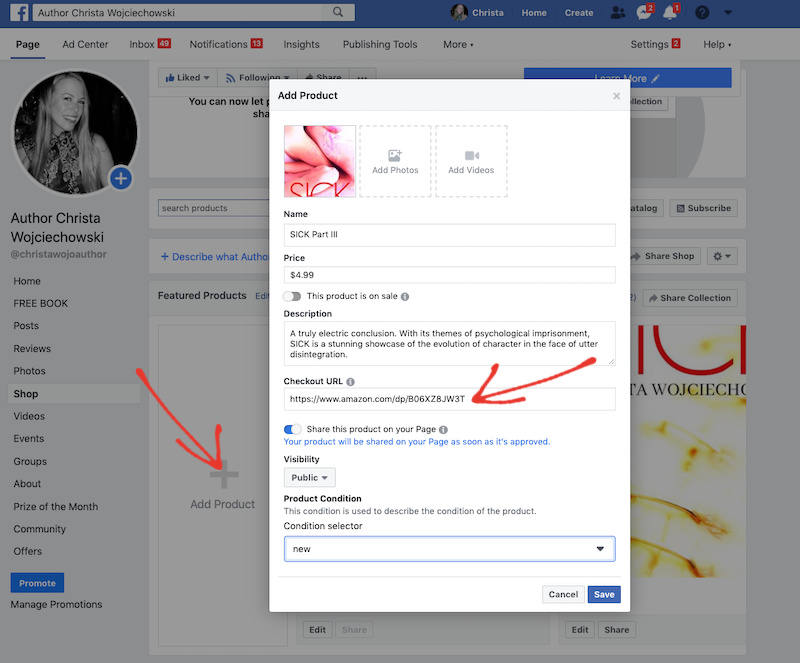
Click Shop in the left sidebar menu. You will see a box where you can Add Product. Click that area to add your book cover, buy link, and toggle the Share this product to your page if you’d like your book to be posted to your timeline.
Adding books to shopping template.
6. Embed a Mailchimp form
If you’re a Mailchimp user, you can grow your email list straight from your Facebook page. However, this must be done through your Mailchimp account.
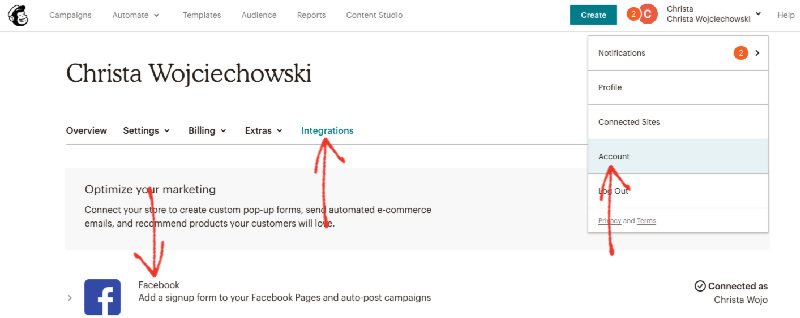
Log in to Mailchimp, click your username in the top menu bar to activate the dropdown menu. Click account and then click integrations. This is where you will find the option to add a tab with a Mailchimp form to your Facebook Author page.
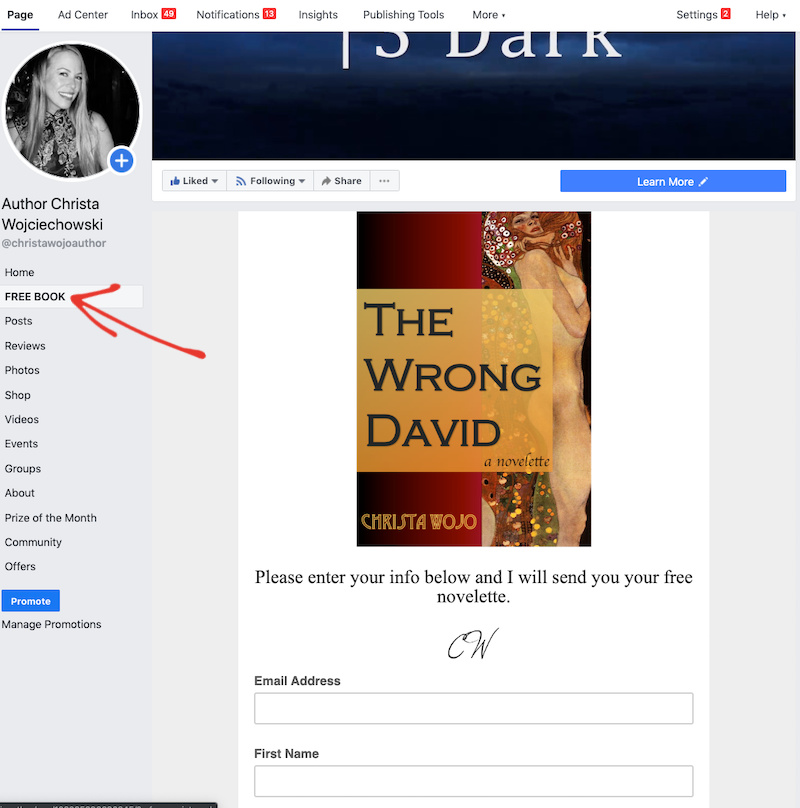
Locate the Facebook signup for option in your Mailchimp dashboard.Offer a free download with a Mailchimp form in a Facebook page tab.
You can reorder your tabs by returning to the Templates and Tabs section under Settings. Click and drag them to the desired spot.
7. Invite Your Friends
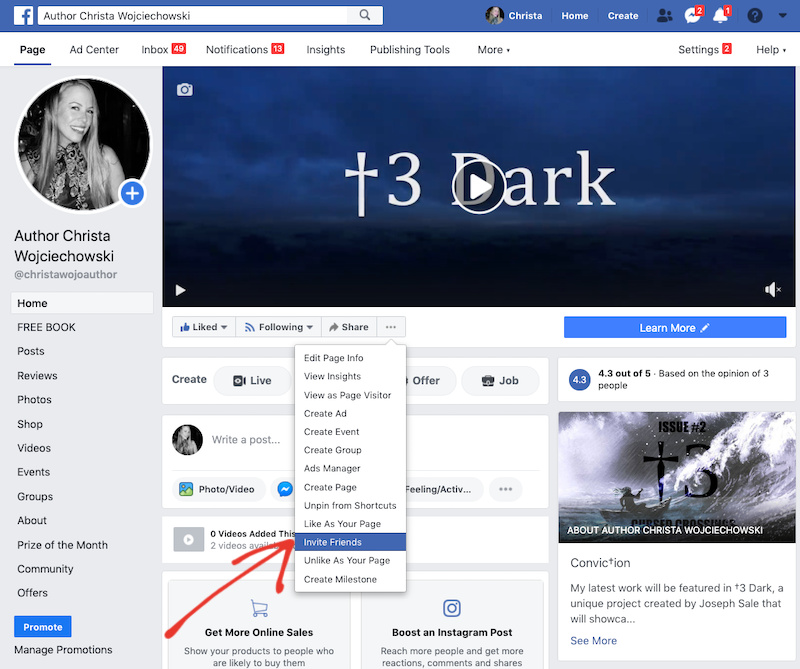
Use the handy Invite Friends button to get the first likes for you page. Click this button ever few months as you add new friends to your personal profile.
Invite friends!
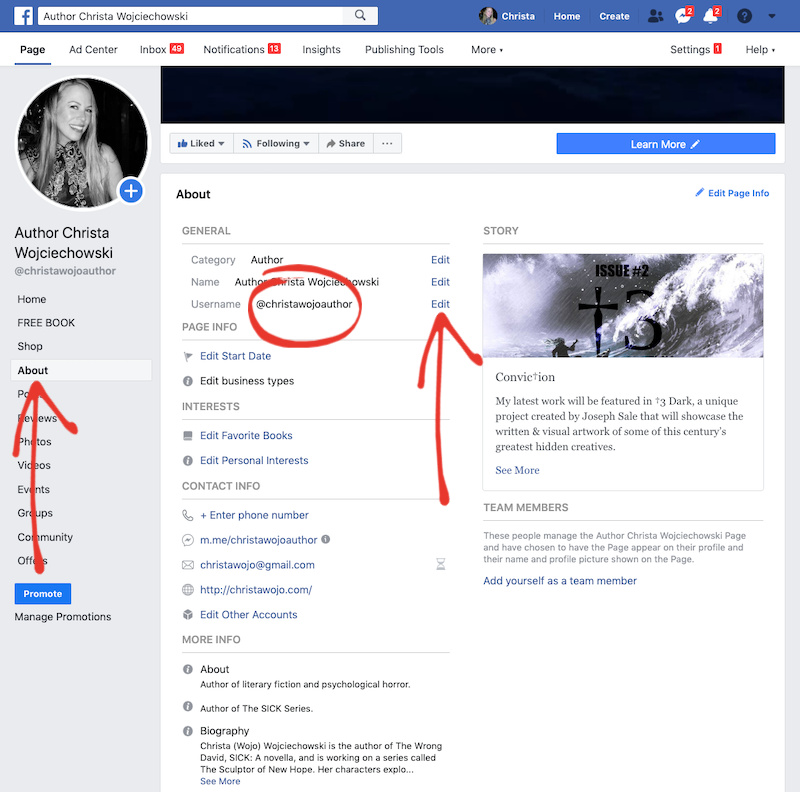
8. Claim Your Facebook Username
Once you get 25 likes on your Facebook author page, you can choose a username.
Try to find a username that is closest to your writing name or the same as your social media handles.
Choosing a username will also set the URL for your page, making a nice, neat address instead of the default jumble of words with numbers.
Check your username in the About tab.
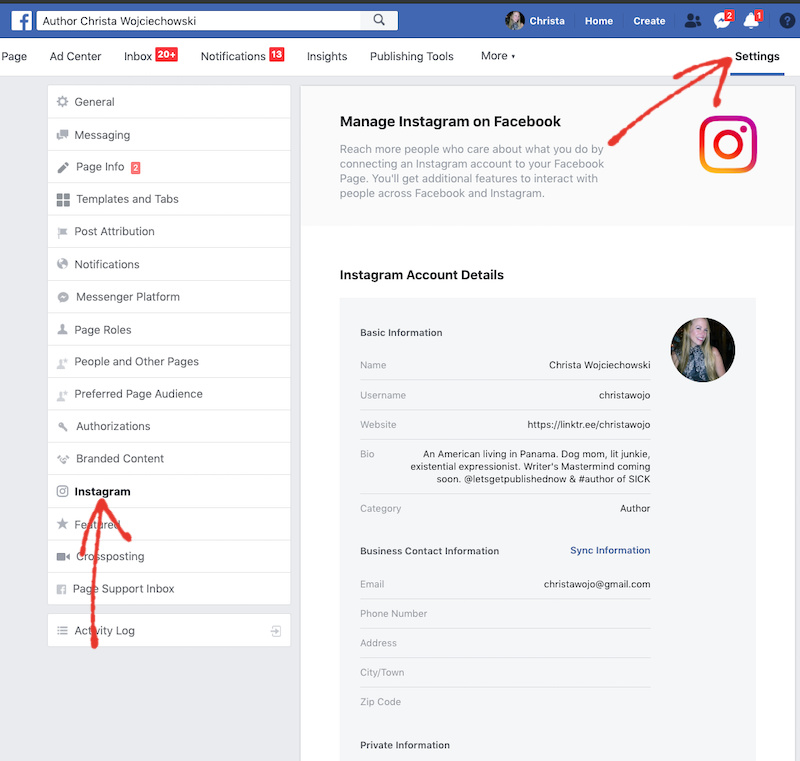
9. Connect to Your Instagram
Connecting your Instagram account allows you to share Instagram posts to your Facebook Author Page. It also makes it possible to configure Instagram ads via Facebook in your browser, which is easier than doing it from a mobile phone.
Make sure your Instagram is connected by visiting the Instagram tab in Settings.
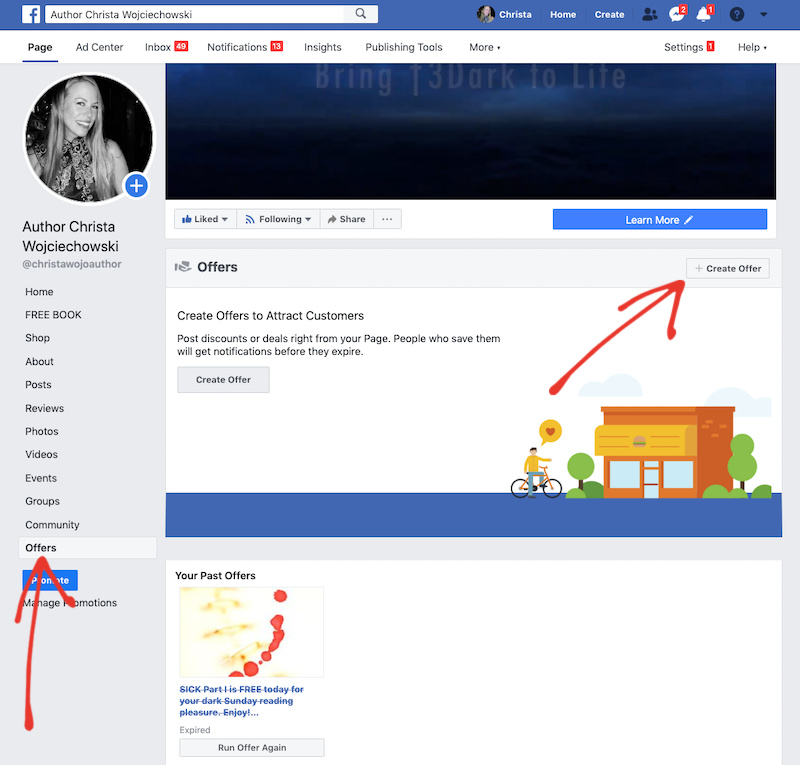
10. Use Offers
Whenever you want to promote your book, you can use Facebook Offers to stir up interest and urgency. Click offers in the left sidebar menu or in the posting options on your timeline.
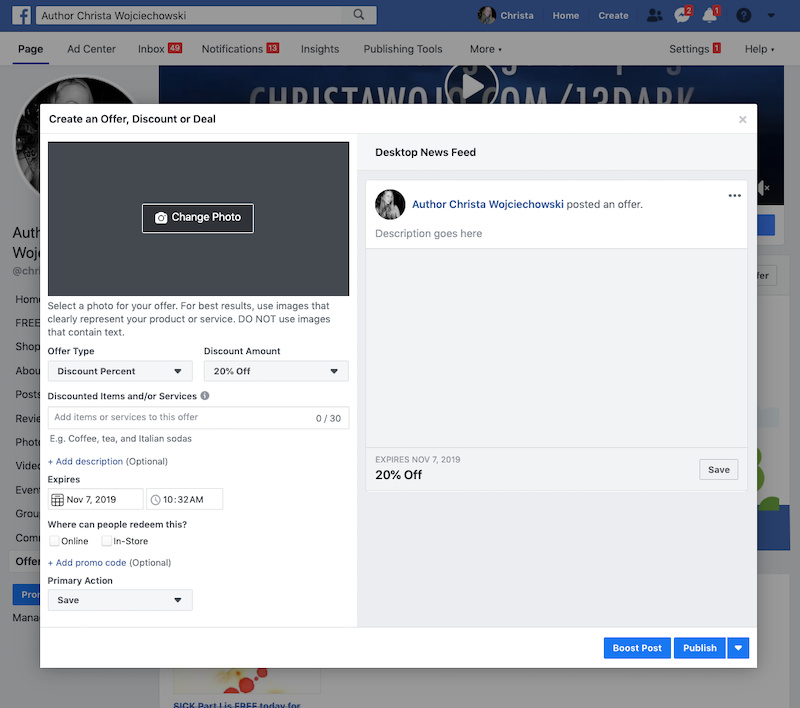
You can then add a photo, choose what kind of offer you want to post (coupon, discount, promocode, or other), and set the expiration date.
Offers tabCreating your offer
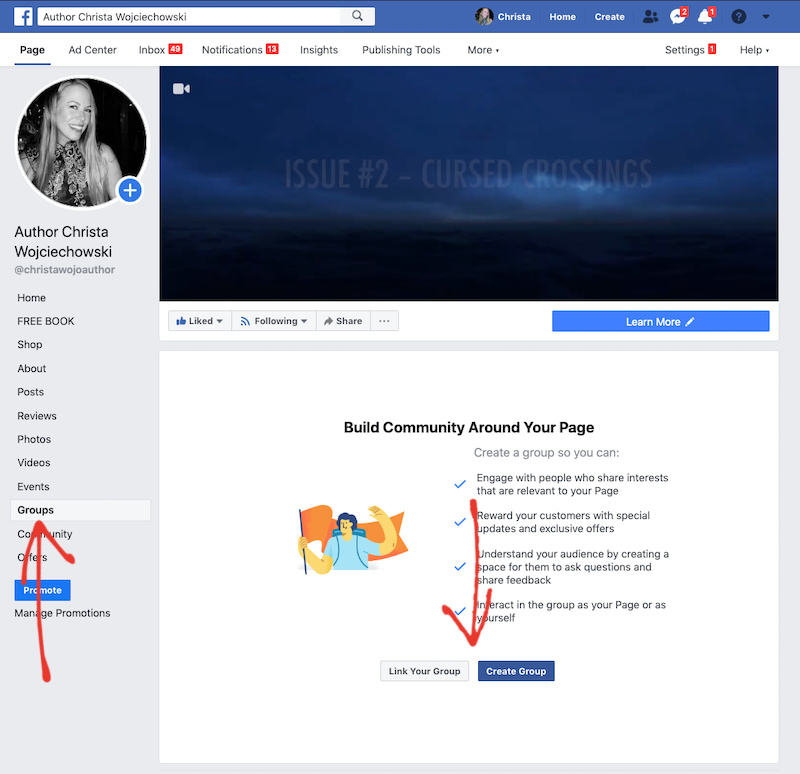
11. Create a Group That’s Connected to Your Page or Link Your Existing Group
Groups are an extremely effective way to stay engaged with your readers. Each time you post to a group, your members will get a notification, so unlike page fans, group members are more likely to see your posts.
A private group can also be a way to give members exclusive access to you. Just make sure you are prepared to invest time and thought into your group to make it a worthwhile endeavor.
If you already have a group, link it to your page so your brand is connected.
Link groups in the Groups tab.
Now You’re Ready to Go!
Your page is ready for using, sharing, and advertising.
Subscribe to Dear Writer for future posts on Social Media Optimization for authors, including Facebook Advertising for books. CLICK HERE.