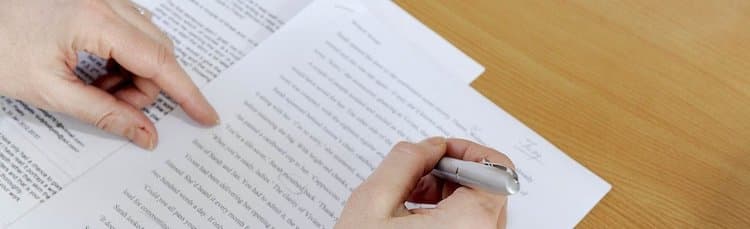
Do you save a new document every time you do a major revision?
Or do you write over the same draft?
I have learned the hard way that, even with minor changes, it’s a huge mistake to rewrite and edit over the same document.
I’ll give you an example with my current WIP, a short story …
In the middle of revisions, I decided to move elements around. I cut a scene, planning to paste it in another area, but I got distracted editing other mistakes I caught along the way. I cut more sentences, never having pasted the first scene in its new spot (or at least a temporary spot).
I saved over the draft without realizing what I had done. When I looked for the scene later, it was long lost, and I didn’t have the original draft to get it back.
This is just one horror story about why writers need to keep all drafts and ideas, no matter how useless they seem. Here is an article from Self-Publishing News that outlines all the reasons you should keep everything you write and never delete your drafts.
***
Keep Everything You Write And Never Delete Your Drafts
Should you keep everything you write? Yes, definitely.
Words have value, even if you might not think so at the time.
If you are a new, young writer, make it a habit to save and store all your writing.
It doesn’t matter if it’s a half-finished poem, an introduction for an essay, or a failed attempt at a short story.
Why you should keep everything you write
Every writer has a file of unpublished work, often containing many more words than those published.
But just because writing is unpublished doesn’t mean it has no value.
Unfinished pieces of writing can sometimes become a source of ideas for you later.
Two verses of an incomplete poem might give you the inspiration for a short story or even a novel.
I often return to my writing archive for ideas or notes.
It saved me a lot of work recently. My publisher is producing an audiobook version of one of my earlier novels.
But the story involves quite a few characters, as it is set in different decades and countries.
Because of this, my publisher asked for a list of characters with a brief description to assist the narrator.
Within a few minutes, I found the list and accompanying notes from over ten years ago in my writing archive. It saved me days of work.
That’s one simple example of the value of keeping everything you write.
Never hit delete – hit save
You can recycle most rubbish. It applies aptly to writing.
You might think that what you write today is garbage. But it has value, and one day, you never know.
Some writers keep their work in notebooks, files, or journals. But most writers today store their work on a computer or online.
Storage space is of no concern to a writer. A full manuscript for a novel takes up far less space than one photo on your phone.
You don’t need to be pedantic like me. But I have all my writing in date-ordered files, with sub-folders for every project.
Yes, I keep everything and never trash a word.
Nothing you write is a waste
Every word you write counts.
Maybe not today. But when you need an idea or think you have writer’s block, your saved words can help you.
Reading some of your incomplete pieces of writing can give you a quick kickstart. You might even stumble upon a piece worth salvaging and start rewriting it again.
No one writes a perfect first draft. Even the most skilled writer makes mistakes.
Once your story is done, how do you keep track of all the things that can possibly go wrong?
And publishers rarely give a reason for rejection. What if an editing issue is the reason your otherwise amazing story was passed up?
Our upcoming self-editing mastermind event is about developing a foolproof system to make your stories and manuscripts the best they can be before submitting to agents, publishers, or a professional editor.
Learning to self-edit will also incrementally help you become a better (and faster) writer.
We invite you to join us and to bring your most pressing editing questions and struggles. We will help you settle them once and for all!
Our Guest Expert
Candace Johnson is a professional freelance editor, writer, proofreader, and ghostwriter. She has worked with traditional publishers, self-published authors, agents, and independent book packagers in numerous fiction genres and nonfiction subjects. As an editorial specialist, she believes in maintaining an author’s unique voice while helping to polish every sentence to make it the best it can be.
Candace Johnson is a professional freelance editor, writer, proofreader, and ghostwriter. She has worked with traditional publishers, self-published authors, agents, and independent book packagers in numerous fiction genres and nonfiction subjects. As an editorial specialist, she believes in maintaining an author’s unique voice while helping to polish every sentence to make it the best it can be.
INTRODUCTION
SELF-EDITING
Self-editing can be a daunting part of the publishing process, but it is a necessary skill set every writer must have.
WHEN TO DO YOUR SELF-EDIT?
Whether you’ve been self-editing your story/book along the way or have waited until you’ve typed “The End,” you will want to make sure your manuscript is as polished as you can possibly make it.
It’s important to emphasize that writers should not rely solely on self-editing before submitting or publishing. Getting the help of a professional editor is crucial to your success as an author.
However, if you know how to prepare your manuscript for your editor, you will save time, money, and frustration.
WHAT YOU’LL LEARN
In this masterclass, you will be guided through a thorough checklist of common issues in story structure, plot, characterization, grammar, sentence structure, punctuation, and formatting.
This will ensure that your self-editing process is efficient and that your manuscript is as tight and clean as can be before handing it off to your editor.
WHAT’S INCLUDED
6-Part Video Series
36-Page Self-Editing Workbook
Support, motivation, and advice in our private Facebook Group
Access to our live write-ins and all classes in the members area
Live Q&A with Candace Johnson from Change It Up Edit (replay available)
COST
FREE with your 30-Day Trial in the Writers’ Mastermind
Then $19 per month if you choose to stay (Sign up soon. Membership price goes up to $29 per month July 1st)
Remove literary, grammatical and syntactical inhibition
Jack Kerouac
Do you proofread as you write?
Whenever spell check underlines something in its taunting red line, I immediately want to make it disappear. I know this interrupts my flow, but it’s almost impossible not to fix the mistake before moving on (I’m doing it right now as I type this!).
I notice that I tend to do more self-editing when I’m stuck in my stories. This is the sneakiest form of writers’ block. It feels like I’m being productive, but what I really am doing is stalling. Instead of getting a thousand words on the page, I get a few over-edited sentences.
Jack Kerouac said to remove literary, grammatical, and syntactical inhibition as you write—not forever. Just until you finish. You’ll have plenty of time to correct your mistakes when the mad dash is over.
May the muses be with you,
—Christa
Do you correct mistakes as you write? What’s your worst procrastination habit?
Want a proofreading checklist for a flawless manuscript?
Look forward to Candace Johnson’s masterclass in the Writers’ Mastermind
SYSTEMIZED SELF-EDITING
Get access to this class and all the benefits of membership with your free trial.