Earlier this year, I was at Authorcon VI in Williamsburg and fortunate enough to share a table with one of my dearest friends and most admired writers of all time, Joseph Sale. Near the end of the convention, I decided to make my rounds and pick up a few books from authors unknown to me. As I returned to the table with haul, I showed Joseph my choices.
“I hope they’re good,” I said.
“Easy to tell,” Joseph said. “Did they pass the first line test?”
“What’s that?”
“I can tell if a book is going to be for me by reading the first line.”
I stood there a bit dumbfounded. So simple, and yet, I had not thought to open the books and read a few lines before buying.
So I looked at the first lines of the novels I’d purchased. Luckily, they were pretty good.
But what if they hadn’t been? What if I had spent money on them, opened them up, and immediately wanted to put them down?
And, then I thought … what if someone put my novels through the first line test?
My books happened to be stacked in front of me on display. I picked up each one and read the first lines.
For the most part, I was underwhelmed. They weren’t bad, but would they compel a person to read the whole book from just one sentence?
I wasn’t going to lie to myself—the answer was no. If I were a stranger, and read the first lines from a list books, mine would not be the must-reads out of the bunch.
That being said, I had written those books before I had ever taken a writing class. I didn’t think strategically about the first page. I didn’t understand why agents and publishers only wanted a few pages, or a few chapters. How could they tell if a story was any good without reading the whole thing?
Then in 2023, I had the amazing experience of working for Gamut, a speculative fiction magazine. As part of the editing staff, I learned from the other side of the game how crucial a good opening was.
I had to read 150 short stories per month, every month. If the first line wasn’t great, I would give the first paragraph a chance. If the first paragraph didn’t get me, I might read the whole page. If at the end of page one, the main character is still waking up and eating breakfast, it was a no go.
This is what I learned from my colleagues—if I started reading a story and didn’t feel like continuing, it meant our magazine subscribers wouldn’t either, and that would be the end of the publication.
A good opening doesn’t necessarily have to start off with an explosive scene, but it does have to have a hook. It can be a deftly crafted one-liner, but it also can be an extremely engaging character, a concept I haven’t encountered before, a dilemma that I can relate to. Even a slow burn can build enough tension and suspense to make a story impossible to put down. A seemingly benign beginning with just the right amount of foreshadowing will tip us off that something unsavory is about to go down.
As an editor, there were times I read through stories with sluggish beginnings because of a hint that it might become something greater. And often, lackluster openers ended up being a great story. But that doesn’t matter if no one finishes it.
Many readers won’t wait to see if a book gets better. Agents and publishers simply can’t afford to invest the time and money. If an author fails to get the story off the ground effectively, it will more than likely have to be rejected.
You don’t have to let this happen to your stories.
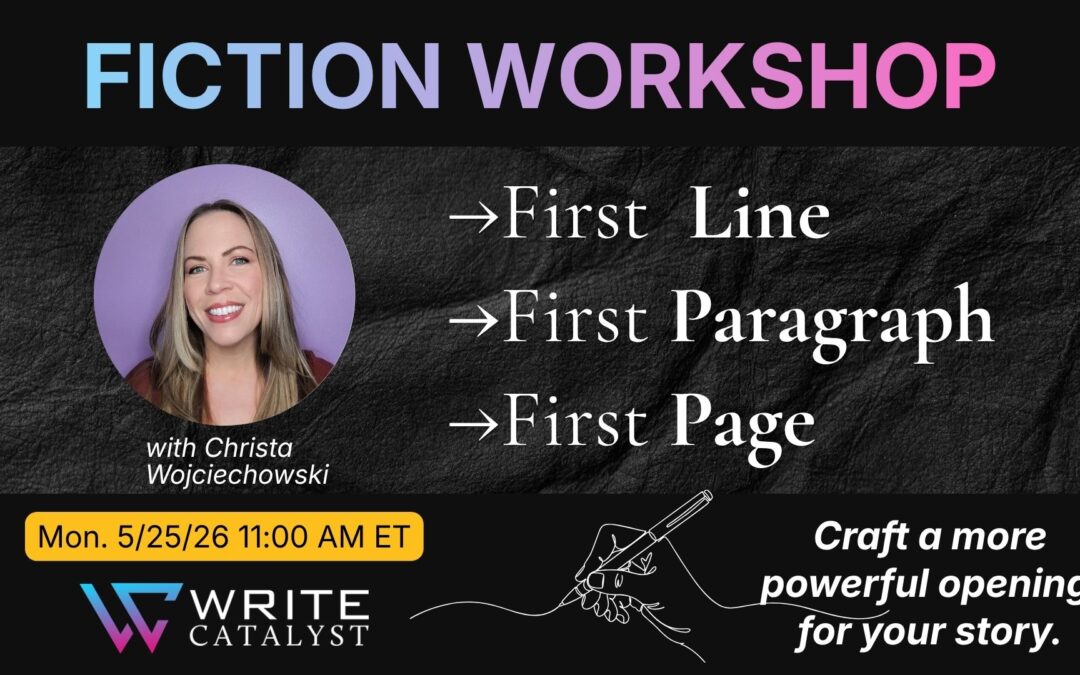
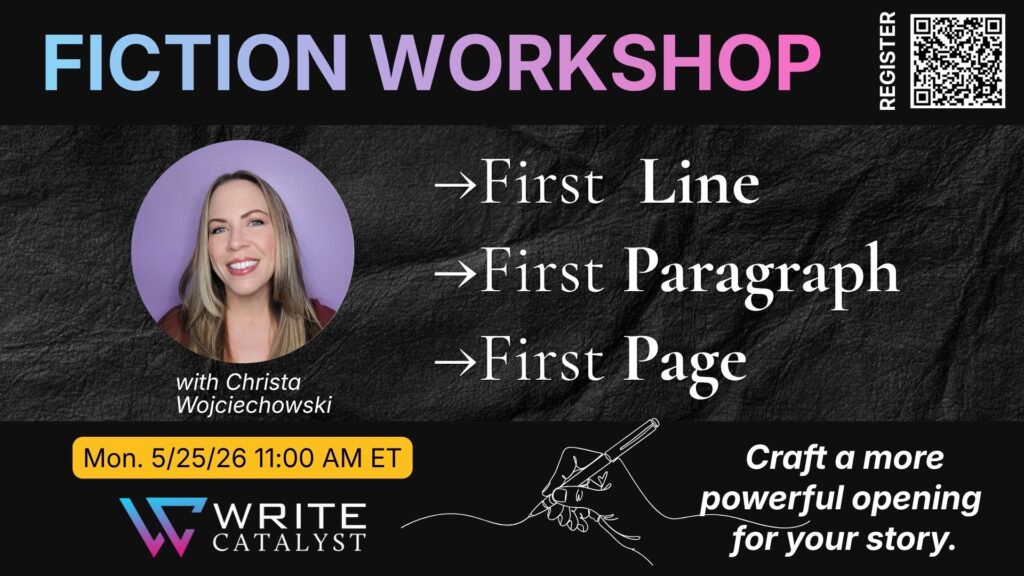
The First Line, First Paragraph, First Page Workshop
In the 1st Line, 1st Paragraph, 1st Page Workshop, each student will bring the first page of one story, novel, or work-in-progress to be shared and critiqued by the group. We will analyze the first line, then open up to the first paragraph, and expand into the first page to see where we are hooked as readers and what it is that makes us want to turn the page. We will discuss the context of the whole story to see what might improve the appeal of its beginning.
So look through your stories (can be published or unpublished). Let’s see where the reader takes the bait.
Did you “win” NaNo? Are you already intoxicated by the sweet smell of success? Congratulations—you’ve earned it!
Let’s talk about what you should—and shouldn’t—do for your next steps. Don’t make these mistakes with your NaNoWriMo Novel.
Congratulations! You Won NaNoWriMo! What’s Next?
Those who didn’t make it learned some valuable lessons about writing, themselves, and their approach to writing—so truly, there is no such thing as NOT winning NaNoWriMo because whether you make that 50,000-word count or not, you’re a better writer now than you were a month ago.
So whether you’ve already finished your first draft or you expect to do so sometime next year, here are three things you shouldn’t do when you cross the finish line:
1. Don’t throw anything away.
Is your 50,000-word first draft ready for publication? Of course not—but neither should it be deleted from your hard drive. Yes, allegedly there are writers who do that, but please do NOT become one of them.
Even if you’re a writer who believes the act of putting your butt in a seat for 30 days and churning out the bones of a novel is enough of a reward without having to ever read what you wrote, please believe that you’ve written some gems.
Okay, maybe you’ll delete some—or most—of those 50,000 words, but save them in a separate folder. In a month or two, you may reread a well-turned phrase you’d forgotten about and will have a brainstorm for an entirely new scene . . . or character . . . or novel!
2. Don’t begin editing your manuscript.
You’ve spent plus or minus thirty days with this manuscript—and if you outlined in October, that number goes up. Believe me, now is NOT the time to begin editing. You’re too close to your story, and let’s face it—you’ve had an exhausting, emotional month.
Do a happy dance, pat yourself on the back, announce to the world (or at least your Facebook friends) that YOU DID IT, and then put your manuscript away for a while.
For how long? Opinions vary on this one, but long enough that when you open it up again, the story feels new and fresh in that “I can’t believe I wrote this” way. That might be a month or a year, but it shouldn’t be tomorrow. Give yourself some time away to gain a little perspective, and you’ll have more clarity once you being to edit and revise.
Taking a very rough first draft and molding it into a saleable novel will require some ruthless revising and self-editing, so give yourself enough time away to gain perspective.
3. Don’t stop writing.
If you’re like most NaNoWriMo authors, you’re pretty excited about ending November with 50,000 words—maybe you have the first draft of a novel, maybe only a third of a longer manuscript, but nevertheless, you’ve written a bodacious number of words in 30 days, and you’ve accomplished something pretty spectacular.
So why quit now? You’ve proven to yourself that you can make the time to write every day, so wrap your mind around that new reality and keep writing.
In my book, every writer who even attempts NaNoWriMo is a winner. And although I know it will be a few months before those drafts are polished enough to make their way to an editor, I’m already looking forward to the day when that happens. For an editor, the thrill is in peeking under the hood, so to speak, and helping to polish a novel that was only an idea in your head a mere month ago. I can’t wait!
#PitMad is a pitch party on Twitter created by PitchWars.org where writers tweet a 280-character pitch for their completed, polished, unpublished manuscripts. Agents and editors make requests by liking/favoriting the tweeted pitch.
Every unagented writer is welcome to pitch. All
genres/categories are welcomed.
#PitMad dates 2020
March 5, 2020 (8AM – 8PM EDT)
June 4, 2020 (8AM – 8PM EDT)
September 3, 2020 (8AM – 8PM EST)
December 3, 2020 (8AM – 8PM EST)
For Official #PitMad rules and the list of category hashtags,CLICK HERE.
About Pitch Wars
Pitch Wars is a mentoring program where published/agented authors, editors, or industry interns choose one writer each, read their entire manuscript, and offer suggestions on how to make the manuscript shine for an agent showcase.
Where I live in the mountains of Panama, the only change of season we see is from rainy to dry. This begins to take place in November. There’s a shift in the wind and the town braces itself for the Fiestas Patrias (Panama’s Independence Days). Strings of small plastic flags crisscross the streets and flap as if applauding you whenever you drive beneath them. Grey clouds hover above the town as barjareque, (not quite rain, but heavier than mist) falls on the tourists and marching bands, covering them with a sparkling layer of microscopic droplets.
November also signals National Novel Writing Month, which I first participated in 2012. I had been wanting to write a novel my whole life, and the only thing that forced me to get a book started and finished was NaNoWriMo.
I completed my first ever book, surprising myself and triggering an addiction to finishing books ever since. Now when the winds of November change and I hear the echoes of the marching bands practicing for the Independence Day parades, I feel like a horse at the starting gate ready to race to my word count with all the other bucking writers.
I think anyone who’s participated in National Novel Writing Month start to look forward to it as a yearly tradition. It’s something to get excited about, and you are not alone in your enthusiasm and anxiety. You can connect with other writers who are on the same crazy train. NaNoWriMo helps to stop the usual procrastinating and put writing first for a whole month.
Unfortunately, I haven’t been able to participate in the last few years. My job consists of mostly writing now and my writing fuel and tolerance for sitting at the computer are wiped out by the time I finish my work for the day. I’m often traveling during this time for the holidays, which makes it difficult to scurry off to some quiet place to write.
I also don’t allow myself to participate because have to stop piling up manuscripts. It’s becoming a problem. I wrote three novels in a mad dash and they are still left rumpled up and tossed aside like piles of dirty laundry on the floor. I have no business writing more Nano novels until I clean these up, right?But I wonder… just because I wrote them, does that mean they should be published? Is it worth salvaging them? These were my first practice novels, before The Sick Series, when I had no idea what I was doing. Hell, I still don’t know.
Then, I decided to revisit the books to do a damage assessment. The story is about two artists – Antoni, who can’t stop the creative outpouring of his soul, and Ona, who is creatively stunted. They frequently talk about the reasons behind making art and what it means to them.
Their wisdom baffles me (did I actually write that?). In the very book I was going to chuck to the side, I received message from my characters. My voice came through them to tell me that maybe the world doesn’t need these books, but that doesn’t matter, because I do. I must finish what I started.
NaNoWriMo has taught me to get the book out. I’m so used to making the 50K a month word count that to this day I write in 1,667 word spurts. But it’s time to face reality and learn how to clean up the messes. Those of you who’ve followed this blog are sick of hearing it. I know a few of you are ready to clobber me over the head if I keep dragging on about The Sculptor.
Believe me, I attempted to revise several times. I did a lot of work and still didn’t get the desired results. I’ve realized that the most important part of writing is rewriting. No matter how experienced a writer is, no one writes a perfect first draft (or second … or third).
All the rewriting and revising methods I’ve tried helped so much, but they still left something missing. Even worse, sometimes I over-rewrote and the story it lost its raw core. That’s because I was trying to control it. Then I ended up completely lost.
Update Nov. 2019:
Another two years has passed since this original post above. November is here, with its cloudy, breezy days and the sound of snare drums ricocheting through the valley.
And no, my NaNoWriMo Novels are still not published.
And yes, I have new ideas for books that I’m dying to put on the page.
But I am restraining myself from NaNoWriMo this year again. No more new novels until my work on The Sculptor, which will resume in 2020.
In the meantime, I completed three new short stories which I am happy to announce will come out in an anthology with three other super-talented writers. It’s called Lost Voices and will be published by The Writing Collective.
As writers, we all have times of confusion, self-doubt, and setbacks. The important thing is to adapt as circumstances change, keep moving forward, and never give up on a story you believe in.
Are you doing NaNoWriMo this year?
What are your plans for the NaNo novels you wrote?
Let’s Get Published is community of writers, and we’d love to get a conversation going. That’s why we’ll be posting a Writers Share every now and then to keep a pulse on the writers working their wordly magic all over the world.
Today we want to know about what you’re working on right now.
Tell us about yourself and your work-in-progress by responding by email, leaving a comment, or posting on our Facebook page.
Tag or share with your writing friends so they can join too.
1. What have you written?
2. What are you working on right now?
3. What do you plan to do with your current work-in-progress?
4. Where are you feeling good about your path to becoming a successful writer?
5. What are you struggling with?
As for me, I’m in the middle of Richard Thomas’s Contemporary Dark Fiction Class. Since the beginning of September, I have finished 8 short pieces of fiction, two 3,500-word short stories, and 2 essays analyzing books we read for the class. I have crammed more short fiction writing in the last two months than I can believe.
Yes, my brain hurts, but I’ve realized that I can make things happen even when I’m pressed for time and feeling uninspired.
I also feel empowered. I used to wonder why my work is not getting accepted. Rejection letters rarely come with an in-depth report about what’s not working in a manuscript. It’s a writer’s job to know that themselves. This class is teaching me the secret language of good writing (there is a language under the language).
Of course, now I want to take down everything I’ve ever written and rewrite it.