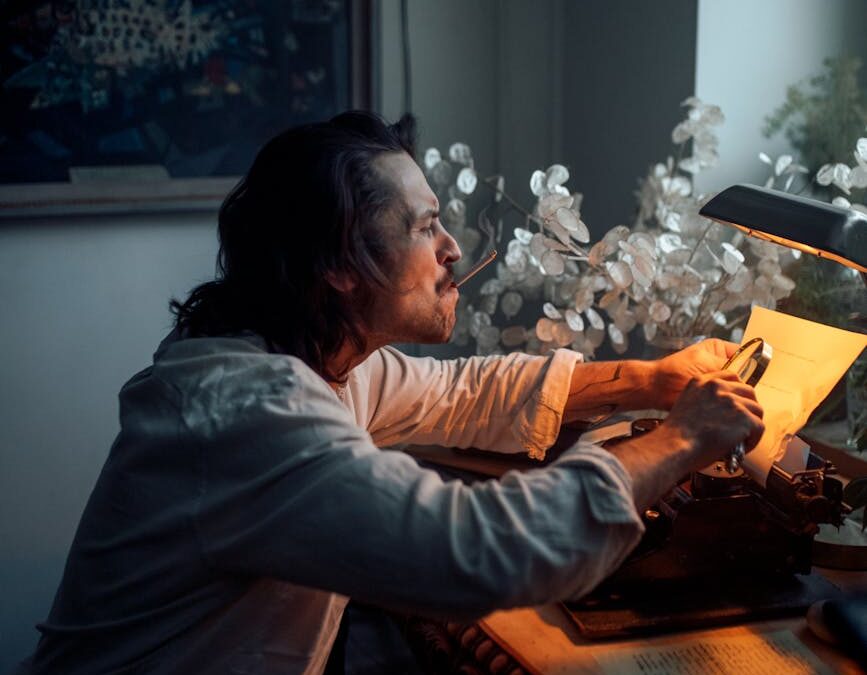
After deciding to become an author, I was frustrated by how hard it was to make things happen.
I knew I could learn to do anything if I worked hard enough—how to structure a novel, to write effective sentences, to publish on Amazon, and to market myself. And I did teach myself to do all those things.
While I was proud of what I achieved, I still felt like I was not writing to my full potential. More than that, I wasn’t doing enough to sell the books I worked so hard to write.
So I tried all the courses and the methods. I read all the articles and listened to all the podcasts about writing fiction, self-publishing, and book marketing.
I could not get any momentum going, and I felt hopeless about my future as an author.
Worst of all, I was the founder of an online writing group, attempting to lead a group of writers to their dreams, and I couldn’t walk the talk. I felt like a fraud.
The REAL reason writers fail
It wasn’t just me. The same issues surfaced again and again for the members in the Writer’s Mastermind group. They were frustrated with themselves for not being able to quite get it together.
They couldn’t build momentum with their email lists or social media. Book rankings and sales made them wonder why they bothered to publish books at all.
I knew the problem very well because I was living it.
All the practical tools in the world did not help me make progress. I watched myself and other writers struggling to fulfill their dreams, I had to face an uncomfortable truth.
The problem was not family, not the job, not “I’m too busy,” “too tired,” “too introverted,” or “not talented enough.”
When I was honest with myself, and audited my habits objectively, I observed that somehow I had time for scrolling Instagram, binging streaming series, folding laundry, and other people’s problems.
Really … I could make time for writing and promoting if I wanted to.
But I didn’t. Deep inside, part of me wanted to stay safe and hide, to not give it my all, because if I failed, I would get confirmation that I sucked.
There was also another voice, one that would not leave me alone, that said: If you feel compelled to write, you need to follow that urge or you will die!!!!
Ok, not that serious, but a huge part of me would die, and it might be the most important part.
This cognitive dissonance made me depressed and frustrated.
How could I be doing all the right things, yet going nowhere?
It was a disease, one hidden beneath the logical brain, in the unconscious.
Arming myself with information patched things temporarily. It only eased the symptoms.
It didn’t actually help because:
All the classes in the world will not help if you don’t act on the information.
All the marketing strategies cannot sell your books if you shrink from being seen.
All the accountability measures you put in place won’t help you write more or better if you have doubts about why you’re writing or if it is any good.
The disease is mindset.
Yeah, I know mindset is a buzzword for personal development and entrepreneurs. But creatives, like fiction writers, need to cultivate a mindset as much as anyone, if not more.
Being a creative means having to believe in yourself on a deeper level. You have to expose yourself to create art that moves people. You have to be willing to be seen in ways that most people will never be brave enough to share.
How to shift your mindset
Why are you fawning instead of fighting for what you want?
Why are you shrinking instead of shining?
Why do you prioritize things that do not bring you closer to your goals?
Do a personal audit
You have to look at your habits objectively, mercilessly face what you’re protecting yourself from, and arm yourself with the practical tools as well as optimize your daily world to give yourself the best chance to write to your full potential.
It might be some of the most difficult work you’ll ever do. But you’ll not only become a better, more prolific writer, you’ll also grow as a person.
Dive into inner work. Investigate who you are and why you are that way. Be curious. Try everything. Books, affirmations, meditation, visualization, therapy, NLP, EFT, shadow work, journaling, peer support groups—do whatever it takes to dig deep and discover why you’re not following through.
Reorient to your true direction
Once you analyze what you’ve been doing and why, it’s time to articulate what you really need to be doing. Becoming a writer means devoting time and energy to something that doesn’t pay off in the ways that a job or business does. You won’t see a regular paycheck, a 401K, or medical insurance. People don’t take writing seriously unless you’re already a huge name.
You need a reason that transcends the approval and validation of others and goes beyond material rewards or praise and status.
What is the real impetus behind your writing? Embody it. Own it. If you don’t take yourself seriously, no one will.
Use tools like the Writer Archetype Quizto gain deep insight into what drives you and how to use your gifts to your advantage.
Choose your companions wisely
Lastly, ask yourself, who do you spend the most time with? Not just the real people in your life— who are you surrounded by on the internet, TV, and social media?
Sure, we all need to indulge in pure entertainment once in a while, but how much of what you are consuming is enriching you in some way?
Follow authors who have what you want. Analyze what they are doing and how they are doing it. Join a writing group that includes other writers who can mentor you.
Read the kind of stories you want to write. Learn about the people you admire. Reduce the time you spend with the crowd that diminishes your energy. Choose people, places, and things that inspire you.
Catalyze Your Writing
It’s not selfish to invest in yourself and your passion. Playing small and going with the status quo will make you depressed and resentful. Living in your truth as a creative will make you expansive and magnetic. Ultimately, your happiness and self-realization will enrich the lives of those around you.
This year, I published my first full-length novel called Oblivion Black. Members of the Writers’ Mastermind witnessed me slaving over this manuscript in our weekly co-writing sessions since our virtual writing group began two years ago. They also know that I have been “working on” this story since 2012.
Yes. TEN years.
It seems like an impossible amount of time to be sitting on a book. And yet, here I am in 2022 just releasing it. It staggers the mind (and also makes me feel old to have been an adult long enough to say that I spent a decade with the same damn novel).
I say “sitting” on a book, because most of time I spent changing things, and changing them back, overthinking and overworking everything instead of moving forward in the process of actually publishing a book. It was ten years wasted second guessing, self-doubt, and perfectionism.
So sadly as you can see, I am more than qualified to speak about today’s topic.
FROM THE ARTIST’S WAY by Julia Cameron
Perfectionism has nothing to do with getting it right. It has nothing to do with fixing things. It has nothing to do with standards. Perfectionism is a refusal to let yourself move ahead.
It is a loop—an obsessive, debilitating closed system that causes you to get stuck in the details of what you are writing or painting or making and to lose sight of the whole.
The Flip Side
On the other side of perfectionism is sloppiness, carelessness, and recklessness. Equally harmful, this is when we don’t take the time and energy to learn what we need to do and how to do it. The artistic wave is so exhilarating, we don’t think about whether or not our boat has any holes in it, and we sink before we reach the shore.
This comes in the form of impatience, self-importance, idealism, and ignorance. But some of this energy is needed to produce compelling work. We must find a balance. We can’t be be blindly confident or overly cautious.
So how do we strike this balance?
As a writer who struggled with crippling perfectionism, here are a few signs you have a problem.
7 Signs Perfectionism is Ruining Your Writing
1. You revisit the same material more than a reasonable amount of times.
2. The things you’ve changed, you change back to their original state, sometimes more than once (second-guessing).
3. You ask for feedback over and over again and shape your story to everyone else’s opinions
4. You don’t believe anyone when they say it’s good or great.
5. The story has lost its original urgency and rawness because of overediting.
6. It has taken you more than a few years to finish (I’ll give you one to three years for a novel, excluding those who have a demanding job or personal live. NOT 10 YEARS, unless you’re Proust!).
7. Your WIP has become such a burden, you struggle to breathe (either metaphorically or literally).
Be mindful and watch yourself for the neuroses of perfectionism.
At some point, have faith, be decisive, and move on.
*****
Do you struggle with perfectionism in your writing?
Or have you rushed into things and released them before they were ready?
Please reply/comment below.
And, may the muses be with you,
—Christa
WHAT’S INSIDE
Crystalize your vision of what it means a successful author
Develop your own Writer Manifesto
Reverse engineer a step-by-step plan to your career as a writer
Writers are notorious for suffering from Imposter Syndrome, writers’ block, and chronic procrastination. I, myself, struggle with these neuroses every day. They never completely go away, but I have discovered how to become a more confident writer.
I started writing ten years ago, having virtually no idea what I was doing. Although I managed to finish a few novels and novellas, I knew there were issues with my writing. The problem was, I couldn’t tell what they were.
In 2019, I finally decided to take my writing seriously and signed up for my first writing class—Contemporary Dark Fiction with Richard Thomas. He’s the award-winning author of three novels, three short story collections, two novellas, and over 150 short stories.
Required reading for the class was four novels, sixteen articles, and sixteen short stories. The work included weekly writing assignments, four complete short stories (one per month), four analyses of the assigned novels, and critiques of the eight other student’s monthly stories. We also met once a week on video conference to discuss the week’s material.
I do not have a college degree. What little I knew about fiction I learned from reading my favorite authors and Google. To say this class was intimidating was an understatement!
But I dove into it and was amazed at my output. There was something about putting up my hard-earned money and being forced to deadlines that made me push myself beyond my perceived limits. The analysis of the stories, the exploration of what other writers were doing, and the giving and receiving of feedback from the students, especially from Richard Thomas himself, advanced me more in four months than all I’d learned on my own the seven years prior. I went into that class a bumbling novice and came out the other side feeling like, hey, I think I can do this!
Since working with Richard Thomas, I have fast-tracked my writing career and have accumulated a body of quality work. Four of the short stories I wrote in his classes have been accepted by notable anthologies. Now that I’ve earned professional rates for my stories, I was able to become an active member of the Horror Writers Association.
My writing style has gelled. I know what I can do, how I want to do it, and where my work belongs. I no longer look at other authors getting acceptances and being published, wondering what the secret is. When I think about how lost and unsure I was three years ago, I could kick myself for not investing in a serious writing class sooner. I’m now in my third class with Richard Thomas, his Advanced Creative Writing Workshop.
So, my advice to any new writers out there, or any writers who’ve been struggling for a long time, is to find a writing group, course, critique circle, or workshop. Do not keep doing the same things over and over again, wondering why you’re not getting anywhere.
Knowledge equals confidence. The more you know, the better you can wield your creative powers. Give your writing the chance it deserves. Keep learning, keep growing.
The beautiful thing about writing fiction is you’ll always be evolving, but it’s up to you to invest in yourself!
“All too often, it is audacity and not talent that moves an artist to center stage.“
Julia Cameron – The Artist’s Way
After running the Writers Mastermind for a year and a half, the biggest problem I see with struggling authors is not that they don’t have talent or that they can’t learn what it takes to be successful. It’s not believing in themselves, not giving themselves a chance to get good, and not thinking they’re worth wild success—thereby not committing fully to their creative life.
If you always put writing last, if you feel like no one takes you seriously, if you are hiding in the shadows watching others achieve the dream that you know in your heart you are capable of and are meant to live, I am in the same position as you.
That is why this year we are going to go through The Artist’s Way process by Julia Cameron. It is a 12 Week path to higher creativity. Many artists, writers, actors, and other creatives credit Julia Cameron’s method to helping them break through to become their fully realized creative selves. I am a huge fan of her work and her mission.
I’ve started The Artist’s Way process several times and never followed through. Obviously, that was my lack of commitment showing again. Also, I was trying to do it alone.
Julia Cameron generously encourages creatives to form peer-run groups for a collective process, so I’m inviting you to join our virtual circle. Going through it with a group will help others empower themselves creatively while ensuring that I don’t flake out!
How to take part?
With today’s jam-packed schedules, a 12-week crash course will be intense. Instead, we will focus on one of the 12 parts each month. That way, we can deeply invest ourselves in the process and enjoy the journey as well.
If you don’t buy the book, you can still follow along. I will send thoughts and exercises each week (and in the private Facebook group) and we will discuss what we discovered and experienced each week during the Monday Zoom meeting.
You decide your level of participation. If your short on time, just reading and meditating on the weekly thoughts will do you a world of good. If you want to go deeper, then you can complete the exercises in their entirety.
I suggest you give it all you got. Why waste one more year not living to your fullest creative potential?
The Artist’s Way – Online Group
January – Recovering a Sense of Safety
February – Recovering a Sense of Identity
March – Recovering a Sense of Power
April – Recovering a Sense of Integrity
May – Recovering a Sense of Possibility
June – Recovering a Sense of Abundance
July – Recovering a Sense of Connection
August – Recovering a Sense of Strength
September – Recovering a Sense of Compassion
October – Recovering a Sense of Self-Protection
November – Recovering a Sense of Autonomy
December – Recovering a Sens of Faith
Why is it all about “recovering?”
When we are born, we all have the fearless compulsion to create. We don’t think about why, or if anyone likes it, or if it earns money, or if it’s not as good as anyone else’s. Then, as we grow older, people, society, and responsibility stifle our enthusiasm and make our creative selves shrink inward.
In 2022, we recover that boundless, bold, and joyous sense of creativity we possessed as children. I believe once we tap into that, we become limitless and lit with a constant fire that ignites all other areas of our lives.
Note: I am not in any way affiliated with Julia Cameron, The Artist’s Way, or her publisher, nor to I claim to be any kind of certified practitioner/teacher.
As stated on her website: “Anyone can teach the course or begin a cluster by following the book and the guidelines below. It is my belief that creative recovery at its best is a nonhierarchical, peer-run, collective process.
There are no ‘accredited’ Artist’s Way teachers. Avoid anyone who offers to ‘certify’ you as a teacher– there is no such thing.”
Remove literary, grammatical and syntactical inhibition
Jack Kerouac
Do you proofread as you write?
Whenever spell check underlines something in its taunting red line, I immediately want to make it disappear. I know this interrupts my flow, but it’s almost impossible not to fix the mistake before moving on (I’m doing it right now as I type this!).
I notice that I tend to do more self-editing when I’m stuck in my stories. This is the sneakiest form of writers’ block. It feels like I’m being productive, but what I really am doing is stalling. Instead of getting a thousand words on the page, I get a few over-edited sentences.
Jack Kerouac said to remove literary, grammatical, and syntactical inhibition as you write—not forever. Just until you finish. You’ll have plenty of time to correct your mistakes when the mad dash is over.
May the muses be with you,
—Christa
Do you correct mistakes as you write? What’s your worst procrastination habit?
Want a proofreading checklist for a flawless manuscript?
Look forward to Candace Johnson’s masterclass in the Writers’ Mastermind
SYSTEMIZED SELF-EDITING
Get access to this class and all the benefits of membership with your free trial.